Executive Summary
The Dates Processing and Packaging Plant project in the industrial and manufacturing sector in Jordan targets a promising market opportunity. With an investment of 180,000 JOD, it achieves a net present value of -4,868 JOD, an internal rate of return of 9%, and a payback period of 4.1 years.
| Indicator | Value |
|---|---|
| Initial Investment | 180,000 JOD |
| First Year Revenue | 250,000 JOD |
| Annual Growth (CAGR) | 12% |
| Net Margin (Y1) | 1% |
| Return on Investment (Avg.) | 6% annually |
| Net Present Value (NPV) | -4,868 JOD |
| Internal Rate of Return (IRR) | 9% |
| Profitability Index (PI) | 1 |
| Payback Period | 4 years |
| Break-even Year | Year 5 |
| Expected NPV (Probability-Weighted) | -2,701 JOD |
Assumptions and Basis
The figures in this study are based on project data, the nature of the industrial and manufacturing sector in Jordan, and local market indicators, according to the following assumptions:
| Assumption | Value |
|---|---|
| Initial Capital | 180,000 JOD |
| First Year Revenue | 250,000 JOD |
| Annual Growth | 12% |
| Cost of Goods Sold (COGS) | 60% of Revenue |
| Operating Expenses | 25% of Revenue |
| Tax/Zakat | 10% |
| Discount Rate (WACC) | 10% |
| Study Horizon | 5 years |
Basis of Assumptions: These figures are based on the average costs of establishing and operating dates packaging factories in Jordan and the expected profit margin in the food industrial sector, taking into account the growth of the dates market.
Project Description and Opportunity
The project aims to establish a modern factory for packaging dates in Jordan, leveraging the quality of Jordanian dates, especially Medjool dates, which enjoy a global reputation. The factory will focus on providing high-quality packaged date products with international specifications to meet the increasing demand in the local and export markets. The business model includes purchasing dates from local farmers, sorting, cleaning, sterilizing, and packaging them in various forms and sizes, with the possibility of producing value-added products such as stuffed or chocolate-covered dates. The target customers include wholesalers, retailers, hypermarkets, hotels, restaurants, and individual consumers, in addition to foreign markets.
Market and Demand Study
The dates sector in Jordan is considered one of the most promising sectors, with the Kingdom witnessing significant growth in the production and export of dates, especially Medjool dates. In 2026, Jordan produces approximately 35,000 tons of dates annually, about 65% of which are exported to 55 global markets. The average consumption of dates per Jordanian individual is about 3.5 kg annually. Demand for dates rises particularly during the holy month of Ramadan, accounting for 40% of annual consumption. The quality of Jordanian dates, especially Medjool, is a key factor in increasing their demand locally and internationally. There are also untapped export opportunities in the Jordanian food industry sector in general, estimated at about 310 million dollars.
Market Sizing (TAM / SAM / SOM)
The market sizing methodology is based on analyzing available data on date production in Jordan, export and import volumes, and average per capita consumption. The Total Addressable Market (TAM) is estimated by multiplying the total annual date production by the average selling price per kilogram. The Serviceable Available Market (SAM) is estimated as a percentage of TAM representing the share of packaged and processed products, considering that the factory initially targets the local market and then expands into exports. The Serviceable Obtainable Market (SOM) is determined as a percentage of SAM that the factory can achieve in its first year of operation, based on initial production capacity and marketing capability. These estimates rely on the latest statistics available from official bodies and specialized reports on the dates sector in Jordan.
| Level | Annual Size | Description |
|---|---|---|
| TAM — Total Market | 157.5 million JOD | Total serviceable demand |
| SAM — Available Market | 78.8 million JOD | Portion reachable by your model |
| SOM — Realistic Target | 15.8 million JOD | Your realistic early share |
Sizing Basis: The Total Addressable Market (TAM) was estimated based on Jordan's total date production (35,000 tons) and the average price per kilogram (4.5 Jordanian Dinars), taking into account local consumption and exports. The Serviceable Available Market (SAM) represents 50% of TAM as it focuses on packaged dates, and the Serviceable Obtainable Market (SOM) represents 10% of SAM in the first year.
Unit Economics
Measures the profitability of each sales unit/customer — the most accurate feasibility indicator:
| Unit Indicator | Value |
|---|---|
| Sales Unit | Kilogram of packaged dates |
| Average Price/Revenue per Unit | 5 JOD |
| Customer Acquisition Cost (CAC) | 1 JOD |
| Customer Lifetime Value (LTV) | 200 JOD |
| LTV/CAC Ratio | 266.7x (Healthy) |
| Contribution Margin | 15% |
Competitive Analysis
In Jordan, there are several major companies in date cultivation, packaging, and export, such as 'Medjool Village,' 'Jana Dates,' and 'Palmyra.' These companies are distinguished by extensive experience, advanced packaging factories, and wide marketing networks. The project faces competition from imported dates from countries like Saudi Arabia and the UAE, which also enjoy high demand. The project's sustainable advantage includes focusing on the quality of Jordanian products, especially Medjool dates, which are among the finest varieties globally. This will be achieved through the use of the latest sorting, packaging, and wrapping technologies, in addition to international quality certifications. The factory will also rely on building a strong brand that focuses on the nutritional value and unique flavor of Jordanian dates, and offering innovative value-added products that meet the needs of various consumer segments.
Market Entry and Pricing Plan
The market entry plan relies on a multi-channel strategy. Initially, the focus will be on the local market through contracts with wholesalers, retailers, hypermarkets, hotels, and restaurants. Marketing will be conducted via the internet and social media to reach individual consumers, highlighting the quality of the Jordanian product. Distribution channels will include a dedicated delivery fleet for local sales and international shipping companies for exports. Pricing will be competitive while maintaining a good profit margin, with special offers during seasons and holidays, especially Ramadan. Participation in local and international specialized date exhibitions will also be pursued to increase brand awareness and open new markets.
Capacity and Operations
The factory will start with a production capacity of 5 tons per day, with a plan to reach 10 tons per day within 3 years, covering 10% of the target local market in the first year, then gradually expanding to include regional export markets. Operations will begin with a single shift.
Daily factory operations include a strict production schedule to ensure demand is met, starting from receiving dates from farmers, passing through sorting, washing, drying, and sterilization stages, all the way to packaging. A strict quality control system will be applied at all production stages to ensure product conformity to local and international specifications, with the necessary certifications obtained. Workers will be trained on best practices in handling dates and operating equipment to ensure efficiency and quality. Continuous cleanliness and sterilization of the factory and equipment are top priorities to maintain product safety.
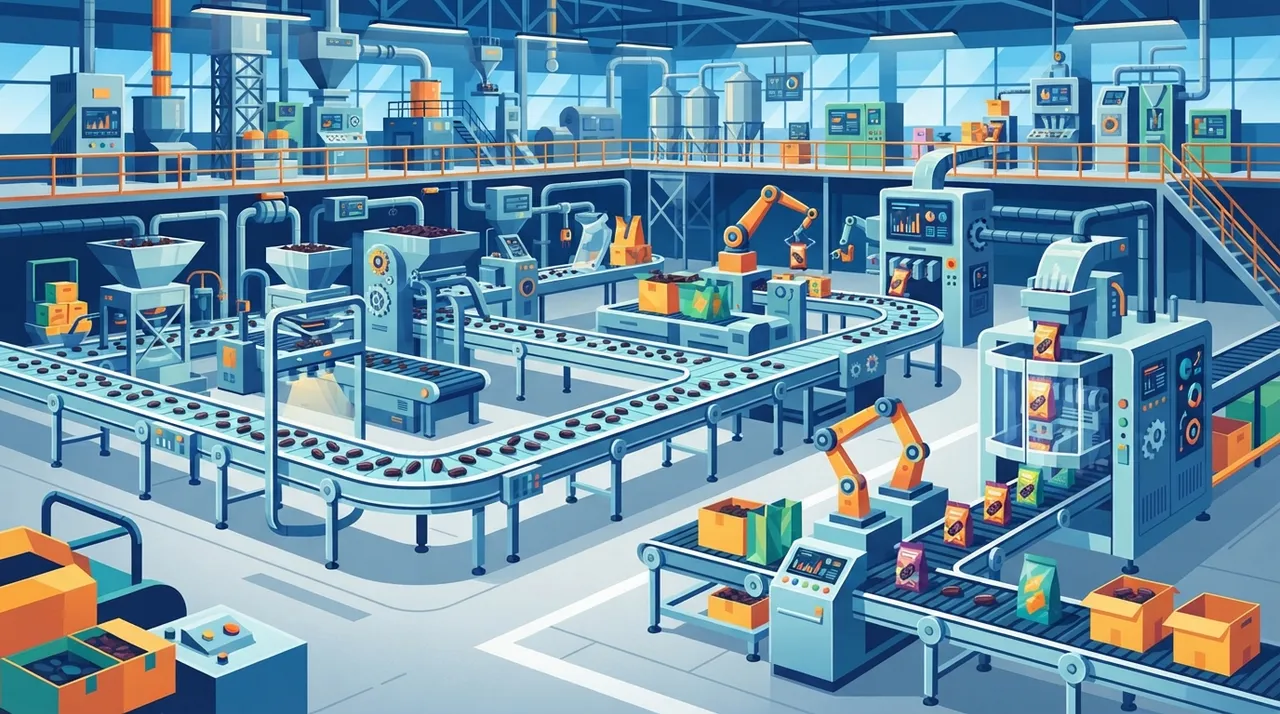
The technical aspect of the project requires a suitable location in an industrial zone, with an area ranging from 200 to 500 square meters, considering proximity to date farms to reduce transportation costs and availability of essential services. Basic equipment includes an integrated production line comprising a metal conveyor belt, vibrator, manual and automatic sorting unit, washing and drying unit, sterilization devices, and refrigerated storage devices. Suppliers will be carefully selected to ensure the quality of raw dates, with a focus on local farms adhering to high-quality standards. The technical process involves receiving dates, sorting them to remove impurities, washing, drying, steaming, then packing and wrapping them in various sized containers.
Projected Income Statement (5 Years)
| Item \ Year | Y1 | Y2 | Y3 | Y4 | Y5 |
|---|---|---|---|---|---|
| Revenue | 250,000 JOD | 280,000 JOD | 313,600 JOD | 351,232 JOD | 393,380 JOD |
| Cost of Sales | (150,000 JOD) | (168,000 JOD) | (188,160 JOD) | (210,739 JOD) | (236,028 JOD) |
| Gross Profit | 100,000 JOD | 112,000 JOD | 125,440 JOD | 140,493 JOD | 157,352 JOD |
| Operating Expenses | (62,500 JOD) | (70,000 JOD) | (78,400 JOD) | (87,808 JOD) | (98,345 JOD) |
| EBITDA | 37,500 JOD | 42,000 JOD | 47,040 JOD | 52,685 JOD | 59,007 JOD |
| Tax | (150 JOD) | (600 JOD) | (1,104 JOD) | (1,668 JOD) | (2,301 JOD) |
| Net Profit | 1,350 JOD | 5,400 JOD | 9,936 JOD | 15,016 JOD | 20,706 JOD |
| Net Margin | 1% | 2% | 3% | 4% | 5% |
Investment Cost Structure
| Item | Cost | Percentage |
|---|---|---|
| Purchase and preparation of machinery and equipment | 72,000 JOD | 40% |
| Construction and preparation of buildings and infrastructure | 45,000 JOD | 25% |
| Working capital (raw materials, salaries, operating expenses) | 36,000 JOD | 20% |
| Licensing and initial marketing costs | 14,400 JOD | 8% |
| Unforeseen costs and contingency | 12,600 JOD | 7% |
Cash Flow and Break-even Point
| Year | Operating Flow | Cumulative Flow |
|---|---|---|
| Year 1 | 37,350 JOD | -142,650 JOD |
| Year 2 | 41,400 JOD | -101,250 JOD |
| Year 3 | 45,936 JOD | -55,314 JOD |
| Year 4 | 51,016 JOD | -4,298 JOD |
| Year 5 | 56,706 JOD | 52,409 JOD |
Estimated break-even point at annual revenue ≈ 246,250 JOD (~99% of first-year revenue), with a contribution margin of 40%. Cumulative cash break-even in Year 5.
Funding Structure
| Funding Source | Percentage | Amount |
|---|---|---|
| Equity | 60% | 108,000 JOD |
| Debt Financing (9% interest) | 40% | 72,000 JOD |
Sensitivity Analysis (Revenue × Operations)
Impact of combined changes in revenue and costs on Net Present Value:
| Revenue \ Operations | −10% | −5% | Base | +5% | +10% |
|---|---|---|---|---|---|
| −20% | 48,902 JOD | 5,886 JOD | -37,878 JOD | -84,409 JOD | -132,205 JOD |
| −10% | 75,787 JOD | 27,394 JOD | -21,204 JOD | -72,461 JOD | -126,230 JOD |
| Base | 102,671 JOD | 48,902 JOD | -4,868 JOD | -60,724 JOD | -120,256 JOD |
| +10% | 129,556 JOD | 70,410 JOD | 11,263 JOD | -49,208 JOD | -114,281 JOD |
| +20% | 156,441 JOD | 91,917 JOD | 27,394 JOD | -37,878 JOD | -108,307 JOD |
Scenario Analysis
| Scenario | Probability | NPV | Assessment |
|---|---|---|---|
| Pessimistic | 25% | -60,724 JOD | Not feasible |
| Base | 50% | -4,868 JOD | Not feasible |
| Optimistic | 25% | 59,656 JOD | Feasible |
Expected Present Value (Weighted): -2,701 JOD.
Risk Analysis and Management
| Risk | Probability | Impact | Mitigation |
|---|---|---|---|
| Fluctuations in raw date prices | Medium | High | Long-term contracts with farmers and diversification of sourcing. |
| Intense competition in local and export markets | High | Medium | Focus on high quality, excellence in packaging, and offering value-added products. |
| Changes in government laws and regulations | Medium | Medium | Continuous monitoring of legal updates and consulting with legal advisors. |
| Marketing challenges and opening new markets | Medium | High | Participation in international exhibitions, building relationships with importers, and using effective digital marketing strategies. |
| Difficulty in securing skilled labor | Medium | Medium | Providing continuous training programs and attractive working conditions. |
Organizational Structure and Team
The factory's organizational structure consists of a General Manager with experience in the food industry sector, a Production Manager responsible for overseeing manufacturing operations, and a team of technicians and production workers. The factory requires at least 5-10 workers, in addition to a technician for equipment maintenance. The focus will be on hiring Jordanian competencies, with continuous training programs provided to enhance the efficiency of workers in date sorting and packaging. The minimum wage in Jordan is 290 Jordanian Dinars per month, and average private sector salaries range between 450 and 700 Jordanian Dinars.
Legal and Regulatory Aspects
The project requires obtaining numerous licenses and approvals from Jordanian government authorities. These licenses include: Commercial Register, Industrial License from the Ministry of Industry, Trade and Supply, Ministry of Health approvals, and the Jordan Food and Drug Administration to ensure product conformity with food safety standards. The factory must adhere to quality and occupational safety standards, provide safety equipment for workers, and insure them. These procedures aim to ensure full compliance with local and international laws and regulations related to the food industries.
Expansion and Sustainability Plan
The project's expansion plan includes increasing the factory's production capacity by adding new production lines or improving the efficiency of existing ones. The factory can expand into new export markets, especially in the Arabian Gulf countries and Europe, due to increasing demand for Jordanian dates. In the long term, consideration can be given to developing new date-based products, such as date paste, date molasses, and date-processed sweets. To enhance sustainability, the factory will seek to build strong relationships with local farmers, support sustainable date farming, and adopt environmentally friendly practices in production operations.
Environmental, Social, and Governance (ESG) Impact
The factory will adhere to the highest environmental safety standards through responsible management of solid and liquid waste. Organic waste from sorting and cleaning processes will be recycled as much as possible. Equipment characterized by energy and water consumption efficiency will be chosen to reduce the environmental footprint. Socially, the project will provide employment opportunities for local labor, especially women in palm cultivation areas. The factory will also support local farmers by purchasing dates from them at fair prices, which enhances the local economy. In terms of governance, the factory will commit to transparency and integrity in all its operations, adhering to local and international laws and regulations, and adopting best institutional governance practices.
Conclusions and Recommendations
The dates processing and packaging plant project in Jordan represents a promising investment opportunity, given the growth of the Jordanian dates sector and the high local and global demand for high-quality date products. With a proposed initial capital of 180,000 Jordanian Dinars, the project can achieve rewarding financial returns through proper planning, focus on quality, and adoption of an effective marketing strategy. Forecasts indicate the potential for high revenues in the first year and sustainable growth, making it an attractive investment in Jordan's food industry sector. It is recommended to proceed with this project after conducting a comprehensive detailed feasibility study to confirm economic viability and ensure optimal planning for all aspects.
Frequently Asked Questions
How much does it cost to set up a date packaging factory in Jordan?
The estimated cost for setting up a date packaging factory in Jordan of the proposed project size is approximately 180,000 Jordanian Dinars.
Is a date factory project profitable in Jordan?
Yes, a date factory project in Jordan is highly profitable, with expected revenues in the first year of approximately 250,000 Jordanian Dinars, and a good profit margin.
What are the licenses for a date factory in Jordan?
Key licenses include the Commercial Register, Industrial License, and approvals from the Ministry of Health and the Food and Drug Administration, in addition to adhering to quality and safety standards.
What is the size of the dates market in Jordan?
Jordan's total date production is approximately 35,000 tons annually, about 65% of which is exported to over 55 global markets, reflecting a large market size and growth opportunities.
What are the main challenges facing date factories in Jordan?
Challenges include fluctuations in raw date prices, intense competition, climate changes, and difficulty in securing skilled labor.
Sources and Disclaimer
- Jordanian Dates Association reports
- Jordan Chamber of Industry reports
- Specialized feasibility studies in the food industries sector
- Central Bank of Jordan data
- Specialized Jordanian economic news websites
Disclaimer: This is a guiding study that provides financial analysis according to approved sector standards; verify the figures locally according to your project's reality before any investment decision.