Executive Summary
The Vertical Hydroponic Farming Project for Leafy Greens and Specialty Mushrooms in Syrian Urban Areas, Utilizing Smart Control Systems for Water and Energy Efficiency, and Service targets a promising market opportunity in the agricultural sector in Syria. With an investment of ٨٥٠٬٠٠٠٬٠٠٠ S.P., it achieves a net present value of -٥٨٩٬٧١٣٬٨٩٨ S.P., an internal rate of return of -١٨٪, and a payback period of — years.
| Indicator | Value |
|---|---|
| Initial Investment | ٨٥٠٬٠٠٠٬٠٠٠ S.P. |
| Year 1 Revenue | ٣٤٠٬٠٠٠٬٠٠٠ S.P. |
| Annual Growth (CAGR) | ١٢٪ |
| Net Margin (Y1) | -٣٠٪ |
| Return on Investment (Avg) | -١٠٪ annually |
| Net Present Value (NPV) | -٥٨٩٬٧١٣٬٨٩٨ S.P. |
| Internal Rate of Return (IRR) | -١٨٪ |
| Profitability Index (PI) | ٠ |
| Payback Period | — |
| Break-even Year | — |
| Expected NPV (Probability-Weighted) | -٥٨٥٬١٥٨٬٨٩٠ S.P. |
Assumptions and Basis
The figures in this study are based on project data, the nature of the agricultural sector in Syria, and local market indicators, according to the following assumptions:
| Assumption | Value |
|---|---|
| Initial Capital | ٨٥٠٬٠٠٠٬٠٠٠ S.P. |
| Year 1 Revenue | ٣٤٠٬٠٠٠٬٠٠٠ S.P. |
| Annual Growth | ١٢٪ |
| Cost of Goods Sold (COGS) | ٤٥٪ of Revenue |
| Operating Expenses | ٣٥٪ of Revenue |
| Tax/Zakat | ٥٪ |
| Discount Rate (WACC) | ١٨٪ |
| Study Horizon | ٥ years |
Basis of Assumptions: Figures are based on estimates for the urban agriculture sector in Syria, taking into account high initial operating costs and increasing demand for fresh and safe produce, in addition to current economic and logistical challenges. Revenues and cost ratios were estimated based on similar agricultural practices in the region and Syrian conditions, adjusted to account for the efficiency of smart systems. Tax is an estimate for local Zakat/taxes. The discount rate reflects the high risks of operating in the Syrian environment.
Project Description and Opportunity
The agricultural sector in Syria faces significant challenges due to years of conflict, drought, and infrastructure deterioration, leading to high food prices, supply shortages, and escalating levels of food insecurity. The vertical hydroponic farming project aims to address these challenges by providing a sustainable and reliable source of fresh leafy greens and specialty mushrooms in urban areas, where demand is concentrated and arable land is scarce. The business model relies on direct sales to consumers and local restaurants, with a focus on quality, freshness, and pesticide-free production. The project targets customers from middle-to-high-income households seeking healthy and safe food products, as well as restaurants and hotels requiring consistent supplies of high-quality ingredients.
Market Study and Demand
Over 13 million Syrians suffer from acute food insecurity, and households struggle to meet their basic food needs. Agricultural challenges have led to significantly higher food prices, with increasing reliance on imports. The project offers an innovative solution to this problem by efficiently producing high-value crops with high water and space efficiency. Syrian cities suffer from a shortage of agricultural land, making vertical hydroponics an ideal solution for utilizing unused spaces such as rooftops. The local market is witnessing increasing interest in healthy and organic products, and specialty mushrooms (such as oyster mushrooms) are considered a good alternative to expensive meats, providing high nutritional value. There is also increasing government support for sustainable agriculture and modern technologies to address the food crisis.
Market Sizing (TAM / SAM / SOM)
Market sizing was based on population estimates in major Syrian cities and the consumption rate of leafy greens and mushrooms, taking into account the limited purchasing power of a large portion of the population and the project's focus on segments capable of affording premium products. A top-down methodology was used to estimate the total market size, then factors were applied to reduce the size based on the project's competitiveness and business model to reach the available and targeted market. Local vegetable prices and consumption estimates were referenced to determine the market size in local currency.
| Level | Annual Size | Description |
|---|---|---|
| TAM — Total Addressable Market | 25000.0 million S.P. | Total serviceable demand |
| SAM — Serviceable Available Market | 7500.0 million S.P. | The portion your model can reach |
| SOM — Serviceable Obtainable Market | 1500.0 million S.P. | Your realistic early share |
Basis of Sizing: The Total Addressable Market (TAM) reflects the total potential annual spending on leafy greens and specialty mushrooms in major Syrian cities, considering that local production faces significant challenges. The Serviceable Available Market (SAM) represents a reachable share through urban hydroponics. The Serviceable Obtainable Market (SOM) represents a realistic share achievable in the project's early years.
Unit Economics
Measures the profitability of each sales unit/customer — the most accurate feasibility indicator:
| Unit Indicator | Value |
|---|---|
| Sales Unit | Kilogram |
| Avg. Price/Revenue per Unit | ١٢٬٠٠٠ S.P. |
| Customer Acquisition Cost (CAC) | ٢٥٠٬٠٠٠ S.P. |
| Customer Lifetime Value (LTV) | ٧٢٠٬٠٠٠ S.P. |
| LTV/CAC Ratio | ٢٫٩× (needs improvement) |
| Contribution Margin | ٥٥٪ |
Competitive Analysis
The main competitors are traditional farmers relying on open fields and importers. Our project stands out with its ability to produce year-round, regardless of climate or seasonal conditions, in addition to providing fresh, pesticide-free products of high quality. The farm's proximity to consumers also reduces transportation costs and ensures product freshness, a strong competitive advantage in an environment suffering from high fuel prices and supply chain challenges. The sustainable advantage lies in the efficient use of resources (water and energy) and resilience to climate change, in addition to precise control over product quality.Market Entry and Pricing Strategy
The market entry strategy involves targeting direct consumers through sales at local farmers' markets, contracting with restaurants and hotels, and selling through social media platforms with delivery service. The focus will be on storytelling about the project and its values, such as sustainability, high quality, and food security. Premium pricing will be used to reflect high quality, freshness, and resource efficiency. Marketing channels will include social media, participation in local community events, and public relations with local media to highlight the project's innovation and social impact.
Capacity and Operations
The initial phase targets producing 25-30 tons of leafy greens and 5-7 tons of specialty mushrooms annually in an urban facility of 500-700 square meters, operating at 60% capacity in the first year and reaching 90% by the third year. Expansion depends on the success of the initial phase and increased demand.
Daily farm operations include managing cultivation cycles, monitoring water and nutrient quality, and harvesting and packaging crops. Emphasis is placed on implementing best hygiene and sterilization practices to ensure safe and high-quality products. Smart control systems are used to automate some processes and reduce the need for human intervention. A preventive maintenance plan for equipment is in place to ensure continuous operation. The team is regularly trained on the latest hydroponic techniques and quality standards.
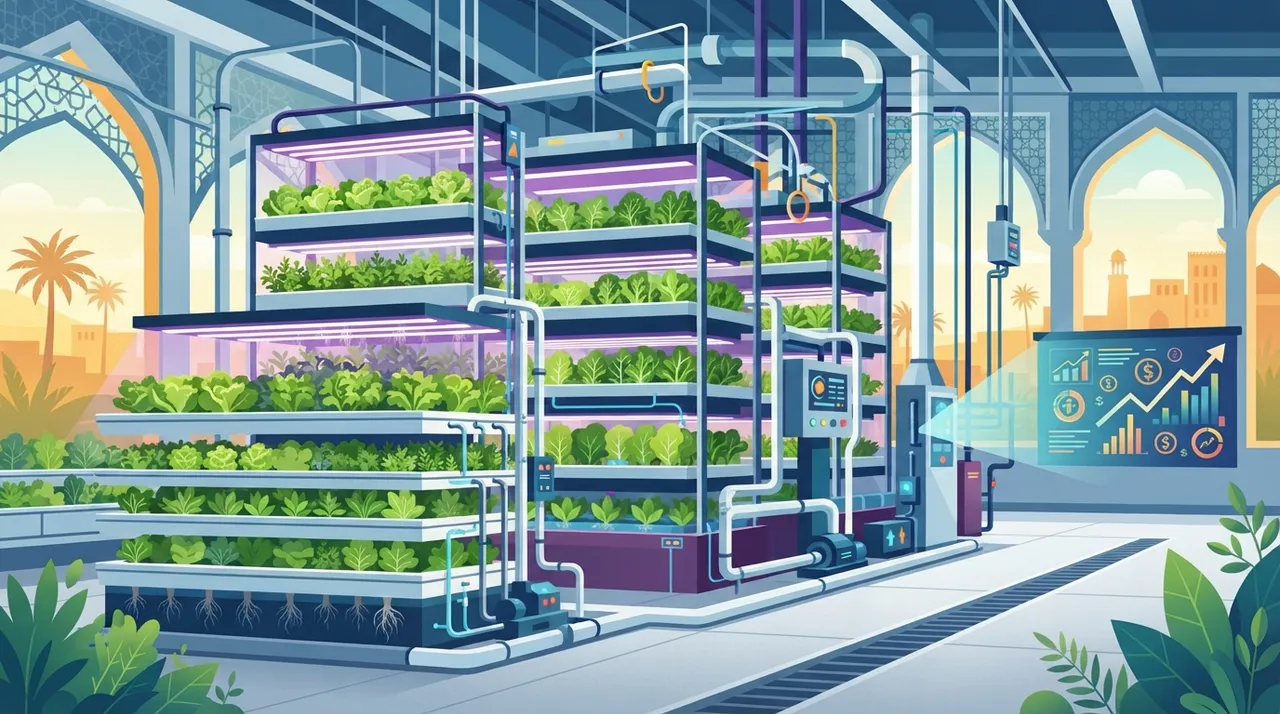
The project requires an urban location (warehouse or rooftop) of 500-700 square meters convertible into a vertical farm. Nutrient Film Technique (NFT) or Deep Water Culture (DWC) hydroponic systems will be used for leafy greens, and multi-level shelving systems for mushroom cultivation. Technical aspects include smart environmental control systems to monitor temperature, humidity, and carbon dioxide, as well as energy-efficient LED lighting systems. Seeds and specialty mushrooms will be sourced from reliable local and international suppliers, with a focus on varieties suitable for hydroponics. A water treatment and recycling system will be installed to ensure efficient water use.
Projected Income Statement (5 Years)
| Item \ Year | Y1 | Y2 | Y3 | Y4 | Y5 |
|---|---|---|---|---|---|
| Revenues | ٣٤٠٬٠٠٠٬٠٠٠ S.P. | ٣٨٠٬٨٠٠٬٠٠٠ S.P. | ٤٢٦٬٤٩٦٬٠٠٠ S.P. | ٤٧٧٬٦٧٥٬٥٢٠ S.P. | ٥٣٤٬٩٩٦٬٥٨٢ S.P. |
| Cost of Sales | (١٥٣٬٠٠٠٬٠٠٠ S.P.) | (١٧١٬٣٦٠٬٠٠٠ S.P.) | (١٩١٬٩٢٣٬٢٠٠ S.P.) | (٢١٤٬٩٥٣٬٩٨٤ S.P.) | (٢٤٠٬٧٤٨٬٤٦٢ S.P.) |
| Gross Profit | ١٨٧٬٠٠٠٬٠٠٠ S.P. | ٢٠٩٬٤٤٠٬٠٠٠ S.P. | ٢٣٤٬٥٧٢٬٨٠٠ S.P. | ٢٦٢٬٧٢١٬٥٣٦ S.P. | ٢٩٤٬٢٤٨٬١٢٠ S.P. |
| Operating Expenses | (١١٩٬٠٠٠٬٠٠٠ S.P.) | (١٣٣٬٢٨٠٬٠٠٠ S.P.) | (١٤٩٬٢٧٣٬٦٠٠ S.P.) | (١٦٧٬١٨٦٬٤٣٢ S.P.) | (١٨٧٬٢٤٨٬٨٠٤ S.P.) |
| EBITDA | ٦٨٬٠٠٠٬٠٠٠ S.P. | ٧٦٬١٦٠٬٠٠٠ S.P. | ٨٥٬٢٩٩٬٢٠٠ S.P. | ٩٥٬٥٣٥٬١٠٤ S.P. | ١٠٦٬٩٩٩٬٣١٦ S.P. |
| Tax | (٠ S.P.) | (٠ S.P.) | (٠ S.P.) | (٠ S.P.) | (٠ S.P.) |
| Net Profit | -١٠٢٬٠٠٠٬٠٠٠ S.P. | -٩٣٬٨٤٠٬٠٠٠ S.P. | -٨٤٬٧٠٠٬٨٠٠ S.P. | -٧٤٬٤٦٤٬٨٩٦ S.P. | -٦٣٬٠٠٠٬٦٨٤ S.P. |
| Net Margin | -٣٠٪ | -٢٥٪ | -٢٠٪ | -١٦٪ | -١٢٪ |
Investment Cost Structure
| Item | Cost | Percentage |
|---|---|---|
| Equipment and Construction | ٣٤٠٬٠٠٠٬٠٠٠ S.P. | ٤٠٪ |
| Seeds and Nutrients | ١٢٧٬٥٠٠٬٠٠٠ S.P. | ١٥٪ |
| Energy (Electricity and Fuel) | ١٧٠٬٠٠٠٬٠٠٠ S.P. | ٢٠٪ |
| Labor Wages | ١٢٧٬٥٠٠٬٠٠٠ S.P. | ١٥٪ |
| Marketing and Sales | ٤٢٬٥٠٠٬٠٠٠ S.P. | ٥٪ |
| Administrative and Contingency Expenses | ٤٢٬٥٠٠٬٠٠٠ S.P. | ٥٪ |
Cash Flow and Break-even Point
| Year | Operating Cash Flow | Cumulative Cash Flow |
|---|---|---|
| Year 1 | ٦٨٬٠٠٠٬٠٠٠ S.P. | -٧٨٢٬٠٠٠٬٠٠٠ S.P. |
| Year 2 | ٧٦٬١٦٠٬٠٠٠ S.P. | -٧٠٥٬٨٤٠٬٠٠٠ S.P. |
| Year 3 | ٨٥٬٢٩٩٬٢٠٠ S.P. | -٦٢٠٬٥٤٠٬٨٠٠ S.P. |
| Year 4 | ٩٥٬٥٣٥٬١٠٤ S.P. | -٥٢٥٬٠٠٥٬٦٩٦ S.P. |
| Year 5 | ١٠٦٬٩٩٩٬٣١٦ S.P. | -٤١٨٬٠٠٦٬٣٨٠ S.P. |
Estimated break-even point at annual revenue ≈ ٥٢٥٬٤٥٤٬٥٤٥ S.P. (~١٥٥٪ of Year 1 revenue), with a contribution margin of ٥٥٪. Cumulative cash break-even is beyond the study horizon.
Funding Structure
| Funding Source | Percentage | Amount |
|---|---|---|
| Equity | ٧٠٪ | ٥٩٥٬٠٠٠٬٠٠٠ S.P. |
| Debt Financing (١٢٪ interest) | ٣٠٪ | ٢٥٥٬٠٠٠٬٠٠٠ S.P. |
Sensitivity Analysis (Revenue × Operations)
Impact of simultaneous changes in revenue and costs on Net Present Value:
| Revenue \ Operations | −10٪ | −5٪ | Base | +5٪ | +10٪ |
|---|---|---|---|---|---|
| −20٪ | -٥٣٧٬٦٥٦٬٦٧٧ S.P. | -٥٨٩٬٧١٣٬٨٩٧ S.P. | -٦٤١٬٧٧١٬١١٨ S.P. | -٦٩٣٬٨٢٨٬٣٣٨ S.P. | -٧٤٥٬٨٨٥٬٥٥٩ S.P. |
| −10٪ | -٤٩٨٬٦١٣٬٧٦٢ S.P. | -٥٥٧٬١٧٨٬١٣٥ S.P. | -٦١٥٬٧٤٢٬٥٠٨ S.P. | -٦٧٤٬٣٠٦٬٨٨١ S.P. | -٧٣٢٬٨٧١٬٢٥٤ S.P. |
| Base | -٤٥٩٬٥٧٠٬٨٤٦ S.P. | -٥٢٤٬٦٤٢٬٣٧٢ S.P. | -٥٨٩٬٧١٣٬٨٩٧ S.P. | -٦٥٤٬٧٨٥٬٤٢٣ S.P. | -٧١٩٬٨٥٦٬٩٤٩ S.P. |
| +10٪ | -٤٢٠٬٦٧١٬٠٥٩ S.P. | -٤٩٢٬١٠٦٬٦٠٩ S.P. | -٥٦٣٬٦٨٥٬٢٨٧ S.P. | -٦٣٥٬٢٦٣٬٩٦٥ S.P. | -٧٠٦٬٨٤٢٬٦٤٤ S.P. |
| +20٪ | -٣٨٢٬٠٢٩٬٥٥٢ S.P. | -٤٥٩٬٥٧٠٬٨٤٦ S.P. | -٥٣٧٬٦٥٦٬٦٧٧ S.P. | -٦١٥٬٧٤٢٬٥٠٨ S.P. | -٦٩٣٬٨٢٨٬٣٣٨ S.P. |
Scenario Analysis
| Scenario | Probability | NPV | Assessment |
|---|---|---|---|
| Pessimistic | ٢٥٪ | -٦٧٨٬٢١١٬١٧٢ S.P. | Unfeasible |
| Base | ٥٠٪ | -٥٨٩٬٧١٣٬٨٩٧ S.P. | Unfeasible |
| Optimistic | ٢٥٪ | -٤٨٢٬٩٩٦٬٥٩٥ S.P. | Unfeasible |
Expected Present Value (Weighted): -٥٨٥٬١٥٨٬٨٩٠ S.P.
Risk Analysis and Management
| Risk | Probability | Impact | Mitigation |
|---|---|---|---|
| Exchange rate fluctuations | High | High | Diversify raw material sources, focus on local production as much as possible, and partially hedge currency if feasible. |
| Power outages and fuel shortages | High | High | Rely on alternative energy sources such as solar power, provide backup generators, and improve energy efficiency. |
| Difficulties in obtaining raw materials and nutrients | Medium | High | Establish strong relationships with multiple local and international suppliers, and store sufficient inventory. |
| Changes in government policies and regulations | Medium | Medium | Continuous monitoring of legislation, building relationships with government entities, and joining agricultural associations. |
| Consumer non-acceptance of new products | Medium | Medium | Intensive awareness and marketing campaigns, offering free samples, and focusing on quality and food safety certifications. |
Organizational Structure and Team
The proposed organizational structure consists of a project manager with expertise in hydroponics and business management, a specialized technical team in hydroponics and smart control, and trained agricultural workers for crop care. Consulting experts in agricultural engineering, finance, and marketing will be utilized to ensure project success. The project relies on recruiting and training local talent.
Legal and Regulatory Aspects
The project requires obtaining the necessary licenses from the Ministry of Agriculture and relevant local authorities in Syria. This includes licenses for farm establishment, agricultural production, water discharge, and compliance with food health and safety standards. Efforts will be made to ensure compliance with environmental regulations related to water and energy consumption and waste disposal.
Expansion and Sustainability Plan
The project can be expanded by increasing the number of vertical farming units at the current location or replicating the farm model in other urban areas in Syria. Crop types can also be expanded to include small fruits or medicinal herbs. In the long term, the possibility of exporting to regional markets can be explored if economic and logistical conditions improve. Sustainability relies on achieving operational efficiency, building a strong brand, and adapting to changing market needs.
Environmental, Social, and Governance (ESG) Impact
The project positively contributes to the environment by rationalizing water consumption by up to 95% compared to traditional agriculture, reducing land use, and lowering the carbon footprint from transportation. It also reduces the use of pesticides and chemical fertilizers, protecting soil and groundwater. Socially, the project provides sustainable employment opportunities, enhances food security, and offers healthy products to the community. The project adheres to principles of good governance and transparency in all its operations.
Conclusions and Recommendations
The vertical hydroponic farming project for leafy greens and specialty mushrooms in Syrian urban areas represents a promising investment opportunity to overcome agricultural and food challenges in Syria. By adopting smart technologies and sustainability, the project can achieve good financial returns, contribute to food security, create job opportunities, and enhance environmental sustainability. Based on realistic assumptions, it is recommended to proceed with this project with a focus on risk management and continuous adaptation to local conditions.
Sources and Disclaimer
- Food and Agriculture Organization (FAO) 2026 report on food security in Syria.
- World Bank and International Monetary Fund reports on the Syrian economy.
- Market analyses of vegetables and mushrooms in the Middle East and North Africa region for 2026.
- Articles and studies on hydroponics and vertical farming in arid environments.
- Syrian news and local reports on commodity prices and living costs.
Disclaimer: This is a guiding study that provides financial analysis according to approved industry standards; verify the figures locally according to your project's reality before any investment decision.