Executive Summary
The hydroponic farming project in the agricultural sector in the UK targets a promising market opportunity. With an investment of £120,000, it achieves a net present value of -£31,719, an internal rate of return of -0%, and a payback period of — years.
| Indicator | Value |
|---|---|
| Initial Investment | £120,000 |
| First-Year Revenue | £90,000 |
| Annual Growth (CAGR) | 15% |
| Net Margin (Y1) | -7% |
| Return on Investment (Avg.) | -0% annually |
| Net Present Value (NPV) | -£31,719 |
| Internal Rate of Return (IRR) | -0% |
| Profitability Index (PI) | 1 |
| Payback Period | — |
| Break-even Year | — |
| Expected NPV (Probability-Weighted) | -£31,170 |
Assumptions and Basis
The figures in this study are based on project data, the nature of the agricultural sector in the UK, and local market indicators, according to the following assumptions:
| Assumption | Value |
|---|---|
| Initial Capital | £120,000 |
| First-Year Revenue | £90,000 |
| Annual Growth | 15% |
| Cost of Goods Sold (COGS) | 45% of Revenue |
| Operating Expenses | 35% of Revenue |
| Tax/Zakat | 19% |
| Discount Rate (WACC) | 10% |
| Study Horizon | 5 years |
Basis of Assumptions: Figures are based on average costs and revenues of medium-sized hydroponic farms in the UK, considering increasing demand and modern technologies.
Project Description and Opportunity
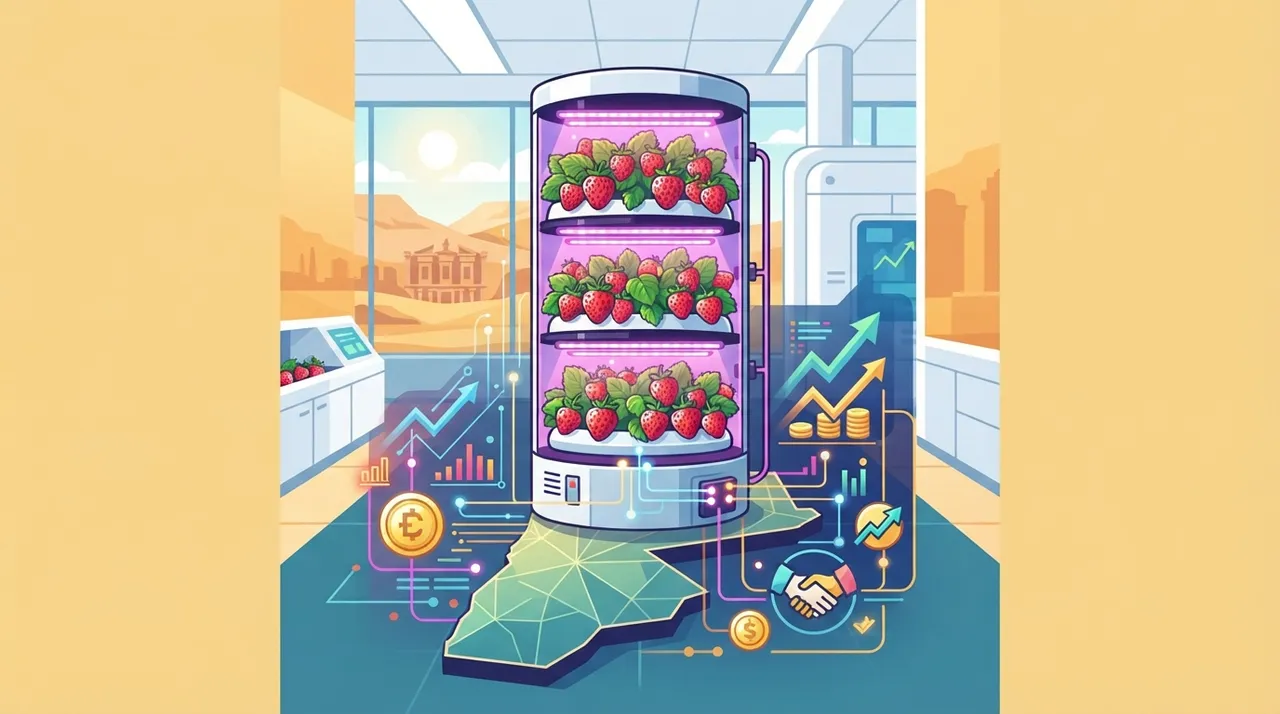
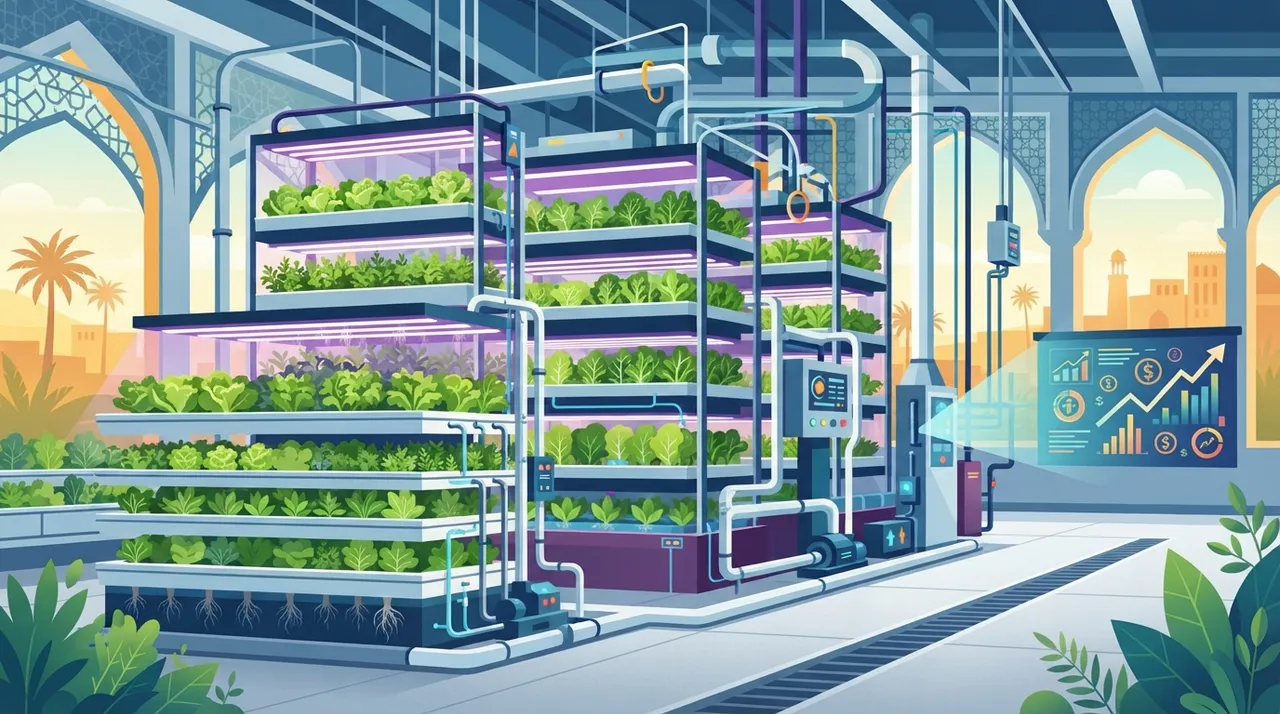
This hydroponic farming project aims to establish a modern farm for producing leafy greens, herbs, and strawberries in an urban or semi-urban environment in the UK. Hydroponics allows for year-round crop production with high efficiency in water and space usage, aligning with global and local trends towards food security and sustainability. The business model will rely on direct sales to consumers (B2C) through local retail channels and farmers' markets, as well as sales to restaurants and hotels (B2B). The target customers are health-conscious consumers interested in fresh, sustainable products, and restaurants focused on high-quality local ingredients. The project benefits from increasing government support for sustainable agricultural practices and growing demand for local, pesticide-free produce.
Market and Demand Study
The hydroponics market in the UK is experiencing significant growth, driven by several key factors. There is increasing demand for fresh produce, fueled by consumer preferences for local and organic foods. Urban expansion and space constraints contribute to the growing importance of hydroponics, especially in urban areas such as London and Manchester. There is also increasing government support for sustainable agricultural practices, including hydroponics, through funding programs and initiatives that encourage this type of farming. The UK hydroponics market is expected to grow at a compound annual growth rate of approximately 10% over the next five years, and 20.36% between 2025 and 2035. The market size reached $132.31 million in 2024 and is projected to reach $1016.16 million by 2035. Products such as lettuce, spinach, basil, strawberries, tomatoes, and cucumbers are popular and profitable crops in hydroponics.
Market Sizing (TAM / SAM / SOM)
The Total Addressable Market (TAM) was determined based on overall estimates for the hydroponics market in the UK. The Serviceable Available Market (SAM) was derived as a percentage of TAM, representing a realistic share the project can reach through targeted distribution channels. The Serviceable Obtainable Market (SOM) represents a smaller, more achievable share, considering the project's initial production capacity and ability to scale. These estimates are based on market analyses indicating a focus on major cities with high population density and increasing demand for fresh, local produce, as well as the growth of vertical farming.
| Level | Annual Size | Description |
|---|---|---|
| TAM — Total Addressable Market | £297.1 million | Total serviceable demand |
| SAM — Serviceable Available Market | £50.0 million | The portion your model can reach |
| SOM — Serviceable Obtainable Market | £10.0 million | Your realistic early share |
Sizing Basis: The total UK hydroponics market size is estimated at approximately $297.15 million in 2030 (equivalent to approximately £235 million). The serviceable available and obtainable markets were estimated based on a realistic share achievable in major cities experiencing high demand for fresh local produce.
Unit Economics
Measures the profitability of each sales unit/customer — the most accurate feasibility indicator:
| Unit Indicator | Value |
|---|---|
| Sales Unit | Crop unit (kg/pack/tray) |
| Average Price/Revenue per Unit | £5 |
| Customer Acquisition Cost (CAC) | £15 |
| Customer Lifetime Value (LTV) | £150 |
| LTV/CAC Ratio | 10× (healthy) |
| Contribution Margin | 60% |
Competitive Analysis
The competitive landscape in the UK hydroponics sector is characterized by the presence of a number of players, ranging from small and medium-sized farms to large companies. Competitors such as HydroGarden, GroWorks, and Holland Horticulture stand out as key suppliers of equipment and services, indicating an integrated ecosystem that supports this sector. The sustainable advantage of our project lies in focusing on superior product quality, environmental sustainability (reduced water and pesticide consumption), and proximity of the farm to local markets to ensure maximum freshness and reduced carbon footprint. Emphasis will also be placed on differentiation by offering a diverse range of in-demand crops and building strong relationships with consumers and commercial buyers.
Market Entry and Pricing Strategy
The market entry and marketing plan involves targeting direct consumers, retailers, and restaurants. Marketing channels will include local farmers' markets, specialty organic and fresh food stores, and local e-commerce platforms. Digital marketing campaigns via social media and collaborations with healthy and sustainable food influencers will be emphasized. Pricing will be competitive with organic and imported products, while highlighting the added value of local quality, freshness, and sustainability. The average selling price per unit (e.g., a pack of leafy greens or a tray of herbs) could range around £4.50.
Capacity and Operations
Initial production capacity will be 2,000 crop units per month, with a plan for gradual expansion to reach 5,000 units per month within 3 years, with staggered occupancy from 60% to 90%.
Daily farm operations will include precise monitoring of nutrient levels, pH, temperature, and humidity, as well as irrigation and lighting schedules. Strict pest and disease control protocols will be implemented to ensure crop quality and safety, with an emphasis on organic and non-chemical solutions wherever possible. Harvesting, packaging, and packing will be carried out to ensure product freshness and delivery to the consumer in the best quality.
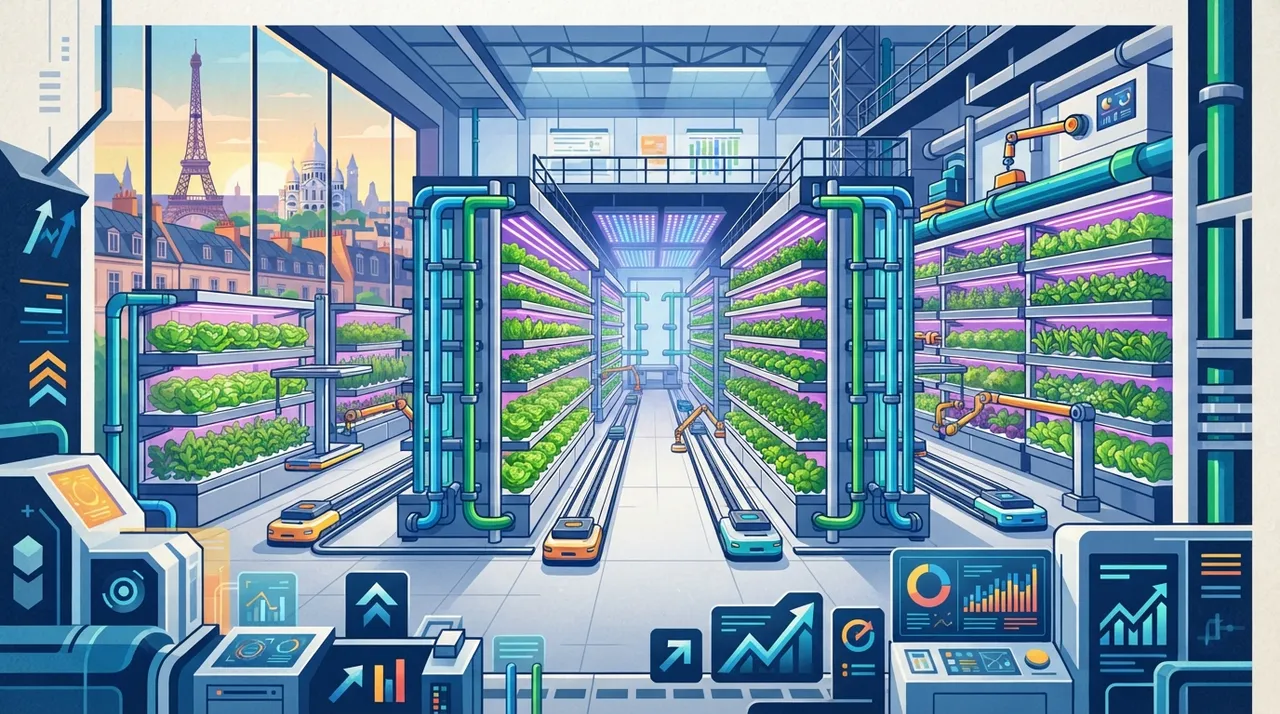
The location will be carefully chosen to be close to target markets, with the necessary infrastructure (electricity and water) available. Modern hydroponic systems such as Nutrient Film Technique (NFT) or Deep Water Culture (DWC) systems will be used, which have proven effective in producing a wide range of crops. Reliance will be placed on reliable suppliers for hydroponic equipment, nutrients, seeds, and pH adjustment solutions (pH up/down).
Projected Income Statement (5 Years)
| Item \ Year | Y1 | Y2 | Y3 | Y4 | Y5 |
|---|---|---|---|---|---|
| Revenue | £90,000 | £103,500 | £119,025 | £136,879 | £157,411 |
| Cost of Sales | (£40,500) | (£46,575) | (£53,561) | (£61,595) | (£70,835) |
| Gross Profit | £49,500 | £56,925 | £65,464 | £75,283 | £86,576 |
| Operating Expenses | (£31,500) | (£36,225) | (£41,659) | (£47,908) | (£55,094) |
| EBITDA | £18,000 | £20,700 | £23,805 | £27,376 | £31,482 |
| Tax | (£0) | (£0) | (£0) | (£641) | (£1,422) |
| Net Profit | -£6,000 | -£3,300 | -£195 | £2,734 | £6,061 |
| Net Margin | -7% | -3% | -0% | 2% | 4% |
Investment Cost Structure
| Item | Cost | Percentage |
|---|---|---|
| Hydroponic System Setup and Equipping | £48,000 | 40% |
| Lighting and Environmental Control Equipment | £30,000 | 25% |
| Initial Inventory (seeds, nutrients, growing media) | £12,000 | 10% |
| Initial Operating Costs (wages, utilities) | £18,000 | 15% |
| Initial Administrative and Marketing Expenses | £12,000 | 10% |
Cash Flow and Break-even Point
| Year | Operating Cash Flow | Cumulative Cash Flow |
|---|---|---|
| Year 1 | £18,000 | -£102,000 |
| Year 2 | £20,700 | -£81,300 |
| Year 3 | £23,805 | -£57,495 |
| Year 4 | £26,734 | -£30,761 |
| Year 5 | £30,061 | -£700 |
Estimated break-even point at annual revenue ≈ £100,909 (~112% of first-year revenue), with a 55% contribution margin. Cumulative cash break-even after the study horizon.
Funding Structure
| Funding Source | Percentage | Amount |
|---|---|---|
| Equity | 70% | £84,000 |
| Debt Financing (7% interest) | 30% | £36,000 |
Sensitivity Analysis (Revenue × Operations)
Impact of simultaneous changes in revenue and costs on Net Present Value:
| Revenue \ Operations | −10% | −5% | Base | +5% | +10% |
|---|---|---|---|---|---|
| −20% | -£16,035 | -£31,719 | -£48,458 | -£66,239 | -£84,159 |
| −10% | -£4,734 | -£21,824 | -£39,952 | -£59,519 | -£79,679 |
| Base | £6,153 | -£12,251 | -£31,719 | -£52,798 | -£75,199 |
| +10% | £17,039 | -£2,920 | -£23,797 | -£46,311 | -£70,719 |
| +20% | £27,926 | £6,153 | -£16,035 | -£39,952 | -£66,239 |
Scenario Analysis
| Scenario | Probability | NPV | Assessment |
|---|---|---|---|
| Pessimistic | 25% | -£60,863 | Not Feasible |
| Base | 50% | -£31,719 | Not Feasible |
| Optimistic | 25% | -£379 | Not Feasible |
Expected Present Value (Weighted): -£31,170.
Risk Analysis and Management
| Risk | Probability | Impact | Mitigation |
|---|---|---|---|
| Rising energy costs | High | High | Invest in energy-efficient systems and use renewable energy where possible |
| Fluctuations in market prices for agricultural products | Medium | Medium | Diversify crops and establish contractual relationships with buyers |
| Technical failures of hydroponic systems | Medium | Medium | Regular maintenance of equipment and presence of backup systems |
| Changes in government regulations | Low | Medium | Continuous monitoring of legal updates and adaptation |
| Intense competition | Medium | Medium | Focus on quality and product differentiation and building a strong brand |
Organizational Structure and Team
The initial organizational structure will consist of a farm manager responsible for overall supervision, and hydroponic technicians specialized in system management and crop care. The team may also include a part-time sales and marketing officer. Emphasis will be placed on recruiting experienced personnel in hydroponics interested in sustainable agriculture.
Legal and Regulatory Aspects
The project requires obtaining the necessary agricultural and health licenses in the UK. Environmental standards and food safety must be adhered to. There are no complex specific licenses for hydroponics, but general agricultural business regulations must be complied with.
Expansion and Sustainability Plan
The expansion plan involves gradually increasing the farm's production capacity by adding more hydroponic units and expanding the growing area. Future expansion could include exploring new markets in other cities or diversifying crop types to include high-demand small fruits like strawberries. Sustainable practices contribute to enhancing the project's image and facilitating expansion.
Environmental, Social, and Governance (ESG) Impact
Hydroponics is considered highly environmentally sustainable. It uses up to 90% less water compared to traditional farming, as water is recycled within the system. It also reduces the need for pesticides and chemical fertilizers due to the controlled environment. Hydroponics can reduce the carbon footprint through local production and reduced transportation costs. However, energy consumption for LED lights and climate control systems must be managed efficiently, and renewable energy sources are preferred.
Conclusions and Recommendations
The hydroponic farming project in the UK shows strong feasibility potential, driven by increasing demand for fresh, local, and sustainable produce. With an initial capital of approximately £120,000, good revenues can be achieved in the first year and continuous growth. Despite the challenges of initial costs and energy consumption, the high efficiency in resource use and the competitive advantage of high-quality products support the project's profitability. The recommendation is to proceed with the project with a focus on improving energy efficiency and effective marketing strategies.
Frequently Asked Questions
How much does it cost to start a hydroponic project in the UK?
The costs to start a medium-sized hydroponic project in the UK range from £20,000 to £100,000 or more, and can reach £500,000 for large farms. Our proposed project is estimated at approximately £120,000.
Is a hydroponic farming project profitable in the UK?
Yes, hydroponic farming projects can be profitable in the UK, especially with a focus on high-value crops and increasing demand for fresh local produce. Profit margins for commercial farms can range from 15% to 25% after establishment.
What are the best crops to grow hydroponically in the UK?
Leafy greens such as lettuce, spinach, and kale, herbs such as basil, coriander, mint, and parsley, strawberries, and cherry tomatoes are among the best crops to grow hydroponically in the UK due to their fast growth and high yields.
What licenses are required for a hydroponic farm in the UK?
Hydroponic farms in the UK are required to comply with general agricultural regulations and food safety standards. There are no unique specific licenses for hydroponics itself, but standard commercial and health licenses for any agricultural business must be obtained.
How much water does hydroponics consume compared to traditional farming?
Hydroponics uses up to 90% less water compared to traditional farming, thanks to closed recycling systems that reduce waste.
What is the UK corporate tax rate for 2026?
The main UK corporate tax rate for 2026 is 25% for companies with profits over £250,000. For profits below £50,000, a 19% rate applies. There is a marginal relief band for profits between £50,000 and £250,000.
Sources and Disclaimer
- British market research reports on hydroponics (Market Research Future, TechSci Research, Grand View Research)
- Specialized feasibility studies in hydroponics in the UK (Hyjo, HydroMart)
- British government websites for taxes and licenses (HMRC)
- Academic articles and industry publications on sustainable agriculture and hydroponics
- Data on operating costs and agricultural product prices in the UK
Disclaimer: This is a guiding study that provides financial analysis according to approved industry standards; verify the figures locally according to your project's reality before any investment decision.