Executive Summary
The Microalgae Cultivation and Production Project for Biofuel and Nutritional Supplement Extraction in Bahrain, Utilizing Treated Wastewater or Seawater for Reduction project in the energy and environment sector in Bahrain targets a promising market opportunity. With an investment of 850,000 BHD, it achieves a Net Present Value (NPV) of -571,238 BHD, an Internal Rate of Return (IRR) of -21%, and a payback period of — years.
| Indicator | Value |
|---|---|
| Initial Investment | 850,000 BHD |
| First-Year Revenue | 280,000 BHD |
| Annual Growth (CAGR) | 15% |
| Net Margin (Y1) | -41% |
| Return on Investment (Avg.) | -11% annually |
| Net Present Value (NPV) | -571,238 BHD |
| Internal Rate of Return (IRR) | -21% |
| Profitability Index (PI) | 0 |
| Payback Period | — |
| Break-even Year | — |
| Expected NPV (Probability-Weighted) | -566,360 BHD |
Assumptions and Basis
The figures in this study are based on project data, the nature of the energy and environment sector in Bahrain, and local market indicators, according to the following assumptions:
| Assumption | Value |
|---|---|
| Initial Capital | 850,000 BHD |
| First-Year Revenue | 280,000 BHD |
| Annual Growth | 15% |
| Cost of Goods Sold (COGS) | 45% of Revenue |
| Operating Expenses | 35% of Revenue |
| Tax/Zakat | 10% |
| Discount Rate (WACC) | 10% |
| Study Horizon | 5 years |
Basis of Assumptions: Figures are based on preliminary estimates of average production costs and revenues in the renewable energy and aquaculture sectors in Bahrain, considering government support and increasing demand for sustainable products.
Project Description and Opportunity
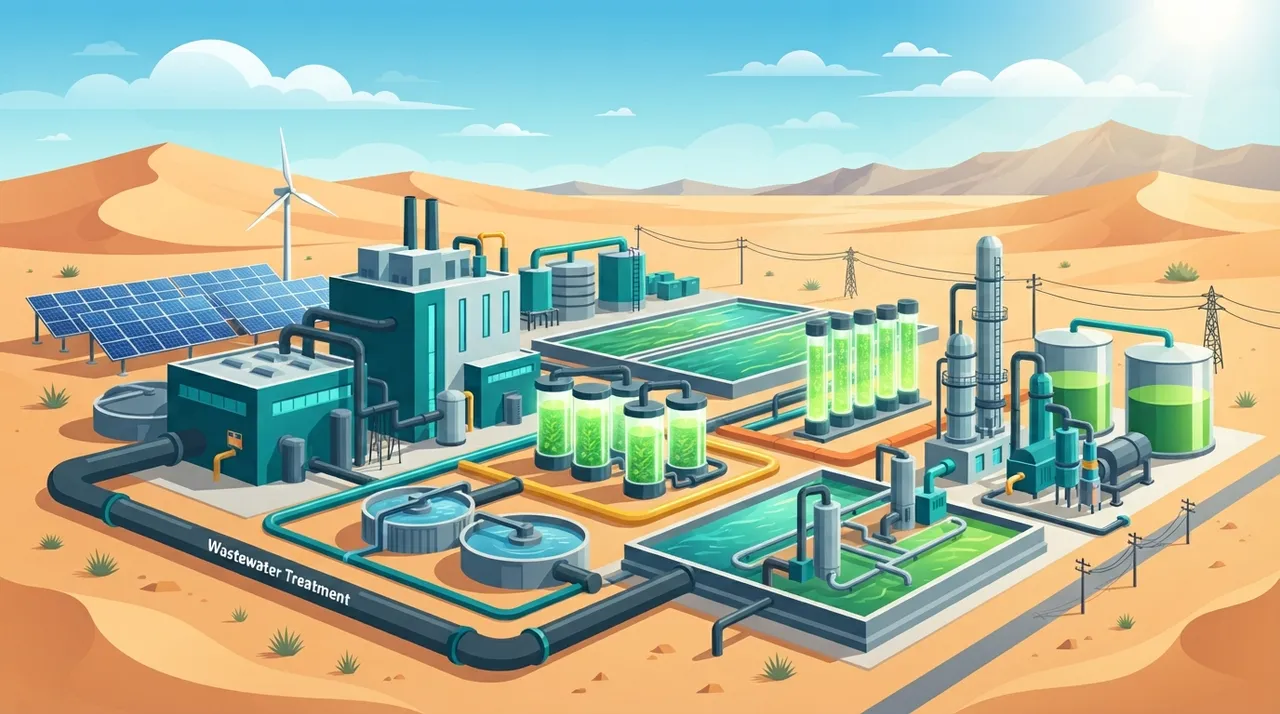
The project aims to cultivate microalgae in Bahrain for the production of biofuel and nutritional supplements. The project represents a promising investment opportunity given Bahrain's efforts to diversify energy sources, achieve food security, and adopt green economy principles. The business model will rely on cultivating various types of microalgae, such as Spirulina and Chlorella, using treated wastewater or seawater to reduce freshwater consumption. The products target diverse markets including the energy sector (biofuel), health and food sector (nutritional supplements), and agriculture sector (organic fertilizers). The project benefits from the environmental advantages of algae in absorbing carbon dioxide and recycling nutrients from treated wastewater.
Market Study and Demand
The global market for algae-based biofuels is experiencing significant growth, projected to double from USD 9.23 billion in 2024 to USD 19.16 billion by 2032, at a compound annual growth rate (CAGR) of 9.5%. This growth is driven by increasing demand for sustainable energy sources and environmental concerns. The market for microalgae-based products is also growing, valued at USD 15.51 billion in 2025, and expected to reach USD 26.93 billion by 2032, with a CAGR of 8.2% from 2025 to 2032. Spirulina is a leading species in this market, capturing 38% of the market share in 2025. In Bahrain, biofuel production from algae is still in its early stages, with production not exceeding zero thousand barrels per day in 2021, indicating a significant growth opportunity. However, the algae biofuel market in Bahrain has shown growth driven by demand for sustainable energy, technological advancements, and government support for sustainable fuels, reaching a value of USD 15 million. The Bahraini government supports renewable energy initiatives through the National Renewable Energy Action Plan (NREAP), which aims to generate 5% of electricity from renewable sources by 2025 and 10% by 2035. There is also increasing interest in using treated wastewater for agriculture and irrigation, as Bahrain produces large quantities of high-quality treated wastewater, which can be used for microalgae cultivation.
Market Sizing (TAM / SAM / SOM)
Market sizing was conducted by estimating the Total Available Market (TAM) based on the size of the biofuel and nutritional supplement market at the GCC level, considering Bahrain's share of this market and focusing on the growing local demand for sustainable products. The Serviceable Available Market (SAM) was estimated by analyzing target sectors (energy, food, agriculture) and the current consumption volume of nutritional supplements and fuel in Bahrain. The Serviceable Obtainable Market (SOM) was then estimated based on the project's initial production capacity, expected penetration rates, and competitiveness. These estimates rely on available data regarding renewable energy initiatives in Bahrain, government plans to enhance food security, and increasing environmental awareness among consumers. Expected growth in these sectors at the GCC level was also taken into account.
| Level | Annual Size | Description |
|---|---|---|
| TAM — Total Market | 5.6 Million BHD | Total serviceable demand |
| SAM — Available Market | 1.7 Million BHD | Portion your model can reach |
| SOM — Realistic Target | 500 Thousand BHD | Your realistic early share |
Sizing Basis: Market sizing is based on the size of the biofuel and microalgae market in the GCC, which reached USD 174.2 million in 2025 and is projected to reach USD 508 million by 2034, with a CAGR of 12.25% from 2026 to 2034, taking into account Bahrain's share of this market and focusing on value-added products such as nutritional supplements first, then biofuel in the long term.
Unit Economics
Measures the profitability of each sales unit/customer — the most accurate feasibility indicator:
| Unit Indicator | Value |
|---|---|
| Sales Unit | Kilogram of dry biomass |
| Avg. Price/Revenue per Unit | 11 BHD |
| Customer Acquisition Cost (CAC) | 20 BHD |
| Customer Lifetime Value (LTV) | 150 BHD |
| LTV/CAC Ratio | 7.5× (Healthy) |
| Contribution Margin | 60% |
Competitive Analysis
Currently, there are no major direct competitors in Bahrain specializing in microalgae cultivation for biofuel and nutritional supplement production on a large commercial scale. However, indirect competition may arise from companies importing algae-based nutritional supplements (such as Spirulina and Chlorella). The project's sustainable advantage lies in utilizing treated wastewater or seawater as a source of water and nutrients, which reduces operating costs and contributes to environmental sustainability. Additionally, the ability to produce multiple products (biofuel, nutritional supplements, fertilizers) creates diverse revenue streams and reduces risks. Increasing government support for renewable energy and food security projects in Bahrain also represents a competitive advantage.
Market Entry and Pricing Strategy
The market entry strategy focuses on targeting the high-value nutritional supplement sector first to ensure early revenue generation, with gradual expansion towards biofuel production in the long term as technology develops and costs decrease. Marketing will be conducted through digital channels (social media platforms, content marketing) and by targeting pharmacies, health food stores, and supermarkets in Bahrain for nutritional supplements. For biofuel, industrial companies and transportation companies seeking to reduce their carbon footprint, as well as power generation companies, will be targeted. Pricing for nutritional supplements will be competitive, emphasizing quality and local product origin, while biofuel pricing will be determined based on production cost and global market prices for alternative fuels.
Capacity and Operations
Initial phase: 1000 square meters of photobioreactors or open ponds, with an estimated production of 20-30 tons per year of dry biomass. Gradual expansion to increase production capacity based on demand and performance.
Daily operation of the project includes precise monitoring of cultivation conditions (temperature, pH, nutrient concentration, light), and ensuring the quality of the water used (treated wastewater or seawater). Harvesting, drying, and extraction processes will be carried out periodically to ensure maximum productivity and quality. Strict quality control standards will be applied to all final products (biofuel and nutritional supplements) to ensure compliance with local and international specifications. Specialized work teams in microbiology, chemical engineering, and industrial operations will be employed to ensure operational efficiency and effectiveness. Standard operating protocols (SOPs) will be developed for all production stages.
The project requires a suitable location that allows access to treated wastewater from major purification plants in Bahrain, such as Tubli plant, or to seawater. Bahrain is rich in high-quality treated wastewater already used for agricultural irrigation, providing a sustainable source of water and nutrients for algae growth. A system of tubular photobioreactors (PBRs) or open ponds will be used, depending on the detailed feasibility study and the specific type of algae cultivated. Photobioreactors offer higher production efficiency and control, while open ponds have lower capital costs. Other technical aspects include mixing and stirring systems, temperature and pH control systems, and algae harvesting and drying systems. Primary raw materials (initial microalgae strains) will be sourced from specialized global suppliers. Focus will be on high-productivity microalgae species for lipids and proteins, such as Spirulina and Chlorella.
Projected Income Statement (5 Years)
| Item \ Year | Y1 | Y2 | Y3 | Y4 | Y5 |
|---|---|---|---|---|---|
| Revenue | 280,000 BHD | 322,000 BHD | 370,300 BHD | 425,845 BHD | 489,722 BHD |
| Cost of Sales | (126,000 BHD) | (144,900 BHD) | (166,635 BHD) | (191,630 BHD) | (220,375 BHD) |
| Gross Profit | 154,000 BHD | 177,100 BHD | 203,665 BHD | 234,215 BHD | 269,347 BHD |
| Operating Expenses | (98,000 BHD) | (112,700 BHD) | (129,605 BHD) | (149,046 BHD) | (171,403 BHD) |
| EBITDA | 56,000 BHD | 64,400 BHD | 74,060 BHD | 85,169 BHD | 97,944 BHD |
| Tax | (0 BHD) | (0 BHD) | (0 BHD) | (0 BHD) | (0 BHD) |
| Net Profit | -114,000 BHD | -105,600 BHD | -95,940 BHD | -84,831 BHD | -72,056 BHD |
| Net Margin | -41% | -33% | -26% | -20% | -15% |
Investment Cost Structure
| Item | Cost | Percentage |
|---|---|---|
| Equipment and Construction | 340,000 BHD | 40% |
| Raw Materials and Nutrients | 212,500 BHD | 25% |
| Operating Costs and Energy | 127,500 BHD | 15% |
| Salaries and Wages | 85,000 BHD | 10% |
| Marketing and Sales | 42,500 BHD | 5% |
| Administrative and General Expenses | 42,500 BHD | 5% |
Cash Flow and Break-even Point
| Year | Operating Cash Flow | Cumulative Cash Flow |
|---|---|---|
| Year 1 | 56,000 BHD | -794,000 BHD |
| Year 2 | 64,400 BHD | -729,600 BHD |
| Year 3 | 74,060 BHD | -655,540 BHD |
| Year 4 | 85,169 BHD | -570,371 BHD |
| Year 5 | 97,944 BHD | -472,427 BHD |
Estimated break-even point at annual revenue ≈ 487,273 BHD (~174% of first-year revenue), with a 55% contribution margin. Cumulative cash break-even is beyond the study horizon.
Funding Structure
| Funding Source | Percentage | Amount |
|---|---|---|
| Equity | 60% | 510,000 BHD |
| Debt Financing (8% interest) | 40% | 340,000 BHD |
Sensitivity Analysis (Revenue × Operations)
The combined impact of changes in revenue and costs on Net Present Value:
| Revenue \ Operations | −10% | −5% | Base | +5% | +10% |
|---|---|---|---|---|---|
| −20% | -515,486 BHD | -571,238 BHD | -626,990 BHD | -682,743 BHD | -738,495 BHD |
| −10% | -473,671 BHD | -536,393 BHD | -599,114 BHD | -661,836 BHD | -724,557 BHD |
| Base | -431,857 BHD | -501,548 BHD | -571,238 BHD | -640,929 BHD | -710,619 BHD |
| +10% | -390,043 BHD | -466,702 BHD | -543,362 BHD | -620,021 BHD | -696,681 BHD |
| +20% | -348,620 BHD | -431,857 BHD | -515,486 BHD | -599,114 BHD | -682,743 BHD |
Scenario Analysis
| Scenario | Probability | NPV | Assessment |
|---|---|---|---|
| Pessimistic | 25% | -666,017 BHD | Not feasible |
| Base | 50% | -571,238 BHD | Not feasible |
| Optimistic | 25% | -456,946 BHD | Not feasible |
Expected Present Value (Weighted): -566,360 BHD.
Risk Analysis and Management
| Risk | Probability | Impact | Mitigation |
|---|---|---|---|
| Fluctuations in global biofuel prices | Medium | High | Focus on high-value-added products (nutritional supplements) and diversify revenue streams. |
| Technical challenges in scaling up production | Medium | Medium | Invest in R&D, partner with specialized research institutions, and select proven technologies. |
| Competition from imported nutritional supplements | Medium | Medium | Focus on product quality, market local products, and build a strong brand. |
| Changes in government regulations and policies | Low | Medium | Continuously monitor legislative developments and communicate with relevant government entities. |
| Availability of specialized labor | Medium | Medium | Invest in training and development programs for local staff and attract foreign expertise when needed. |
Organizational Structure and Team
The project requires a multidisciplinary management and technical team. The proposed structure consists of a Project Manager with experience in industrial operations or aquaculture management, an Operations Manager with experience in algae cultivation and production, a Financial Manager, and a Marketing and Sales Manager. At the technical level, the team will include chemical engineers, microbiologists, and operations technicians. Emphasis will be placed on recruiting and training Bahraini personnel in the latest technologies in this field, in line with Bahrain's sustainable development goals.
Legal and Regulatory Aspects
The project requires obtaining several licenses and approvals from government authorities in Bahrain. These licenses include: commercial registration from the Ministry of Industry and Commerce, environmental permits from the Supreme Council for Environment, approvals from the Ministry of Health for nutritional supplement products, and licenses for using treated wastewater from the Ministry of Works, Municipalities Affairs and Urban Planning. Compliance with local and international regulations and standards related to biofuel production and food safety is essential. Bahrain does not impose corporate income tax on most sectors except oil and gas, but there is a 10% corporate income tax on profits exceeding 200,000 Bahraini Dinars, which is expected to come into effect in January 2027.
Expansion and Sustainability Plan
The expansion plan involves gradually increasing production capacity by adding more photobioreactors or ponds and developing improved algae strains with higher productivity. New markets can be expanded regionally (GCC countries) for biofuel and nutritional supplements. In the long term, the possibility of extracting higher value-added products from algae such as pharmaceuticals or cosmetics can be explored. Sustainability is at the core of the project, with a focus on water and nutrient recycling, reducing the carbon footprint, and using renewable energy in operational processes.
Environmental, Social, and Governance (ESG) Impact
The project has a significant positive environmental impact, contributing to wastewater treatment and pollution reduction, and limiting carbon dioxide emissions through algae photosynthesis. It also contributes to diversifying energy sources and reducing reliance on fossil fuels. Socially, the project creates new job opportunities in a vital and innovative sector and supports food security through the production of nutritional supplements. In terms of governance, the project will adhere to the highest standards of transparency and corporate social responsibility, with a focus on sustainable practices in all aspects of operation.
Conclusions and Recommendations
The microalgae cultivation and production project in Bahrain represents a feasible and high-value-added investment opportunity, aligning with global and local trends towards sustainability and the green economy. With careful planning, leveraging government support, and focusing on innovation, the project can achieve rewarding financial returns and effectively contribute to Bahrain's sustainable development goals.
Frequently Asked Questions
What is the cost of establishing a microalgae cultivation project in Bahrain?
The estimated initial capital cost for a microalgae cultivation project for biofuel and nutritional supplement production in Bahrain is approximately 850,000 Bahraini Dinars, and it may vary depending on the project size and technologies used.
Is microalgae cultivation profitable in Bahrain?
Yes, the microalgae cultivation project for producing nutritional supplements and biofuel in Bahrain is profitable, especially with a focus on high-value-added products such as nutritional supplements first, and increasing government support for renewable energy and sustainability projects. First-year revenues are expected to be around 280,000 Bahraini Dinars.
What licenses are required for a microalgae cultivation project in Bahrain?
The project requires licenses from the Ministry of Industry and Commerce, the Supreme Council for Environment, the Ministry of Health (for nutritional supplements), and the Ministry of Works, Municipalities Affairs and Urban Planning for using treated wastewater or seawater.
What is the market size for biofuel and microalgae in Bahrain?
The market size for algae-based biofuel in Bahrain reached USD 15 million in 2025. The global market for microalgae-based products was valued at USD 15.51 billion in 2025 and is expected to grow significantly.
Is there government support for renewable energy projects in Bahrain?
Yes, the government of Bahrain supports renewable energy projects through the National Renewable Energy Action Plan (NREAP), which aims to increase the share of renewable energy in the energy mix, and provides financial and non-financial incentives for sustainable projects.
Sources and Disclaimer
- Reports from the Food and Agriculture Organization of the United Nations (FAO) on aquaculture in Bahrain
- Market reports and studies for the biofuel and microalgae sector in the Gulf region
- Documents of the National Renewable Energy Action Plan (NREAP) in Bahrain
- Data on the use of treated wastewater in Bahrain
- Reports on tax policies and the business environment in Bahrain
Disclaimer: This is a guiding study that provides a financial analysis according to approved industry standards; verify the figures locally according to your project's reality before any investment decision.