Executive Summary
The Carton Packaging Factory project in the Industrial and Manufacturing sector in Morocco targets a promising market opportunity. With an investment of 1,800,000 MAD, it achieves a Net Present Value of -293,477 MAD, an Internal Rate of Return of 6%, and a payback period of 4.3 years.
| Indicator | Value |
|---|---|
| Initial Investment | 1,800,000 MAD |
| Year 1 Revenue | 2,500,000 MAD |
| Annual Growth (CAGR) | 8% |
| Net Margin (Y1) | 1% |
| Return on Investment (Avg.) | 4% annually |
| Net Present Value (NPV) | -293,477 MAD |
| Internal Rate of Return (IRR) | 6% |
| Profitability Index (PI) | 1 |
| Payback Period | 4 years |
| Break-even Year | Year 5 |
| Expected NPV (Probability-Weighted) | -287,701 MAD |
Assumptions and Basis
The figures in this study are based on project data, the nature of the industrial and manufacturing sector in Morocco, and local market indicators, according to the following assumptions:
| Assumption | Value |
|---|---|
| Initial Capital | 1,800,000 MAD |
| Year 1 Revenue | 2,500,000 MAD |
| Annual Growth | 8% |
| Cost of Goods Sold (COGS) | 65% of Revenue |
| Operating Expenses | 20% of Revenue |
| Tax/Zakat | 20% |
| Discount Rate (WACC) | 12% |
| Study Horizon | 5 years |
Basis of Assumptions: The figures are based on the average costs of establishing small and medium-sized factories in Morocco, the estimated market size, and profitability ratios in the packaging sector.
Project Description and Opportunity
The carton packaging factory project in Morocco aims to produce a variety of high-quality carton packages to meet the needs of various industrial and commercial sectors. The business model relies on providing customized and eco-friendly packaging solutions, focusing on corrugated cardboard and luxury packaging, which are experiencing increasing demand in the Moroccan market. The project primarily targets food and beverage companies, pharmaceutical industries, e-commerce companies, and consumer product manufacturers who are looking for efficient, economical, and sustainable packaging solutions.
Market Study and Demand
The packaging market in Morocco is experiencing steady growth, driven by the expansion of industrial sectors such as automotive, electrical equipment, and chemicals, as well as the growth of e-commerce and exports. The size of the flexible packaging market in Morocco reached 2.07 billion USD in 2026 and is expected to grow at a compound annual growth rate of 3.92% to reach 2.51 billion USD by 2031. There is increasing demand for eco-friendly and recyclable packaging, which represents a significant opportunity for the carton packaging factory.
Market Sizing (TAM / SAM / SOM)
Market sizing was qualitatively performed by analyzing industry reports and economic trends in Morocco, with a focus on the packaging sector in general and the paper and cardboard sector in particular. Total Addressable Market (TAM) was estimated based on the size of the flexible packaging market, while Serviceable Available Market (SAM) was estimated by focusing on the share of the paper and cardboard sector within this market, taking into account the growth of targeted sectors such as food and e-commerce. The Serviceable Obtainable Market (SOM) is based on the proposed factory's production capacity and competitiveness.
| Level | Annual Size | Description |
|---|---|---|
| TAM — Total Market | 2510.0 Million MAD | Total serviceable demand |
| SAM — Available Market | 500.0 Million MAD | Portion reachable by your model |
| SOM — Realistic Target | 75.0 Million MAD | Your realistic early share |
Sizing Basis: Market sizing is based on the size of the flexible packaging market in Morocco, which reached 2.07 billion USD in 2026, considering that cardboard is part of this market. It is also based on the expected growth in the industrial sector in Morocco and the increasing demand for sustainable packaging solutions.
Unit Economics
Measures the profitability of each sales unit/customer — the most accurate feasibility indicator:
| Unit Indicator | Value |
|---|---|
| Sales Unit | Cardboard unit (average) |
| Avg. Price/Revenue per Unit | 5 MAD |
| Customer Acquisition Cost (CAC) | 750 MAD |
| Customer Lifetime Value (LTV) | 15,000 MAD |
| LTV/CAC Ratio | 20× (healthy) |
| Contribution Margin | 15% |
Competitive Analysis
The carton packaging market in Morocco is characterized by the presence of several local and international players. Some major companies operating in the flexible packaging sector include Amcor plc, Mondi plc, and Hotpack Packaging Industries LLC. The proposed factory distinguishes itself with a sustainable competitive advantage through its focus on high quality, customized manufacturing according to client requests, innovation in eco-friendly packaging design, and competitive pricing. It can also benefit from government support programs for industrial innovation.
Market Entry and Pricing Plan
The market entry plan relies on a multi-channel marketing strategy. Emphasis will be placed on direct relationships with companies in target sectors (B2B) through a dedicated sales team. Digital marketing online, including search engine optimization (SEO) and social media, will be used to reach a wider customer base. Participation in specialized industrial exhibitions in Morocco, such as PACK EXPO, will also be pursued to showcase products and build relationships. Competitive pricing will be offered with a focus on added value and quality, and special offers will be provided for large customers.
Capacity and Operations
The factory will start with an initial production capacity of approximately 10,000 to 20,000 carton units per month, with a plan for gradual expansion to reach 50,000 units per month within the first three years, with an expected occupancy rate starting from 60% in the first year and gradually increasing.
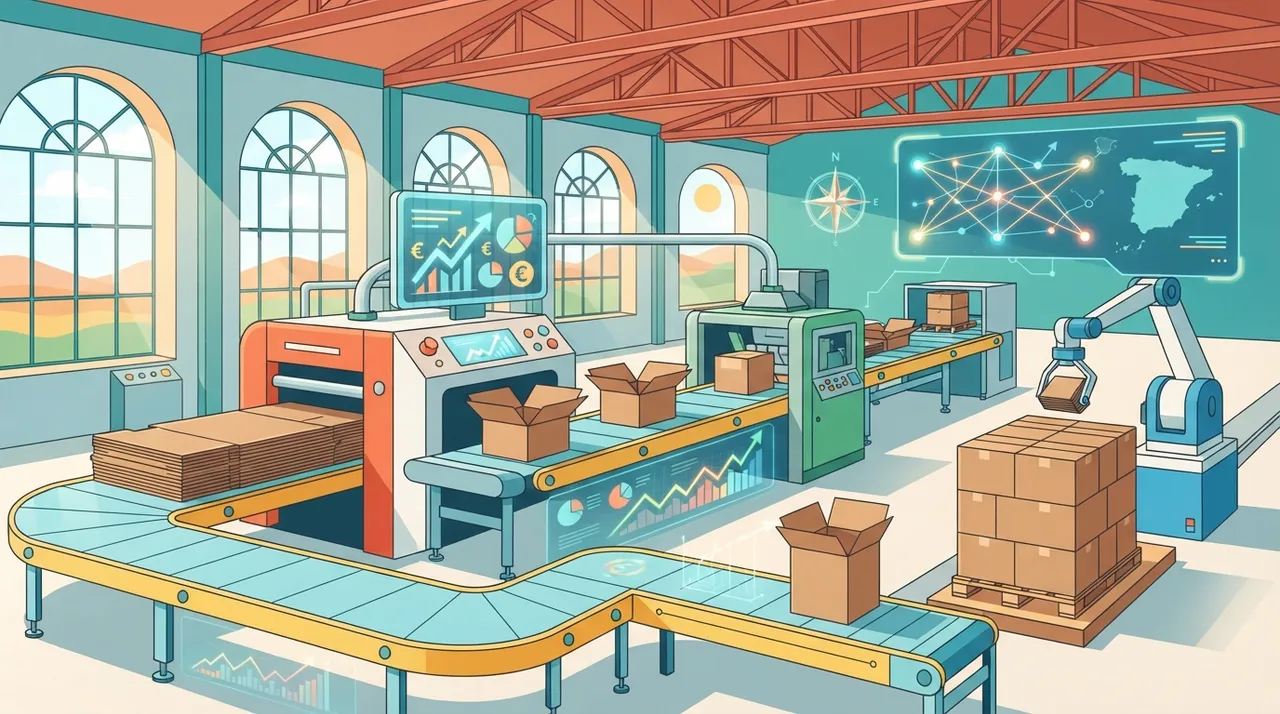
Daily operations of the factory include raw material reception, manufacturing processes involving corrugation, printing, cutting, shaping, and gluing, followed by quality inspection, packaging, and delivery. Strict quality control standards will be applied at all production stages to ensure products conform to required specifications. Labor will be trained on the latest technologies and industrial standards. Emphasis will be placed on energy and water efficiency, and sustainable solid and liquid waste management.
The project requires a suitable location in an industrial zone in Morocco, with necessary infrastructure such as electricity, water, and sewage available. The factory area is preferably between 300 and 800 square meters. Essential equipment includes an integrated production line for corrugated cardboard, including printing machines (flexo), cutting, shaping, and gluing machines. The project will rely on local and international suppliers for raw materials such as cardboard, inks, and adhesives, with priority given to recycled materials.
Projected Income Statement (5 Years)
| Item \ Year | Y1 | Y2 | Y3 | Y4 | Y5 |
|---|---|---|---|---|---|
| Revenues | 2,500,000 MAD | 2,700,000 MAD | 2,916,000 MAD | 3,149,280 MAD | 3,401,222 MAD |
| Cost of Sales | (1,625,000 MAD) | (1,755,000 MAD) | (1,895,400 MAD) | (2,047,032 MAD) | (2,210,795 MAD) |
| Gross Profit | 875,000 MAD | 945,000 MAD | 1,020,600 MAD | 1,102,248 MAD | 1,190,428 MAD |
| Operating Expenses | (500,000 MAD) | (540,000 MAD) | (583,200 MAD) | (629,856 MAD) | (680,244 MAD) |
| EBITDA | 375,000 MAD | 405,000 MAD | 437,400 MAD | 472,392 MAD | 510,183 MAD |
| Tax | (3,000 MAD) | (9,000 MAD) | (15,480 MAD) | (22,478 MAD) | (30,037 MAD) |
| Net Profit | 12,000 MAD | 36,000 MAD | 61,920 MAD | 89,914 MAD | 120,147 MAD |
| Net Margin | 1% | 1% | 2% | 3% | 4% |
Investment Cost Structure
| Item | Cost | Percentage |
|---|---|---|
| Machinery and Production Line Equipment | 810,000 MAD | 45% |
| Factory Purchase/Lease and Setup | 450,000 MAD | 25% |
| Working Capital and Initial Raw Materials | 360,000 MAD | 20% |
| Licenses and Establishment Costs | 90,000 MAD | 5% |
| Marketing and Business Development | 90,000 MAD | 5% |
Cash Flow and Break-even Point
| Year | Operating Cash Flow | Cumulative Cash Flow |
|---|---|---|
| Year 1 | 372,000 MAD | -1,428,000 MAD |
| Year 2 | 396,000 MAD | -1,032,000 MAD |
| Year 3 | 421,920 MAD | -610,080 MAD |
| Year 4 | 449,914 MAD | -160,166 MAD |
| Year 5 | 480,147 MAD | 319,980 MAD |
Estimated break-even point at annual revenue ≈ 2,457,143 MAD (~98% of Year 1 revenue), with a contribution margin of 35%. Cumulative cash break-even in Year 5.
Funding Structure
| Funding Source | Percentage | Amount |
|---|---|---|
| Equity | 70% | 1,260,000 MAD |
| Debt Financing (7% interest) | 30% | 540,000 MAD |
Sensitivity Analysis (Revenue × Operations)
Impact of simultaneous changes in revenue and costs on Net Present Value:
| Revenue \ Operations | −10% | −5% | Base | +5% | +10% |
|---|---|---|---|---|---|
| −20% | 122,182 MAD | -210,346 MAD | -560,762 MAD | -968,681 MAD | -1,384,341 MAD |
| −10% | 330,011 MAD | -44,082 MAD | -422,193 MAD | -864,766 MAD | -1,332,383 MAD |
| Base | 537,841 MAD | 122,182 MAD | -293,478 MAD | -760,851 MAD | -1,280,426 MAD |
| +10% | 745,671 MAD | 288,446 MAD | -168,780 MAD | -658,541 MAD | -1,228,468 MAD |
| +20% | 953,501 MAD | 454,709 MAD | -44,082 MAD | -560,762 MAD | -1,176,511 MAD |
Scenario Analysis
| Scenario | Probability | NPV | Assessment |
|---|---|---|---|
| Pessimistic | 25% | -719,285 MAD | Not Feasible |
| Base | 50% | -293,478 MAD | Not Feasible |
| Optimistic | 25% | 155,435 MAD | Feasible |
Expected Present Value (Weighted): -287,701 MAD.
Risk Analysis and Management
| Risk | Probability | Impact | Mitigation |
|---|---|---|---|
| Fluctuation in raw material prices (paper and cardboard) | Medium | High | Enter into long-term contracts with suppliers, diversify sourcing, and explore recycled material alternatives. |
| Intense competition from existing factories | Medium | Medium | Focus on high quality, innovative designs, competitive pricing, building strong customer relationships, and providing excellent customer service. |
| Difficulty in obtaining sufficient funding | Low | Medium | Prepare a comprehensive and convincing feasibility study for investors and banks, and leverage government support programs for industrial and innovative projects. |
| Operational challenges (equipment malfunctions, skilled labor shortage) | Medium | Medium | Regular equipment maintenance, continuous training for technical staff, and providing an attractive work environment to retain talent. |
| Regulatory and environmental changes | Low | High | Continuous monitoring of legal updates, adherence to international and local environmental standards, and investing in eco-friendly solutions. |
Organizational Structure and Team
The proposed organizational structure consists of a General Manager, Production Manager, Sales and Marketing Manager, and Financial and Administrative Manager. The team will include specialized technicians for machine operation, production workers, quality controllers, and sales representatives. Qualified Moroccan competencies will be recruited and continuously trained to ensure the highest levels of efficiency and productivity.
Legal and Regulatory Aspects
The project requires obtaining necessary licenses from the Moroccan Ministry of Industry and Trade, in addition to a commercial register and tax card. Compliance with environmental legislation related to waste management and the use of recycled materials is essential, especially with the increasing focus on sustainable packaging. Labor laws and social security regulations in Morocco must also be observed.
Expansion and Sustainability Plan
The project can be expanded by increasing production capacity through the addition of new production lines and diversifying products to include different types of carton packaging, such as specialized food packaging or reinforced cardboard for heavy products. Geographical expansion to include other cities and regions in Morocco, or even exporting to regional markets, especially given Morocco's strategic location, can be considered.
Environmental, Social, and Governance (ESG) Impact
The project is committed to environmental standards by using recycled raw materials as much as possible, reducing industrial waste, treating wastewater, and limiting carbon emissions. The factory aims to contribute to the circular economy by recycling paper and cardboard waste. The social impact will also be studied through providing decent employment opportunities and contributing to local economic development.
Conclusions and Recommendations
The carton packaging factory project in Morocco represents a promising investment opportunity due to the increasing demand for packaging, especially sustainable solutions. With good planning and a focus on quality and innovation, the project can achieve rewarding financial returns and contribute to industrial and environmental development in Morocco.
Frequently Asked Questions
What is the cost of establishing a carton packaging factory in Morocco?
The proposed initial capital is around 1,800,000 Moroccan Dirhams, which includes machinery and equipment, factory setup, working capital, and licenses.
Is the carton packaging factory project profitable in Morocco?
Yes, the project is considered profitable due to the increasing demand for carton packaging from various industrial and commercial sectors, especially with the growth of e-commerce, and is expected to achieve a good profit margin.
What licenses are required for a carton factory in Morocco?
The project requires licenses from the Ministry of Industry and Trade, a commercial register, and a tax card, in addition to adhering to environmental standards.
What is the size of the packaging market in Morocco?
The flexible packaging market in Morocco reached 2.07 billion USD in 2026 and is expected to grow continuously.
What are the main risks that the project might face?
Risks include fluctuating raw material prices, competition, difficulty in obtaining funding, operational challenges, and regulatory changes, which can be mitigated through good planning and flexibility.
Does Morocco support innovative industrial projects?
Yes, the Ministry of Industry and Trade launches programs to support industrial innovation and offers incentives that can reach up to 30% of the total investment within the framework of the new Investment Charter.
Sources and Disclaimer
- Moroccan market reports for the packaging sector
- Articles and analyses on industrial investment in Morocco
- Data on taxes and economic growth rates in Morocco
- Feasibility studies for similar projects
- Information sources on customer acquisition cost and customer lifetime value
Disclaimer: This is a guidance study providing financial analysis according to approved industry standards; verify figures locally according to your project's reality before any investment decision.