
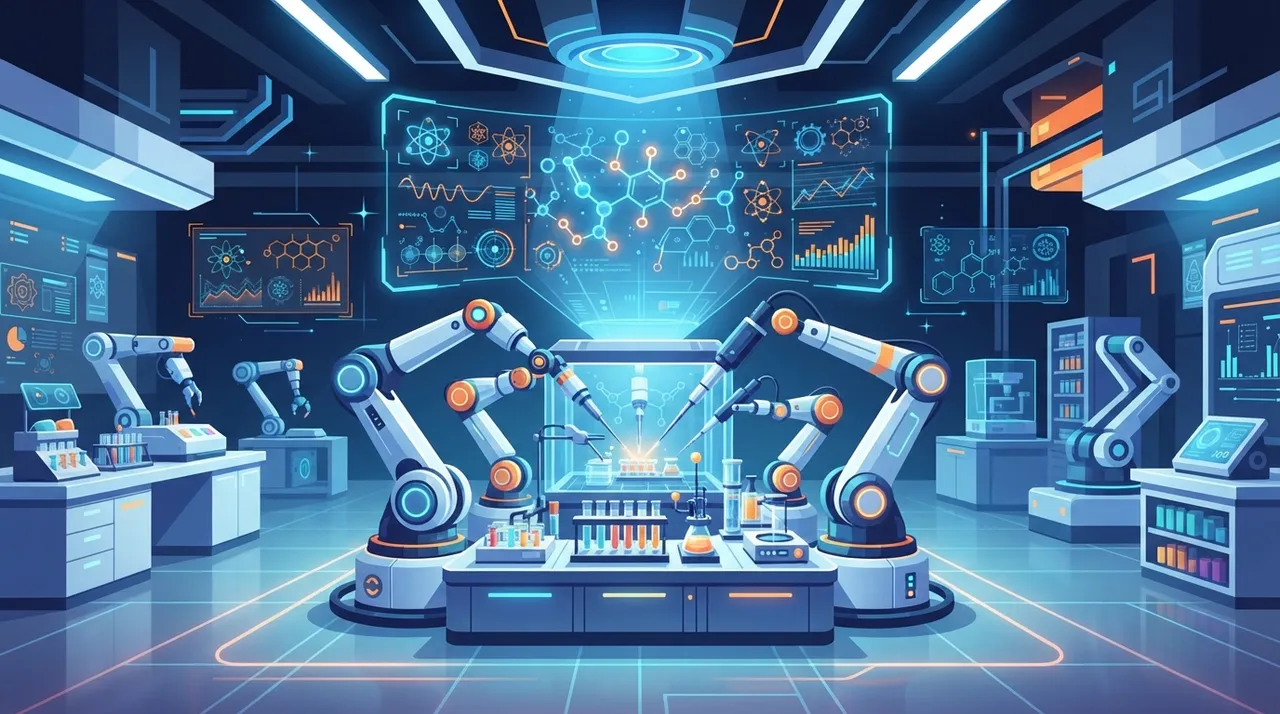
In a world of accelerating innovation, artificial intelligence (AI) is emerging as a pivotal force, especially in the realm of material discovery and design. The era of lengthy, costly trial-and-error is fading. We are now in an age where laboratories are undergoing a radical transformation thanks to the integration of AI, opening new horizons for developing high-performance materials with unprecedented properties.
What's New
2026 is witnessing significant advancements in Self-Driving Labs, also known as AI-Accelerated Materials Discovery Platforms. These platforms combine AI, robotics, and automation to create closed-loop experimental systems that can design, execute, analyze, and iteratively optimize target materials, all with minimal human intervention [2, 21, 31].
Generative AI models can now not only scan vast landscapes of known structures and combinations but also directly create novel, nature-defying molecules and reaction pathways tailored for specific applications, unlocking unprecedented possibilities in inverse design and innovation [1, 6]. For instance, Microsoft developed MatterGen, a generative AI tool that directly creates new materials based on design prompts [6]. A research team at Argonne National Laboratory successfully demonstrated an AI-driven system to automate atomistic simulations, potentially reducing new material discovery time from months or years to just days [2].
Why It Matters
These developments are crucial for several reasons:
- Accelerated Innovation: AI can compress material discovery timelines from decades to months or even weeks [4, 7, 31]. This acceleration is vital for meeting the growing demand for advanced materials in sectors like solar cells, high-capacity batteries, carbon capture technologies, and aerospace [1, 7, 14].
- Cost and Resource Savings: By predicting material properties and optimizing synthesis processes before physical experimentation, these technologies reduce the need for extensive and costly trials. Virtual prototyping can significantly cut material and energy consumption during the R&D phase [5, 19].
- Inverse Design: Instead of finding applications for existing materials, AI can start with desired material properties and work backward to design the material that achieves that goal [4, 6, 7, 15, 17]. This opens possibilities for developing custom materials for specific challenges.
- Sustainability: AI contributes to the development of more sustainable materials by optimizing material use, reducing waste, and minimizing energy consumption. It can also assist in designing eco-friendly materials to combat climate change [5, 9, 27, 29].
- Overcoming Human Limitations: AI can analyze vast amounts of data and uncover complex patterns and relationships that human researchers might miss, leading to unexpected discoveries [16, 17].
However, these technologies are not without challenges. Obstacles remain concerning the scarcity of well-curated, high-quality data in certain material domains, as well as the need to ensure the interpretability of AI models to understand the underlying physical and chemical principles behind predictions [3, 11, 12, 18, 20, 24].
How Readers Can Practically Benefit (Tools/Steps)
If you are a researcher, product developer, or interested in leveraging this trend, here are some practical steps and tools:
- Learn AI and Machine Learning Fundamentals: To understand how these systems work, start by learning basic machine learning concepts (e.g., neural networks, deep learning, generative models). Many online courses are available.
- Explore Available Platforms: Platforms like Citrine Informatics, Atinary SDLabs, and CuspAI now offer AI-powered tools for material discovery and design, with some requiring no coding or AI expertise [21, 22, 30]. These platforms enable you to run virtual experiments and optimize materials.
- Focus on Data: Data quality and quantity are crucial for successful AI in materials science [3, 12, 18, 26]. If you are involved in R&D, invest in carefully collecting, organizing, and cleaning your data.
- Consider "Inverse Design": Instead of starting with a material and trying to find a use for it, begin by defining the properties you need for your project (e.g., strength, thermal conductivity, sustainability) and let AI tools suggest materials that meet these criteria [7, 15, 17].
- Engage with Research Communities: Stay updated on the latest developments by attending conferences and workshops such as the AI for Materials Science (AIMS) workshop organized by NIST, or the Gordon Research Conference on AI for Materials, Energy, and Chemical Sciences (AIMECS) [12, 23].
- Collaborate with Experts: Given the complexity of this field, collaboration with materials scientists and AI experts can be invaluable for developing effective solutions [18].
The integration of AI into material discovery is not just an incremental improvement; it's a paradigm shift reshaping how we design our physical world. As these technologies continue to mature, industries will be revolutionized, and new materials will emerge to address pressing global challenges, from clean energy to advanced healthcare.







Comments 0
No comments yet — be the first to share your thoughts.
Share your thoughts
To comment, sign in first — we email you a one-time code (no password). This keeps the discussion clean.
Sign in to comment →