Executive Summary
The Used Cooking Oil Recycling project in the U.S. energy and environment sector targets a promising market opportunity. With an investment of $150,000, it achieves a Net Present Value (NPV) of $5,419, an Internal Rate of Return (IRR) of 9%, and a payback period of 3.9 years.
| Indicator | Value |
|---|---|
| Initial Investment | $150,000 |
| First Year Revenue | $250,000 |
| Annual Growth (CAGR) | 6% |
| Net Margin (Y1) | 2% |
| Return on Investment (Avg.) | 6% annually |
| Net Present Value (NPV) | $5,419 |
| Internal Rate of Return (IRR) | 9% |
| Profitability Index (PI) | 1 |
| Payback Period | 4 years |
| Break-even Year | Year 4 |
| Expected NPV (Probability-Weighted) | $7,122 |
Assumptions and Basis
The figures in this study are based on project data, the nature of the energy and environment sector in the United States, and local market indicators, according to the following assumptions:
| Assumption | Value |
|---|---|
| Initial Capital | $150,000 |
| First Year Revenue | $250,000 |
| Annual Growth | 6% |
| Cost of Goods Sold (COGS) | 55% of Revenue |
| Operating Expenses | 30% of Revenue |
| Tax/Zakat | 25% |
| Discount Rate (WACC) | 8% |
| Study Horizon | 5 years |
Basis of Assumptions: These figures are based on market averages for small to medium-sized used cooking oil recycling projects in the United States, taking into account price fluctuations for used cooking oil and biodiesel.
Project Description and Opportunity
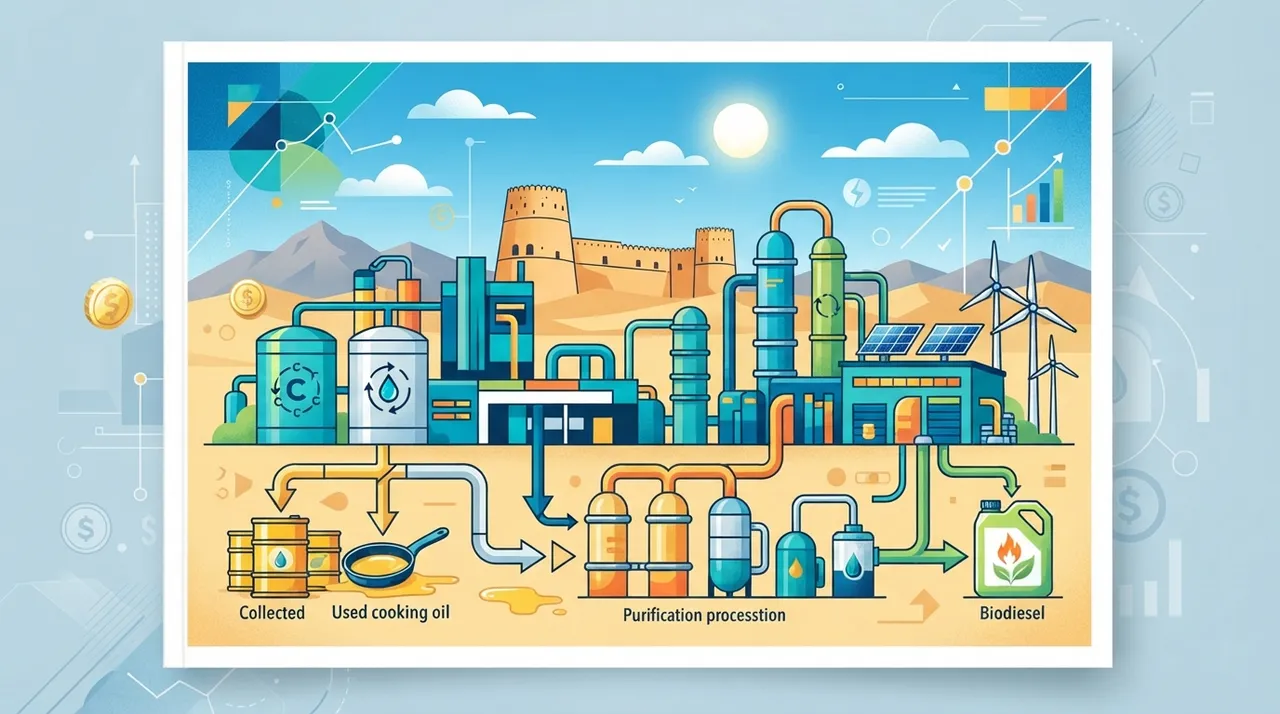
The used cooking oil recycling project in the United States aims to establish a sustainable process for collecting and processing Used Cooking Oil (UCO) from restaurants and commercial establishments. Improper disposal of used cooking oil represents a significant environmental challenge, as it can lead to water and soil pollution and clogged sewage systems. This project offers a solution to this problem by converting UCO into valuable products, contributing to the circular economy. The business model focuses on collecting oil from multiple sources, processing it to improve its quality, and then selling it to buyers in the biodiesel, animal feed, and lubricant markets. Target customers are restaurants, hotels, colleges, and catering institutions that produce significant quantities of UCO.
Market Study and Demand
The used cooking oil recycling market in the United States is experiencing strong growth, driven by increasing demand for renewable energy sources, rising environmental awareness, and regulatory support for waste management. The market size reached $2.8 billion in 2026 and is expected to grow at a Compound Annual Growth Rate (CAGR) of 6.26% during the 2026-2034 period. Biodiesel production is the largest application for used cooking oil, while animal feed is the fastest-growing sector. Strict government regulations on cooking oil disposal contribute to the increased supply of UCO. The price of UCO is influenced by soybean oil and diesel prices, with the average price restaurants receive ranging between $0.25 and $0.50 per gallon.
Market Sizing (TAM / SAM / SOM)
The market has been sized by analyzing available data on the used cooking oil recycling industry in the United States, focusing on estimating the volume of UCO produced by the food service sector. The Serviceable Obtainable Market (SOM) is realistically determined based on the project's initial operational capacity, geographic location, and restaurant density in selected areas. The methodology relies on collecting data from industry reports, analyzing market trends, and estimating a reasonable market share achievable through marketing and development efforts.
| Level | Annual Size | Description |
|---|---|---|
| TAM — Total Addressable Market | $2,800.0 million | Total serviceable demand |
| SAM — Serviceable Available Market | $1,500.0 million | The portion your model can reach |
| SOM — Serviceable Obtainable Market | $2.0 million | Your realistic early share |
Basis of Sizing: Market sizing is based on the 2026 U.S. used cooking oil recycling market size, focusing on the restaurant and food service sector as the primary source of used oil.
Unit Economics
Measures the profitability of each sales unit/customer — the most accurate feasibility indicator:
| Unit Indicator | Value |
|---|---|
| Sales Unit | Gallon |
| Avg. Price/Revenue per Unit | $0 |
| Customer Acquisition Cost (CAC) | $0 |
| Customer Lifetime Value (LTV) | $1,000 |
| LTV/CAC Ratio | 20,000x (Healthy) |
| Contribution Margin | 45% |
Competitive Analysis
There are many large and small companies in the used cooking oil recycling market in the United States, such as Darling Ingredients Inc. and Restaurant Technologies Inc. The sustainable advantage of this project lies in building strong relationships with local restaurants and food services by providing reliable and transparent service, in addition to focusing on the quality of collected oil to ensure the highest value for the final products. The project can leverage advanced processing technology to produce high-quality products, offer customized solutions to customers, and benefit from government incentives for renewable fuels.
Market Entry and Pricing Plan
The market entry plan will focus on targeting independent restaurants and small restaurant chains in urban and suburban areas. Marketing strategies will include building direct relationships with restaurant owners, offering competitive oil collection services, and highlighting the environmental and economic benefits of recycling. Marketing channels will include direct sales, participation in local trade shows, and targeted digital marketing. Pricing will be based on current market prices for UCO, with the possibility of offering additional incentives for large quantities or high-quality oil.
Operations and Energy
Planning to collect 500,000 gallons of used cooking oil annually in the first year, with a gradual increase of 10-15% annually over the first five years. Initial processing operations will begin in a small facility, with the potential for expansion to produce biodiesel on a larger scale later.
Daily operations will involve collecting used cooking oil from customers using equipped trucks and transporting it to the facility for preliminary processing. Processing will include filtration to remove impurities and solids, and water separation. Oil quality will be regularly monitored to ensure it meets the required specifications for final markets. There will be regular equipment maintenance schedules and staff training on best operational and safety practices.
Technical aspects of the project include establishing a facility for collecting, storing, and processing used cooking oil. The site will require sufficient space for oil tank storage, filtration and purification equipment, and an area for loading and unloading trucks. The project will require essential equipment such as storage tanks, pumps, filtration systems, and quality testing equipment. Suppliers (restaurants and food services) will be secured through regular collection contracts. All operations must comply with applicable environmental and health standards in the United States.
Projected Income Statement (5 Years)
| Item \ Year | Y1 | Y2 | Y3 | Y4 | Y5 |
|---|---|---|---|---|---|
| Revenue | $250,000 | $265,000 | $280,900 | $297,754 | $315,619 |
| Cost of Sales | ($137,500) | ($145,750) | ($154,495) | ($163,765) | ($173,591) |
| Gross Profit | $112,500 | $119,250 | $126,405 | $133,989 | $142,029 |
| Operating Expenses | ($75,000) | ($79,500) | ($84,270) | ($89,326) | ($94,686) |
| EBITDA | $37,500 | $39,750 | $42,135 | $44,663 | $47,343 |
| Tax | ($1,875) | ($2,438) | ($3,034) | ($3,666) | ($4,336) |
| Net Profit | $5,625 | $7,313 | $9,101 | $10,997 | $13,007 |
| Net Margin | 2% | 3% | 3% | 4% | 4% |
Investment Cost Structure
| Item | Cost | Percentage |
|---|---|---|
| Initial Equipment Costs | $60,000 | 40% |
| Vehicle Purchase and Setup | $37,500 | 25% |
| Licenses and Legal Costs | $15,000 | 10% |
| Initial Working Capital | $22,500 | 15% |
| Marketing and Business Development | $15,000 | 10% |
Cash Flow and Break-even Point
| Year | Operating Cash Flow | Cumulative Cash Flow |
|---|---|---|
| Year 1 | $35,625 | -$114,375 |
| Year 2 | $37,313 | -$77,062 |
| Year 3 | $39,101 | -$37,961 |
| Year 4 | $40,997 | $3,036 |
| Year 5 | $43,007 | $46,043 |
Estimated break-even point at annual revenue ≈ $233,333 (~93% of first-year revenue), with a contribution margin of 45%. Cumulative cash break-even in Year 4.
Funding Structure
| Funding Source | Percentage | Amount |
|---|---|---|
| Equity | 60% | $90,000 |
| Debt Financing (8% interest) | 40% | $60,000 |
Sensitivity Analysis (Revenue × Operating Costs)
The impact of changes in both revenue and costs on Net Present Value:
| Revenue \ Operating Costs | −10% | −5% | Base | +5% | +10% |
|---|---|---|---|---|---|
| −20% | $47,244 | $13,785 | -$19,675 | -$60,774 | -$105,387 |
| −10% | $68,157 | $30,514 | -$7,128 | -$49,621 | -$99,810 |
| Base | $89,069 | $47,244 | $5,420 | -$38,733 | -$94,234 |
| +10% | $109,981 | $63,974 | $17,967 | -$28,801 | -$88,657 |
| +20% | $130,894 | $80,704 | $30,514 | -$19,675 | -$83,080 |
Scenario Analysis
| Scenario | Probability | NPV | Assessment |
|---|---|---|---|
| Pessimistic | 25% | -$42,980 | Not viable |
| Base | 50% | $5,420 | Viable |
| Optimistic | 25% | $60,628 | Viable |
Expected Present Value (Weighted): $7,122.
Risk Analysis and Management
| Risk | Probability | Impact | Mitigation |
|---|---|---|---|
| Fluctuations in UCO and biodiesel prices | Medium | High | Long-term contracts with suppliers and buyers, diversification of revenue streams. |
| Competition from large, established companies | Medium | Medium | Building strong relationships with local customers, providing excellent service, and focusing on operational efficiency. |
| Logistical challenges in oil collection | Medium | Medium | Optimizing collection routes, utilizing tank monitoring technologies, and training drivers for efficiency. |
| Compliance with changing environmental regulations | Low | High | Continuous monitoring of regulations, investing in technology that exceeds requirements, and collaborating with legal and environmental consultants. |
| Contamination of collected oil | Medium | Medium | Awareness programs for suppliers on the importance of oil quality, regular quality tests during collection and reception. |
Organizational Structure and Team
The initial organizational structure will consist of an operations manager, oil collection staff, and processing technicians. The operations manager will oversee all aspects of the project, including sales, logistics, and compliance. Team members will have expertise in logistics, chemical processing, and sales or customer service, with a focus on efficiency and adherence to safety and environmental standards.
Legal and Regulatory Aspects
The project requires obtaining licenses from federal and local government agencies concerned with waste management, environmental protection, and transportation safety. Compliance with Environmental Protection Agency (EPA) regulations and local NPDES programs is essential. Some states may require special licenses for processing and storing used cooking oil. Adherence to labor and occupational safety laws is also required.
Expansion and Sustainability Plan
Future expansion plans include increasing the number of customers and geographic areas served, and exploring the possibilities of developing a facility for processing UCO into biodiesel on a larger scale, which will significantly increase the value of the final product. Sustainability can be achieved by improving operational efficiency, reducing waste, leveraging new technologies to enhance product quality, and expanding into new markets for by-products.
Environmental, Social, and Governance (ESG) Impact
The project significantly contributes to reducing environmental pollution resulting from improper disposal of used cooking oil. By converting UCO into biofuel, it reduces reliance on fossil fuels and lowers greenhouse gas emissions by up to 85%. It also reduces clogged sewer pipes and maintenance costs. Governance reflects the project's commitment to ethical, environmental, and social standards in all its operations, including transparency in dealing with suppliers and customers, fair workplace practices, and adherence to strict environmental regulations.
Conclusions and Recommendations
The used cooking oil recycling project in the United States has strong economic and environmental viability. Increasing demand for biofuels, government incentives, and growing environmental awareness create a favorable environment for success. With an efficient business model, a qualified team, and a commitment to sustainability, the project can achieve rewarding financial returns and contribute positively to environmental protection.
Frequently Asked Questions
How much does it cost to start a used cooking oil recycling business in the United States?
Initial costs for a small to medium-scale used cooking oil recycling project in the United States range from approximately $150,000 to $300,000, including equipment, vehicles, and licenses.
Is a used cooking oil recycling business profitable in the United States?
Yes, a used cooking oil recycling business is considered profitable in the United States, especially with increasing demand for biodiesel and government incentives. Return on investment can reach over 25%.
What licenses are required for used cooking oil recycling in the United States?
The project requires licenses from the Environmental Protection Agency (EPA) and local government agencies concerned with waste management and transportation safety. Requirements may vary by state.
What products can be extracted from used cooking oil?
Used cooking oil can be converted into biodiesel, sustainable aviation fuel, animal feed, lubricants, soap, and cosmetics.
How much does a gallon of used cooking oil earn in the United States?
Restaurants in most parts of the United States receive between $0.25 and $0.50 per gallon of used cooking oil.
Sources and Disclaimer
- IBISWorld and IMARC Group reports for the used cooking oil recycling market in the United States
- Average used cooking oil price data from Eazy Grease and Grease Connections
- Estimates of tax rates and discount rates for projects in the United States from Nationwide and Solar Data Atlas
- Specialized articles and feasibility studies on oil recycling projects
- Information from oil collection companies and financial analysts specializing in the energy and environment sector.
Disclaimer: This is a guiding study that provides financial analysis according to approved industry standards; verify figures locally according to your project's reality before any investment decision.