Executive Summary
The cooking oil recycling project in Oman's energy and environment sector targets a promising market opportunity. With an investment of OMR 350,000, it achieves a Net Present Value of OMR -88,632, an Internal Rate of Return of 0%, and a payback period of 5 years.
| Indicator | Value |
|---|---|
| Initial Investment | OMR 350,000 |
| Year 1 Revenue | OMR 280,000 |
| Annual Growth (CAGR) | 12% |
| Net Margin (Y1) | -5% |
| Return on Investment (Avg) | 0% Annually |
| Net Present Value (NPV) | OMR -88,632 |
| Internal Rate of Return (IRR) | 0% |
| Profitability Index (PI) | 1 |
| Payback Period | 5 years |
| Break-even Year | Year 5 |
| Expected NPV (Probability-Weighted) | OMR -87,444 |
Assumptions and Basis
The figures in this study are based on project data, the nature of Oman's energy and environment sector, and local market indicators, according to the following assumptions:
| Assumption | Value |
|---|---|
| Initial Capital | OMR 350,000 |
| Year 1 Revenue | OMR 280,000 |
| Annual Growth | 12% |
| Cost of Goods Sold (COGS) | 55% of Revenue |
| Operating Expenses | 25% of Revenue |
| Tax/Zakat | 15% |
| Discount Rate (WACC) | 10% |
| Study Horizon | 5 years |
Basis of Assumptions: Figures were estimated based on the average costs of establishing small and medium-sized recycling plants in the region and the increasing demand for biofuel in Oman, taking into account the proposed capital amount.
Project Description and Opportunity
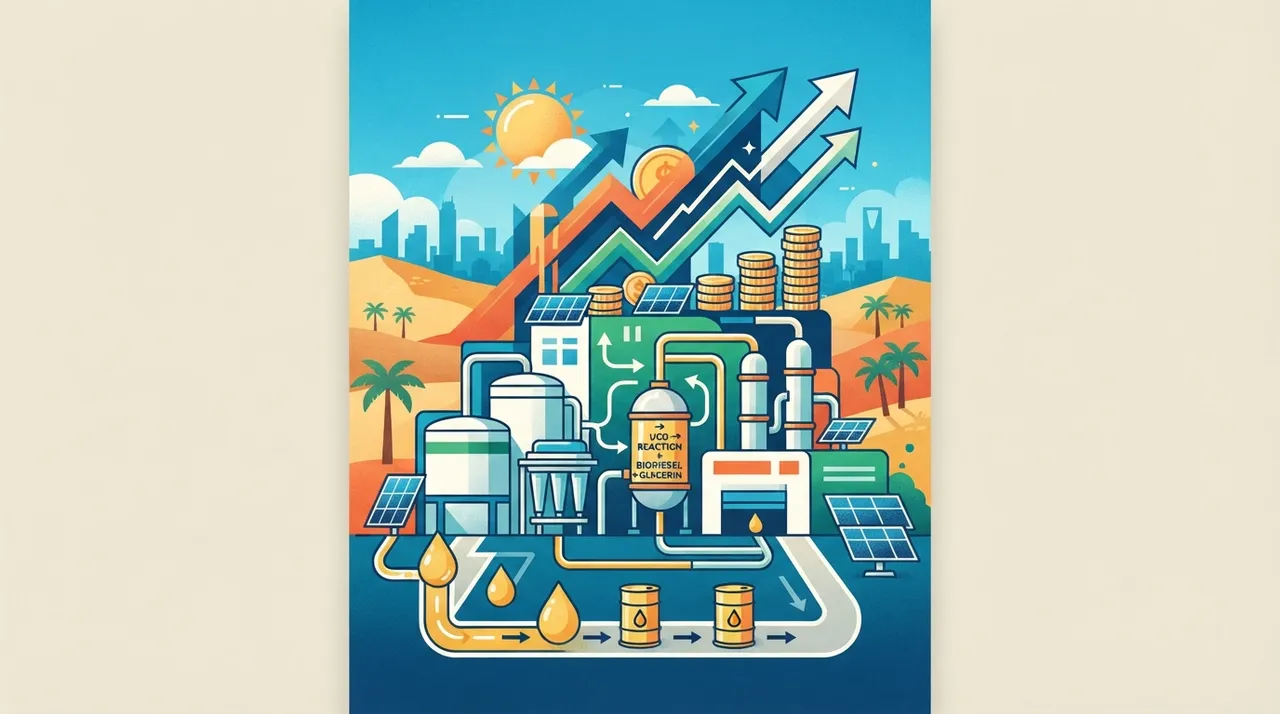
The used cooking oil recycling project in Oman aims to process these oils and convert them into biofuel (biodiesel), an environmentally friendly alternative to fossil fuels. This project aligns with Oman Vision 2040 and carbon neutrality goals by 2050, supporting the Sultanate's drive towards renewable energy and a circular economy. The business model involves collecting used cooking oil from various sources such as hotels, restaurants, and homes, then processing it to produce biofuel that can be used in trucks, generators, and ships. Target customers are industrial companies, transportation companies, and government entities seeking to reduce carbon emissions.
Market Study and Demand
The renewable energy sector in Oman is experiencing rapid growth, and the government supports the transition to clean and sustainable energy. There is no accurate database for the quantities of used cooking oil in Oman, but 90% of these oils are currently exported to foreign markets. This indicates a significant opportunity for local factories to process these oils within the Sultanate. Demand for biofuel is increasing globally and locally, especially with the growing focus on sustainability and environmental policies. Biofuel can be used as an alternative to regular diesel in operating industrial and agricultural machinery and light vehicles.
Market Sizing (TAM / SAM / SOM)
Market sizing was estimated based on the number of restaurants and hotels in Oman, their average oil consumption, and household consumption estimates. It was taken into account that a leading factory in Oman produces 600,000 liters of biofuel per month, indicating the availability of significant quantities of used oils. The initial focus will be on Muscat and major governorates with a high concentration of restaurants and hotels, then gradually expanding to other areas.
| Level | Annual Size | Description |
|---|---|---|
| TAM — Total Addressable Market | OMR 12.0 Million | Total addressable demand |
| SAM — Serviceable Available Market | OMR 6.0 Million | The portion your model can reach |
| SOM — Serviceable Obtainable Market | OMR 1.5 Million | Your realistic early share |
Basis of Sizing: Market sizing is based on estimates of used cooking oil quantities produced in Oman from restaurants, hotels, and homes, and the expected local demand for biofuel.
Unit Economics
Measures the profitability of each sales unit/customer — the most accurate feasibility indicator:
| Unit Indicator | Value |
|---|---|
| Sales Unit | Liter of Biofuel |
| Avg. Price/Revenue per Unit | OMR 0 |
| Customer Acquisition Cost (CAC) | OMR 0 |
| Customer Lifetime Value (LTV) | OMR 15 |
| LTV/CAC Ratio | 300x (Healthy) |
| Contribution Margin | 45% |
Competitive Analysis
The "Waqood" factory is the first of its kind in Oman to produce biofuel from used cooking oil. This gives the project a competitive advantage as a pioneer in this field. However, there are other companies involved in collecting and recycling used oils for industrial or commercial purposes. The project's sustainable advantage will be in the quality of the final product (biofuel), the ability to secure continuous sources of used oils, applying the latest technologies to reduce costs and increase efficiency, in addition to benefiting from government support and environmental trends. External competition poses a challenge, as a significant portion of used oils is currently exported.
Market Entry and Pricing Plan
The market entry plan involves building strong relationships with large hotels, restaurants, and catering companies to secure stable sources of used cooking oil. A smart application will be developed to facilitate oil collection from homes, similar to successful initiatives in the region. Biofuel will be marketed as an environmentally friendly and economical alternative to regular diesel, focusing on its benefits in reducing carbon emissions. Target customers can include industrial companies, transportation companies, and government entities with fleets of vehicles and equipment. Partnerships with oil companies to market the product can also be explored.
Capacity and Operations
Phase one: production capacity of 5 tons per day (approximately 5500 liters), with gradual utilization starting at 50% and increasing to 80% during the first year. Expansion plan to increase capacity to 20 tons per day in subsequent years.
Daily operations include regularly collecting used cooking oil from various sources, transporting it to the factory, and then processing it through several stages including purification from impurities and water, a chemical conversion process to produce biofuel, followed by packaging and storage. Strict quality standards must be applied to ensure the final product meets the required specifications for biofuel. This requires periodic product testing. Environmental standards must also be adhered to throughout all operational stages and in the safe disposal of any secondary waste.
The project requires a suitable location for establishing the factory, preferably in industrial areas for easy access and infrastructure availability. Technical aspects include obtaining specialized equipment for processing used oils and converting them into biofuel, such as filtration, purification, heating, and packaging units. Equipment costs vary depending on production capacity and required quality. It is possible to start with medium-capacity equipment (5-10 tons per day) to suit the proposed capital. Tanks must be provided for storing used oils and the produced biofuel. Key suppliers will be used cooking oil collectors, in addition to suppliers of chemicals and catalysts necessary for the conversion process.
Projected Income Statement (5 Years)
| Item \ Year | Y1 | Y2 | Y3 | Y4 | Y5 |
|---|---|---|---|---|---|
| Revenue | OMR 280,000 | OMR 313,600 | OMR 351,232 | OMR 393,380 | OMR 440,585 |
| Cost of Sales | (OMR 154,000) | (OMR 172,480) | (OMR 193,178) | (OMR 216,359) | (OMR 242,322) |
| Gross Profit | OMR 126,000 | OMR 141,120 | OMR 158,054 | OMR 177,021 | OMR 198,263 |
| Operating Expenses | (OMR 70,000) | (OMR 78,400) | (OMR 87,808) | (OMR 98,345) | (OMR 110,146) |
| EBITDA | OMR 56,000 | OMR 62,720 | OMR 70,246 | OMR 78,676 | OMR 88,117 |
| Tax | (OMR 0) | (OMR 0) | (OMR 37) | (OMR 1,301) | (OMR 2,718) |
| Net Profit | OMR -14,000 | OMR -7,280 | OMR 209 | OMR 7,375 | OMR 15,400 |
| Net Margin | -5% | -2% | 0% | 2% | 4% |
Investment Cost Structure
| Item | Cost | Percentage |
|---|---|---|
| Factory Machinery and Equipment | OMR 140,000 | 40% |
| Site Preparation and Infrastructure | OMR 87,500 | 25% |
| Initial Working Capital (Raw Materials, Wages) | OMR 70,000 | 20% |
| Licenses, Studies, and Establishment Expenses | OMR 35,000 | 10% |
| Collection and Transport Vehicles | OMR 17,500 | 5% |
Cash Flow and Break-even Point
| Year | Operating Cash Flow | Cumulative Cash Flow |
|---|---|---|
| Year 1 | OMR 56,000 | OMR -294,000 |
| Year 2 | OMR 62,720 | OMR -231,280 |
| Year 3 | OMR 70,209 | OMR -161,071 |
| Year 4 | OMR 77,375 | OMR -83,696 |
| Year 5 | OMR 85,400 | OMR 1,704 |
Estimated break-even point at annual revenue ≈ OMR 311,111 (~111% of Year 1 revenue), with a contribution margin of 45%. Cumulative cash break-even in Year 5.
Funding Structure
| Funding Source | Percentage | Amount |
|---|---|---|
| Equity | 60% | OMR 210,000 |
| Debt Financing (6% Interest) | 40% | OMR 140,000 |
Sensitivity Analysis (Revenue × Operations)
Impact of combined changes in revenue and costs on Net Present Value:
| Revenue \ Operations | −10% | −5% | Base | +5% | +10% |
|---|---|---|---|---|---|
| −20% | OMR -41,328 | OMR -88,633 | OMR -138,869 | OMR -191,617 | OMR -244,411 |
| −10% | OMR -7,289 | OMR -58,729 | OMR -113,375 | OMR -171,819 | OMR -231,213 |
| Base | OMR 26,367 | OMR -29,727 | OMR -88,633 | OMR -152,021 | OMR -218,014 |
| +10% | OMR 60,023 | OMR -1,680 | OMR -64,654 | OMR -132,475 | OMR -204,816 |
| +20% | OMR 93,680 | OMR 26,367 | OMR -41,328 | OMR -113,375 | OMR -191,617 |
Scenario Analysis
| Scenario | Probability | NPV | Assessment |
|---|---|---|---|
| Pessimistic | 25% | OMR -165,220 | Not feasible |
| Base | 50% | OMR -88,633 | Not feasible |
| Optimistic | 25% | OMR -7,289 | Not feasible |
Expected Present Value (Weighted): OMR -87,444.
Risk Analysis and Management
| Risk | Probability | Impact | Mitigation |
|---|---|---|---|
| Fluctuating prices of used oil purchases | Medium | High | Signing long-term contracts with key suppliers, diversifying collection sources. |
| Difficulty in securing sufficient quantities of used oil | Medium | High | Developing a smart application for collecting oil from homes, expanding the collection scope to include large hotels, restaurants, and catering companies. |
| Competition from imported products or large local companies | Medium | Medium | Focusing on product quality, competitive pricing, building a strong brand, and exploring new distribution channels. |
| Technical challenges in the conversion process | Low | Medium | Hiring an experienced technical team, investing in modern processing technologies, and conducting regular equipment maintenance. |
| Changes in government policies or environmental regulations | Low | High | Monitoring legislative updates, participating in industry dialogues, and complying with the highest environmental standards. |
Organizational Structure and Team
The proposed organizational structure consists of a General Manager for the project, specialized staff for oil collection (drivers and laborers), a technical team for factory operation and maintenance, and an administrative team for sales, marketing, and financial affairs. The technical team should include engineers or technicians with experience in oil processing and chemical production. It is possible to start with a small team and expand as needed.
Legal and Regulatory Aspects
The project requires obtaining necessary licenses from the Ministry of Commerce, Industry and Investment Promotion, the Environment Authority, and the Municipality. The company must be registered and obtain commercial and tax registrations. It must also comply with environmental and health standards issued by the competent authorities in Oman. It may also require obtaining approvals from the Civil Defense regarding safety and security requirements in the factory.
Expansion and Sustainability Plan
The project can be expanded by increasing the factory's production capacity by adding more processing lines, or by opening other oil collection branches in different governorates of the Sultanate. The scope of products can also be expanded to include other derivatives from used cooking oil (such as organic fertilizers or chemicals). Strategic partnerships with major oil producers and consumers contribute to achieving sustainable growth.
Environmental, Social, and Governance (ESG) Impact
The project contributes positively to environmental protection by recycling used cooking oil that could cause pollution if disposed of improperly. Biofuel production reduces carbon emissions by up to 93% compared to regular diesel, supporting Oman's net-zero targets. The project also promotes a circular economy and optimal resource utilization. Socially, the project contributes to creating job opportunities and raising awareness about the importance of recycling. The governance aspect involves adherence to Environmental, Social, and Governance (ESG) standards in all operations.
Conclusions and Recommendations
The used cooking oil recycling project in Oman is a promising investment opportunity with economic, environmental, and social feasibility. While there are some challenges such as external competition and the availability of an accurate database for used oils, government support for the renewable energy sector and increasing demand for sustainable products provide a conducive environment for success. The recommendation is to proceed with the project, focusing on product quality, expanding the collection network, and strategic partnerships.
Frequently Asked Questions
What is the cost of establishing a cooking oil recycling project in Oman?
The proposed initial capital for the project is approximately OMR 350,000, with the possibility of starting with smaller phases.
Is the cooking oil recycling project profitable in Oman?
Yes, the project is profitable with an expected annual revenue growth of 12%, a contribution margin of 45%, in addition to government support for the environmental and renewable energy sector.
What are the licenses required for a cooking oil recycling project in Oman?
The project requires licenses from the Ministry of Commerce, Industry and Investment Promotion, the Environment Authority, and the Municipality, in addition to commercial and tax registration and Civil Defense approvals.
What are the main products of the cooking oil recycling project?
The main product is biofuel (biodiesel), which can be used as an alternative to regular diesel in trucks, generators, and ships. Other secondary products can also be explored.
Who are the target customers for the produced biofuel?
Target customers are industrial companies, transportation and logistics companies, and government entities seeking to reduce their carbon footprint, in addition to the shipping and power generation sectors.
Sources and Disclaimer
- Oman Newspaper
- Oman News Agency
- Oman Tax Authority
- Specialized feasibility study websites
- Regional recycling companies
Disclaimer: This is a guiding study that provides financial analysis according to approved sector standards; verify the figures locally according to your project's reality before any investment decision.