
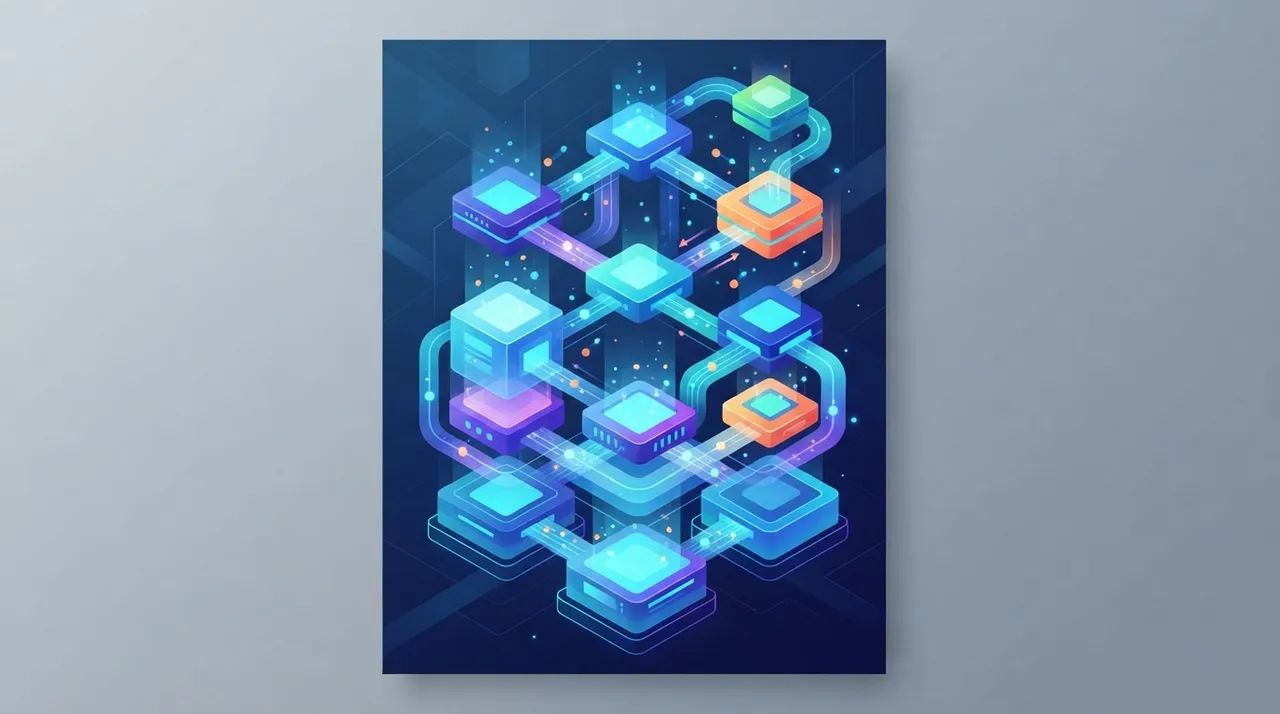
As blockchain adoption continues to expand across decentralized finance and enterprise applications, developers face persistent challenges with network congestion and high transaction costs on base layer blockchains. In light of these challenges, Rollup-as-a-Service (RaaS) emerges as a revolutionary solution, simplifying the creation and deployment of application-specific blockchains, and thus shaping a more efficient and flexible future for Web3.
What's New
Rollup-as-a-Service (RaaS) refers to deployment platforms and SDKs that allow developers to launch custom application-specific blockchains (sometimes referred to as 'app-chains'). RaaS abstracts away complex infrastructure, enabling rapid creation of scalable Layer 2 and Layer 3 networks. Similar to the Software-as-a-Service (SaaS) model in traditional cloud computing, RaaS provides ready-to-use frameworks, managed infrastructure, and intuitive interfaces to launch Layer 2 or Layer 3 networks without needing to engineer the underlying architecture. Historically, deploying a custom rollup required manual configuration of complex components, deep technical expertise, significant capital, and extensive time commitments. RaaS removes these burdens, allowing teams to focus entirely on building their applications rather than managing backend infrastructure, thus accelerating the shift toward a highly scalable, modular Web3 space.
Among the prominent RaaS providers in 2026 are companies like AltLayer, Caldera, Conduit, Gelato, and Ankr RaaS. These platforms offer end-to-end solutions ranging from customizations in the underlying tech stack to no-code management and one-click custom integrations with core infrastructure.
Why It Matters
RaaS is crucial because it addresses the scalability issues that have long plagued monolithic blockchains like Ethereum, which suffer from slow transaction speeds, high gas fees, and congestion. By enabling applications to have their own dedicated blockspace, RaaS ensures consistent performance and predictable transaction costs, even during periods of high network activity. This opens the door for new use cases that were previously not economically viable due to high fees.
RaaS lowers the technical and financial barriers to deploying custom networks. Instead of spending months building a chain or paying millions of dollars to a team of developers, app builders can use RaaS providers to deploy rollups in minutes, and for as little as $50 per month on a testnet. This low cost and ease of deployment make RaaS particularly attractive for startups and small to medium-sized enterprises looking to explore Web3 applications without a massive upfront capital investment.
For example, applications built on Optimism's OP Stack chains generated over half a billion dollars in revenue in the first half of 2026, underscoring the economic viability of these scalable solutions. RaaS also contributes to driving innovation towards a modular blockchain environment, where each component can be updated independently without affecting the entire network, providing flexibility and adaptability for developers.
How You Can Practically Benefit
To practically benefit from Rollups-as-a-Service, interested readers can follow these steps and use these tools:
- Understand Your Needs: Clearly define the problems you are trying to solve with your decentralized application. Do you need faster transactions, lower fees, or dedicated blockspace? This will help you choose the appropriate rollup type (e.g., Optimistic Rollups or ZK-Rollups) and RaaS provider.
- Select a RaaS Provider: Evaluate different RaaS providers based on your requirements. Each provider offers a different set of features, supported frameworks (e.g., OP Stack, Arbitrum Orbit, Polygon CDK, ZK Stack), and data availability options (e.g., Celestia, EigenDA). Prominent providers include:
- AltLayer: Supports both Optimistic and ZK rollup frameworks, focusing on versatility for deploying ephemeral or persistent rollups.
- Caldera: Specializes in high-performance, customizable Layer 2 and Layer 3 blockchains, with a focus on gaming and DeFi.
- Conduit: Targets production-grade OP Stack deployments with strong DevOps tooling, making it easy to launch mainnet networks.
- Gelato: Emphasizes developer experience and seamless integration with essential Web3 services.
- Ankr RaaS: Provides a platform for developers to deploy and manage their own custom rollups.
- Utilize Low-Code/No-Code Platforms: Many RaaS providers offer user-friendly dashboard interfaces or low-code/no-code tools for deploying rollups. This reduces the need for deep technical expertise, allowing smaller teams and traditional enterprises to explore Web3 applications.
- Integrate Monitoring and Analytics Tools: RaaS providers offer tools for monitoring rollup chain performance, tracking gas fees, and analyzing user behavior. Use these tools to optimize your application's performance.
- Leverage Customization and Flexibility: RaaS allows you to customize your rollup to meet your application's specific needs, including support for custom smart contracts, transaction types, and security features. It also enables integration with Chainlink oracles to connect rollups to off-chain data.
By embracing RaaS, developers and businesses can unlock immense potential in the cryptocurrency space, building faster, more efficient, and cost-effective decentralized applications, thus driving innovation in the Web3 ecosystem.


Comments 0
No comments yet — be the first to share your thoughts.
Share your thoughts
To comment, sign in first — we email you a one-time code (no password). This keeps the discussion clean.
Sign in to comment →