
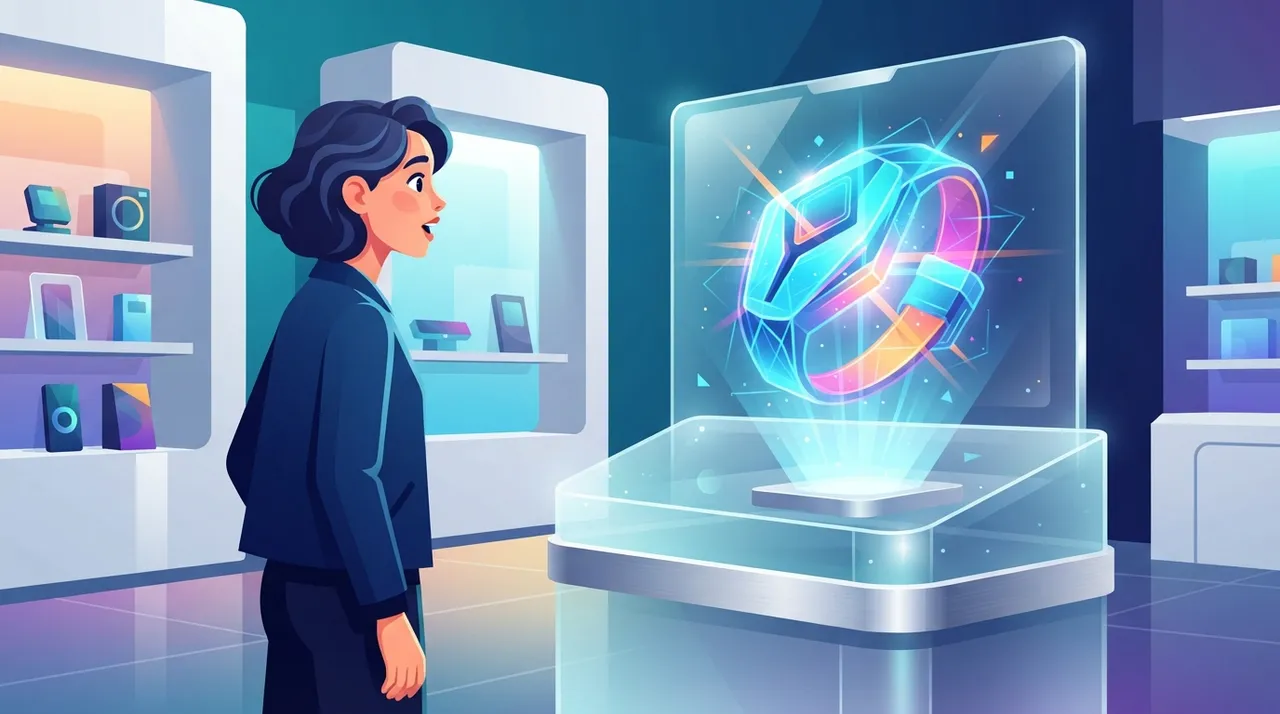
For too long, 3D content has been hampered by the need for special glasses, limiting its adoption and making it seem like a temporary visual gimmick. But imagine a world where you can see three-dimensional objects emerge from or recede into the screen, with crystal clarity and realism, without any barriers between you and the scene. This world is not a distant future; it's here now, thanks to monumental advancements in glasses-free 3D displays, powered by artificial intelligence.
What's New
The year 2026 has witnessed a qualitative leap in glasses-free (autostereoscopic) 3D display technologies. Unlike traditional 3D screens that require glasses to deliver distinct images to each eye, these displays rely on advanced techniques such as lenticular lens arrays or light field displays with real-time eye tracking to direct different images to each eye, creating a perception of depth without the need for any accessories.
Leading companies like Samsung have announced the launch of revolutionary generations of spatial signage displays for businesses, such as the 85-inch 4K UHD QHB-P model, which offers viewers an ultra-realistic 3D content experience with a depth of up to 1.1 meters. Samsung is also developing technology that enables seamless switching between high-resolution 2D images and realistic 3D images at the click of a button.
Furthermore, consumer-oriented displays such as the Samsung Odyssey 3D (G90XF), Acer SpatialLabs View Pro 27, Owl3D Shift, and CubeVi P1 are now commercially available. These displays combine eye tracking, light field technologies, and real-time AI-powered 2D-to-3D conversion to deliver an immersive experience.
AI technologies can now automatically convert static images and 2D videos into professional 3D content, with intelligent processing of shadows and backgrounds to enhance visual depth realism. There are also developments in AI-powered 3D modeling tools, making content creation for these displays easier.
Why It Matters
The significance of these displays lies in their ability to redefine visual interaction. 3D content is no longer confined to cinemas or isolated VR experiences but is becoming directly and engagingly accessible in our daily lives. Here are some aspects that make this development highly important:
- Enhanced Attention Grab: In an era saturated with screens and advertisements, glasses-free 3D displays have a unique ability to capture attention. Objects appear to emerge from the screen, creating a stunning visual effect that attracts passersby and increases their engagement with the content.
- Commercial and Industrial Applications: These displays are ideal for outdoor advertising, product showcases in luxury stores, exhibitions, and museums. Businesses can use them to display 3D product models, allowing customers to view product details from all angles as if they were real, enhancing purchasing decisions.
- Education and Training: In educational settings, they can be used to display complex models in medicine, engineering, and design, providing a more interactive and clearer learning experience. Students and professionals can interact with virtual models and simulations in safe environments.
- Home and Entertainment Uses: While the initial focus was on commercial applications, these displays are beginning to make their way into laptops and desktop monitors. Gamers and designers can benefit from enhanced visual depth in games and spatial design workflows, offering a more immersive experience.
- Ease of Content Creation: The integration of AI in 2D-to-3D content conversion and the availability of AI-powered 3D modeling tools make content creation for these displays easier and more widespread, opening the door for further innovation.
Real-World Examples:
- Samsung Spatial Signage: At ISE 2026, Samsung unveiled Spatial Signage displays that show 3D objects seemingly floating in mid-air, captivating visitors.
- Owl3D Shift Displays: These 4K desktop monitors offer a glasses-free 3D experience with unique features like real-time 2D-to-3D conversion.
- MUXWAVE Transparent Displays: These displays are revolutionizing store window displays and exhibitions, seamlessly blending high-definition advertisements with real products to create eye-catching visuals while maintaining window transparency.
- Glasses-Free 3D Displays in China: Glasses-free 3D LED screens are becoming prevalent in Chinese city streets, showcasing stunning and realistic visual effects that attract crowds and become new city landmarks.
How to Benefit Practically
To leverage this development, whether you are a tech enthusiast or a company seeking innovation, here are some practical tools and steps:
- For Individual Users:
- Purchase Specialized Displays: If you are a gamer or 3D designer, consider purchasing monitors like the Samsung Odyssey 3D, Acer SpatialLabs View Pro 27, or Owl3D Shift. These screens provide excellent depth perception for single-user scenarios where head movement is limited and content is optimized.
- Follow Developments: Stay up-to-date with new releases from manufacturers, as the coming years are expected to bring more integration and improvements in these technologies.
- For Businesses and Developers:
- Invest in Spatial Signage: If your business relies on advertising or interactive displays (e.g., retail stores, museums, exhibitions), investing in Spatial Signage can give you a significant competitive edge.
- Utilize AI Content Conversion Tools: To take advantage of current and future displays, companies can use AI applications like Samsung's AI Studio to convert 2D images and videos into 3D content.
- Develop 3D Content: Invest in developing custom 3D content for glasses-free displays. 3D design software like 3D Max or AI-powered 3D modeling tools can be used. Content should be specifically designed to account for viewing angles and depth to deliver the best effect.
- Collaborate with Experts: Engage with companies specializing in 3D LED display design and installation to ensure optimal results.
- Design for Interaction: When creating content, focus on designing interactive experiences that allow viewers to explore and engage with 3D objects, enhancing the appeal of presentations.
Glasses-free 3D displays are not just a new technology; they are a promising visual revolution that will change how we interact with digital content in multiple aspects of our daily and commercial lives. As AI and display technologies continue to evolve, the future holds even more stunning visual experiences that transcend the limitations of flat screens.



Comments 0
No comments yet — be the first to share your thoughts.
Share your thoughts
To comment, sign in first — we email you a one-time code (no password). This keeps the discussion clean.
Sign in to comment →