
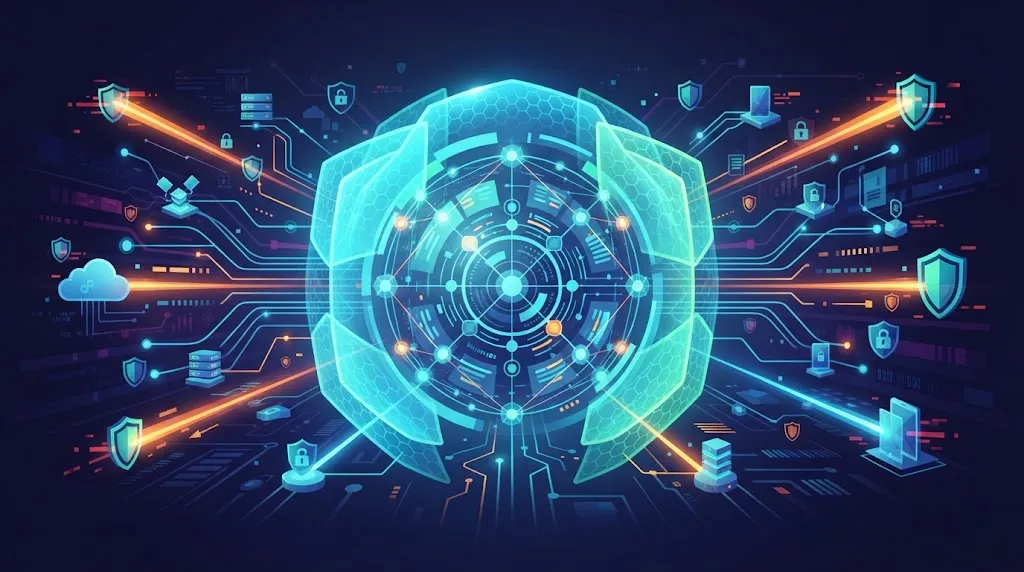
With the increasing complexity and expansion of today's digital environments to include multi-cloud, remote work, and IoT devices, traditional perimeter-based security models are becoming increasingly ineffective. Relying on a single firewall to protect all assets is no longer viable, as access points and data are spread across a vast network. This is where Cybersecurity Mesh Architecture (CSMA) emerges as a new and essential paradigm to address modern cybersecurity challenges.
What's New
Gartner defines Cybersecurity Mesh Architecture (CSMA) as a composable and scalable approach to extending security controls, even to widely distributed assets. Its flexibility is especially suitable for increasingly modular approaches consistent with hybrid multi-cloud architectures. CSMA focuses on the interoperability and coordination between individual security products, resulting in a more integrated security policy. Instead of every security tool running in a silo, a cybersecurity mesh enables tools to interoperate through several supportive layers, such as consolidated policy management, security intelligence, and identity fabric.
In 2026, Cybersecurity Mesh Architecture has reached 31% enterprise adoption, up from just 8% in 2024, as organizations shift from traditional perimeter-based security to distributed, identity-centric protection. This transformation is driven by the collapse of the network perimeter; remote work, multi-cloud deployments, and IoT proliferation have rendered 'castle-and-moat' security obsolete. Reports indicate that 73% of security mesh adopters report a reduced attack surface, 79% see improved visibility across distributed environments, and 61% achieve better compliance with regulations like GDPR, HIPAA, and SOC 2.
Why it Matters
The importance of Cybersecurity Mesh Architecture lies in its ability to provide robust and flexible protection in a fragmented and complex digital world. With the growing number of devices, access points, and cloud services, relying on a single, centralized security approach is no longer feasible. CSMA enables organizations to distribute security controls around individual identities and devices, ensuring that each access point is independently verified and secured, while still working together as part of a cohesive framework.
CSMA is an ideal solution for hybrid and multi-cloud environments, remote work, and IoT-heavy infrastructures. It aligns closely with the principles of 'Zero Trust,' which emphasizes continuous authentication and authorization for all access requests. By incorporating microsegmentation, CSMA enhances cloud security and provides granular control over network access. It also allows organizations to incrementally integrate existing tools through open standards and Application Programming Interfaces (APIs).
CSMA helps security teams automate incident response by connecting various security tools (such as SIEM, EDR/XDR, and firewalls) into repeatable workflows. Security Orchestration, Automation, and Response (SOAR) platforms contribute to reducing alert fatigue and standardizing responses.
How to Practically Benefit
To practically benefit from Cybersecurity Mesh Architecture, readers can follow these steps:
- Assess Current Architecture: Start by evaluating the vulnerabilities in your current security system and identifying distributed assets that require enhanced protection. Consult experts to assess your CSMA and Zero Trust maturity.
- Adopt Zero Trust Principles: Zero Trust is the cornerstone of CSMA. Focus on continuous verification, least privilege access, and microsegmentation to reduce the attack surface.
- Utilize SOAR Tools: Leverage Security Orchestration, Automation, and Response (SOAR) platforms to connect different security tools and automate repetitive tasks. Many options are available in 2026, such as Palo Alto Networks Cortex XSOAR and Splunk SOAR.
- Integrate Threat Intelligence Platforms: Use Threat Intelligence Platforms (TIP) to collect and analyze data on cyber threats and identify Indicators of Compromise (IoCs). Examples include Recorded Future and CrowdStrike Falcon X Intelligence.
- Leverage Python for Automation: Python has become the primary automation language for security mesh. Security teams can use it to orchestrate policy deployment, aggregate threat intelligence, and automate incident response.
- Rely on Integrated Cloud Solutions: Many modern cloud solutions, such as Microsoft's Azure Sentinel and Defender for Cloud, support cybersecurity mesh architectures, enabling unified policy enforcement across on-premises and multi-cloud environments.
By adopting these steps, organizations and individuals can significantly strengthen their cybersecurity defenses, transitioning from a static security model to a dynamic and adaptive one, providing better protection against evolving threats in 2026 and beyond.



Comments 0
No comments yet — be the first to share your thoughts.
Share your thoughts
To comment, sign in first — we email you a one-time code (no password). This keeps the discussion clean.
Sign in to comment →