
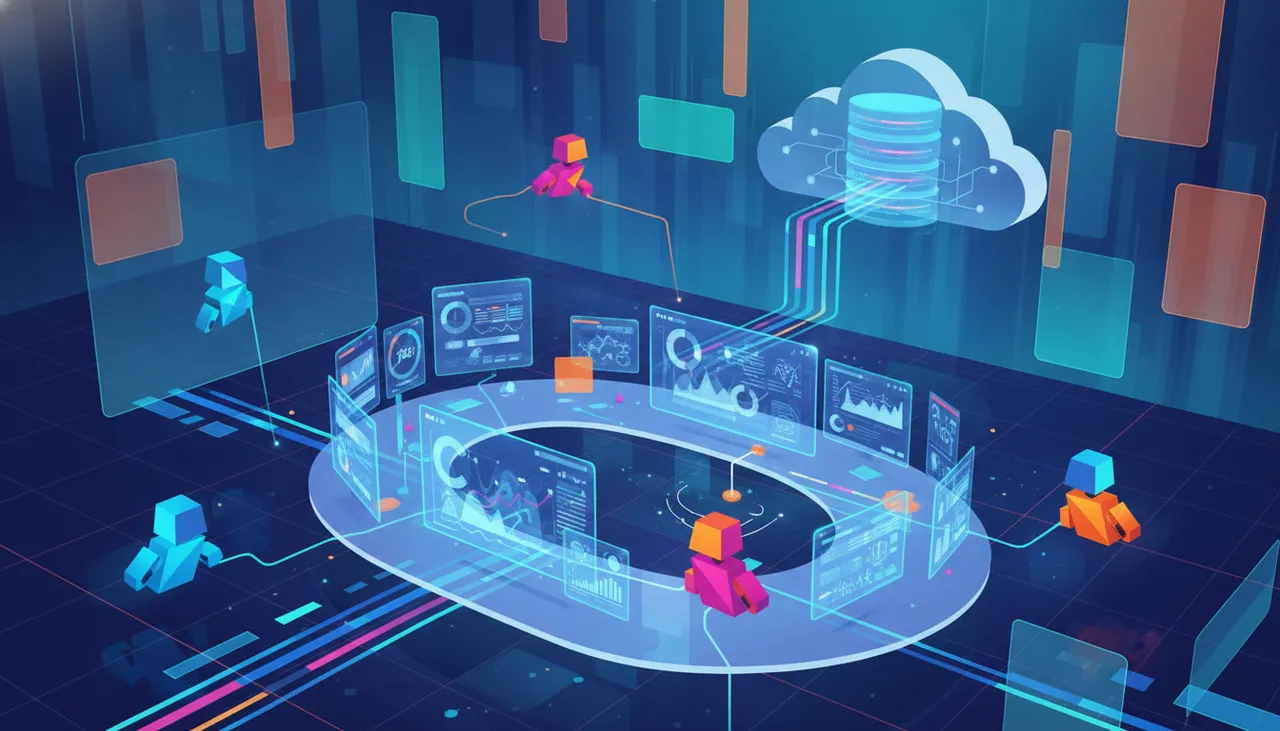
Artificial intelligence has moved beyond simple assistive tools to become an active participant in core daily operations. While previous years focused on exploring the potential of generative AI in content creation and query answering, 2026 marks a radical shift towards what is known as "Agentic AI." These systems, characterized by their ability to plan, make decisions, and execute complex tasks autonomously, are reshaping the concept of work and productivity.
What's New
The most significant shift in AI currently is the transition from generative models, which focus on producing content based on prompts, to Agentic AI systems capable of planning tasks, using tools, calling APIs, and executing multi-step workflows autonomously under specific constraints. By 2028, Gartner predicts that 33% of enterprise software applications will include agentic AI, up from less than 1% in 2024.
Agentic AI is no longer an experimental concept but an integral part of work environments. Instead of merely drafting an email or summarizing a document, these systems can manage support tickets, assist with procurement decisions, automate financial reporting, and co-author production-grade code. Cisco refers to this trend as "Connected Intelligence," a new model of collaboration that connects people to people, people to AI, and increasingly, AI to AI.
On a personal level, AI-powered personal assistants in 2026 are moving beyond simple command-based responses. Instead of basic chatbots like Siri or ChatGPT, personal AI agents are crossing into real, autonomous action. They don't wait for commands; they plan, decide, act, and learn from the user. Examples of currently available personal agents include Pokee AI, which features over 90 native integrations and can take real action within work applications. Lindy also excels at handling daily work tasks across communication, scheduling, and meetings, while delivering a smooth user experience.
On the organizational front, despite significant investments in AI, 79% of organizations face challenges in adopting AI, a double-digit increase from 2025. This is attributed to AI capabilities advancing faster than organizational capabilities, making AI a leadership challenge rather than just a technological one. Key challenges include data quality, governance, justifying costs, skills gaps, and workflow integration. Therefore, long-term AI success depends on how well AI integrates into business processes and day-to-day operations.
Why It Matters
This shift to agentic AI is crucial because it fundamentally changes how we work and interact with technology. Instead of AI being merely a productivity assistant, it becomes a workflow participant, redesigning how organizations design software, how teams collaborate, and how value is measured.
Companies that effectively adopt these systems achieve significant productivity gains. In 2026, roles and workflows are expected to be redesigned around AI capabilities. A PwC study indicates that companies most exposed to AI are increasing wages and headcount faster than less exposed companies, as they use AI to amplify human performance and create new forms of value.
However, this development also brings fundamental challenges, most notably the urgent need for robust AI governance. With agentic systems capable of making decisions, coordinating tasks, and interacting with sensitive data with minimal human oversight, new operational risks emerge that many organizations may be unprepared to manage. Deloitte emphasizes that trust, safety, and misuse resistance have become core product requirements. Therefore, AI governance in 2026 is no longer optional but essential for sustainable digital transformation.
Furthermore, the regulatory gap is widening; while AI capabilities evolve rapidly, many organizations still lack the operational foundations needed to scale AI effectively. This includes fragmented data, incomplete governance, talent gaps, system complexity, and skepticism of autonomous systems.
How to Practically Benefit
To leverage this trend, readers can take practical steps and utilize specific tools:
1. Understand and Experiment with Personal AI Agents:
- **Explore Tools:** Start by exploring personal AI agent tools like Pokee AI for tasks requiring multiple integrations with work applications, or Lindy for organizing daily tasks and communications. ChatGPT can provide an excellent conversational experience, while Perplexity is excellent for research with citations.
- **Define Goals:** Think about repetitive or complex tasks in your personal or professional life that are time-consuming, such as organizing your schedule, managing emails, or even planning a trip. Give the agent a clear goal and observe how it plans and executes.
2. Develop Agentic AI Literacy Skills:
- **Focus on Human Skills:** As AI takes over routine tasks, human skills such as empathy, judgment, creativity, and leadership become more valuable. Invest in developing these skills that AI cannot replicate.
- **Understand Limitations:** Learn when it is appropriate to use AI and when human intervention is necessary, especially in decisions requiring ethical judgment or a nuanced understanding of social context.
3. AI Governance and Compliance Awareness:
- **For Organizations:** Organizations must establish robust AI governance frameworks, including defining responsibilities at the leadership level, clear AI usage policies, risk assessment procedures, compliance monitoring systems, and ethical review processes. This includes continuous training for employees on responsible AI use.
- **For Individuals:** Be aware of the growing AI regulations at regional and international levels. In the United States, there are state-level laws like the Colorado AI Act and California's amendments to the California Consumer Privacy Act (CCPA) regulating automated decision-making technologies. In the European Union, the AI Act has entered into force in phases, with obligations for high-risk AI systems applying by August 2026.
The transition to agentic AI presents an immense opportunity to increase productivity and streamline operations, but it also requires a strategic approach that combines innovation with responsibility. By adopting the right tools, developing relevant skills, and implementing robust governance frameworks, individuals and organizations can maximize the benefits of this revolutionary development.





Comments 0
No comments yet — be the first to share your thoughts.
Share your thoughts
To comment, sign in first — we email you a one-time code (no password). This keeps the discussion clean.
Sign in to comment →