
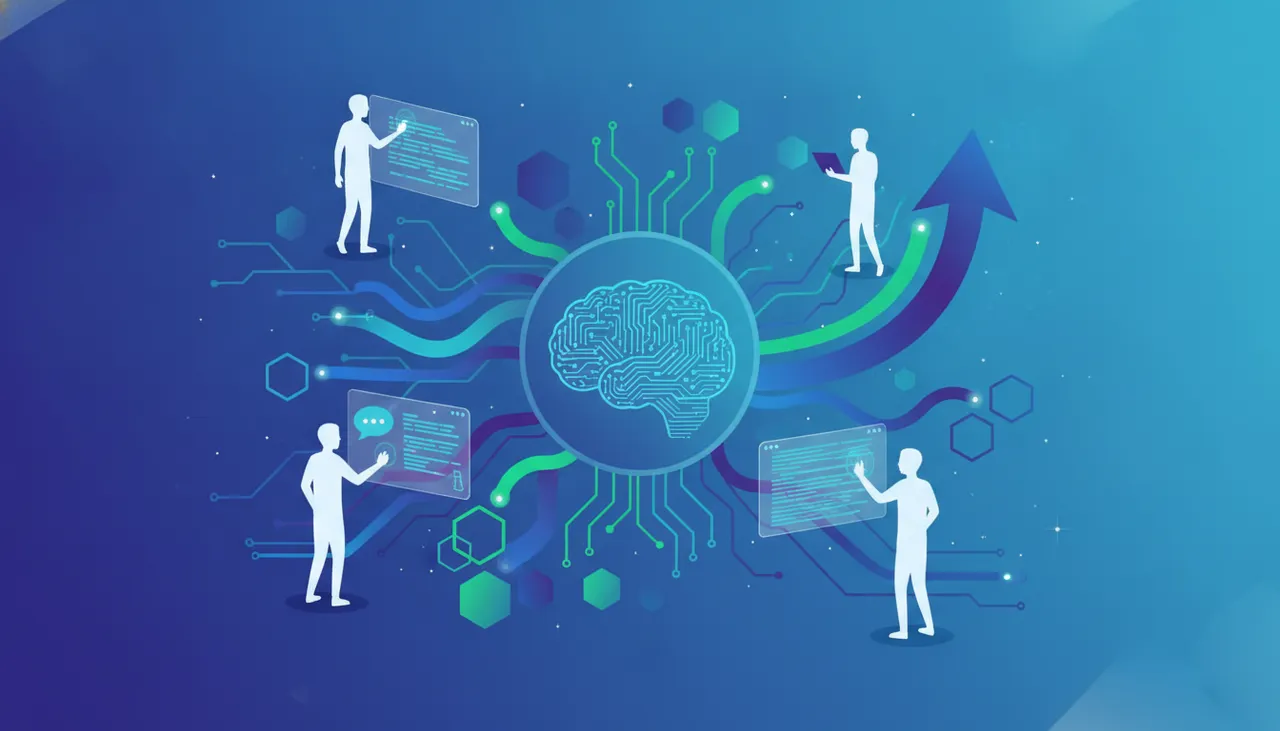
AI is no longer just an auxiliary tool, but a fundamental driver of business transformation, moving from mere experimentation to an integral part of enterprise infrastructure. 2026, in particular, is witnessing a significant shift towards integrating generative AI into daily operations, especially in data analysis and decision-making, promising to revolutionize productivity and innovation.
What's New
In 2026, generative AI goes beyond being just a content creation technology; it represents an intelligent automation layer that integrates with existing systems to connect workflows, extract insights from complex data, and automate decisions without disrupting existing operations. The focus is no longer on standalone tools, but on integrated systems where models, data pipelines, analytics platforms, and operational systems work together seamlessly.
These technologies enable analysts and business users to interact with data through conversational interfaces, receive auto-generated reports, and explore hypothetical scenarios with ease. This places generative AI at the heart of the modern enterprise intelligence stack, removing friction and dramatically reducing the time from raw data to decision. For example, users can ask questions in plain language to get automated SQL queries, visualizations, and insights from large datasets.
Why It Matters
The proliferation of generative AI in data analysis is crucial for several reasons:
- Increased Productivity and Efficiency: Analysts typically spend 50-70% of their time on data preparation. Generative AI automates tasks such as building ETL pipelines, query writing, and data cleaning, cutting preparation time by half. This allows teams to focus on high-impact projects instead of repetitive tasks.
- Accelerated Decision-Making: Analysis cycles that once took days can now be completed in minutes. Generative AI enables enterprises to sense, reason, and act continuously, reducing blind spots and accelerating response times. This leads to faster, more confident decisions across the organization.
- Democratization of Data Access: By enabling non-technical users to query databases in plain language, generative AI removes technical barriers to data exploration. This fosters a more data-driven culture across the entire organization.
- Innovation and Product Development: Generative AI assists in generating new ideas, prototyping designs, and optimizing product features, reducing time-to-market. For instance, it can be used to create high-fidelity synthetic data for training models where real data is unavailable or sensitive, opening new frontiers in fields like healthcare and finance.
- Improved Customer Experience: Generative AI can create personalized marketing campaigns, customize product recommendations, and enhance customer support through intelligent conversational agents.
Real-world Examples:
- Financial Services: Large banks use AI to review and interpret contracts and filings, compressing work that once took hundreds of thousands of staff hours. It's also used for real-time fraud detection and personalized services.
- Retail: Personalization engines determine which products to display for each shopper, improving conversion rates and reducing returns.
- Healthcare: Generative AI models are revolutionizing medical diagnostics, record management, and drug discovery by analyzing vast datasets.
- Software Development: Generative AI writes SQL queries, Python scripts, and transformation logic from natural language, reducing development time by 40-60%.
How Readers Can Practically Benefit (Tools/Steps):
To leverage generative AI in data analysis, readers can follow these steps and utilize available tools:
- Understand the Basics: Start by understanding how generative AI works, specifically Large Language Models (LLMs) and multimodal models that can process various types of data (text, images, audio, video).
- Define Business Objectives: Before choosing any tool, clearly define the business goals you aim to achieve. Are you looking to reduce data preparation time, accelerate decision-making, or improve customer experience?
- Prepare Your Data: Generative AI heavily relies on data quality. Ensure your data is organized, clean, and reliable. Investing in good data governance is crucial for the success of generative AI applications.
- Explore Tools: Several tools can help integrate generative AI into data analysis:
- ChatGPT (from OpenAI) and Gemini (from Google): These can be used as a daily 'second analyst' to assist in data exploration, suggest analysis methods, generate code snippets, and summarize insights.
- Microsoft Copilot for Power BI and ThoughtSpot: These tools allow users to ask questions about their data in natural language, automatically generating visualizations and reports, speeding up exploratory analysis.
- DataRobot: For organizations looking to operationalize machine learning at scale, platforms like DataRobot help in building predictive models, deploying them to production, and monitoring performance.
- Integrated Generative AI Platforms: Look for platforms that offer integrated capabilities for automating ETL pipelines, query generation, and report generation.
- Focus on Prompt Engineering: As output quality depends on prompt quality, mastering the art of crafting effective prompts for generative models will unlock greater value from these tools.
- Human-AI Collaboration: The goal is not to replace analysts, but to empower them. Future data analysts will focus less on coding and data preparation, and more on asking better questions, designing experiments, interpreting patterns, and communicating insights.
Generative AI represents a critical turning point in 2026, moving from a promising technology to an essential infrastructure supporting data-driven decision-making. With the right tools and strategies, any organization can harness this revolution to enhance efficiency, accelerate innovation, and gain a competitive edge in the ever-evolving digital landscape.







Comments 0
No comments yet — be the first to share your thoughts.
Share your thoughts
To comment, sign in first — we email you a one-time code (no password). This keeps the discussion clean.
Sign in to comment →