
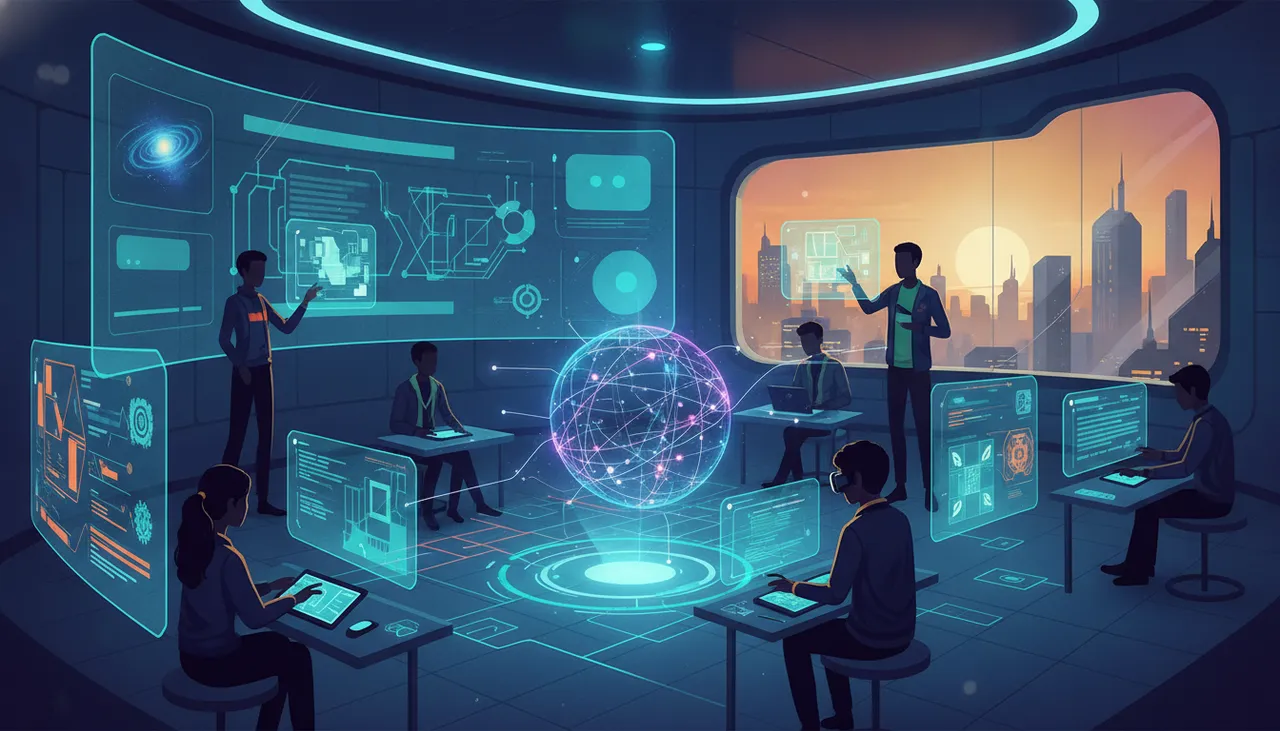
The discussion about integrating AI into education is no longer a futuristic vision; it's a tangible reality that's revolutionizing how knowledge is acquired. 2026 marks a qualitative shift in this field, where AI is no longer just an auxiliary tool but has become the fundamental operating system for learning. This development aims not to replace educators but to empower them with powerful tools to deliver more effective, engaging, and inclusive learning experiences.
What's New
The most significant development in AI in education for 2026 is the widespread emergence of Hyper-Personalized Learning and Adaptive Learning Systems. These systems go beyond simply adjusting content difficulty to include customizing learning pace, delivery methods, and even the emotional tone of feedback, leading to a 42% improvement in learning outcomes. By 2026, 71% of higher education institutions are expected to deploy adaptive learning platforms.
These platforms rely on AI's knowledge tracing capabilities to estimate learner mastery of concepts in real-time, adapting learning paths based on performance, interests, and pace. Neurodiversity-aware systems are also emerging, adapting to learners with ADHD, dyslexia, and autism spectrum, achieving 63% better outcomes.
Furthermore, Generative AI has become a key driver for real-time educational content creation. Projections indicate that 89% of new courses will utilize AI-assisted content creation by 2026. AI can generate lesson plans, assessments, educational materials, and even immersive learning environments, reducing the average content development time per course module from 120 hours to just 8 hours.
Why It Matters
The importance of this development lies in its ability to address chronic educational challenges and unlock previously impossible potentials:
- Improved Learning Outcomes: By providing tailor-made learning experiences, AI can bridge knowledge gaps and offer the individualized support each student needs. 80% of students globally reported that AI positively supported their learning experience, with 70% believing AI will improve exam performance and the overall quality of higher education.
- Time Savings for Educators: AI automates administrative tasks such as grading, lesson planning, and report generation, saving teachers up to 5.9 hours per week, equivalent to six full weeks per academic year. This time can be redirected towards direct student interaction, critical thinking, and fostering curiosity.
- Enhanced Access and Equity: AI can provide personalized education regardless of a student's geographical location or socioeconomic background, helping to bridge the gap between different learner groups and promote equity and inclusivity.
- Continuous Learning and Skill Development: In a world where skill requirements are rapidly changing, adaptive learning platforms support continuous skill development, helping individuals adapt to the evolving job market.
However, a 2026 OECD report highlights that generative AI can support learning when guided by clear teaching principles. But when designed or used without pedagogical support, outsourcing tasks to AI will only enhance performance without leading to real learning gains. Concerns also exist about students' over-reliance on these tools and the potential decline in critical thinking skills, emphasizing the importance of intentional pedagogical design and appropriate training for both teachers and students.
How to Practically Benefit (Tools/Steps)
To maximize the benefits of this development, readers can adopt practical tools and strategies:
- Explore Adaptive Learning Platforms: Look for platforms like SchoolAI for custom AI tutoring spaces with real-time teacher monitoring, Diffit for creating differentiated, reading-level leveled materials from any text, and MagicSchool which offers 80+ teacher tools including personalization features. Other prominent platforms include D2L Brightspace, Docebo, Absorb LMS, and CYPHER Learning, which integrate AI to personalize learning paths and automate administrative tasks.
- Utilize Generative AI Tools for Content Creation: Educators and trainers can use tools like OpenAI's ChatGPT Edu or Google Gemini to generate lesson plans, quizzes, assignments, and educational materials, saving significant time.
- Embrace Virtual Tutors (AI Tutors): Intelligent tutoring systems provide personalized guidance, feedback, and practice recommendations outside regular classroom hours, enhancing comprehension and filling knowledge gaps.
- Leverage Learning Analytics: Many platforms offer detailed analytics of learner behavior and performance, helping to identify strengths and weaknesses and provide targeted interventions.
- Focus on Training and Professional Development: Both educators and students should receive appropriate training on how to use AI tools effectively and responsibly to ensure maximum benefit and avoid potential challenges.
In conclusion, AI in education represents a tremendous opportunity to reshape the educational landscape towards a more personalized, effective, and equitable future. By embracing new innovations wisely and focusing on pedagogical principles, we can harness the power of AI to empower both educators and students, creating life-enriching learning experiences that prepare future generations for the challenges of an ever-changing world.



Comments 0
No comments yet — be the first to share your thoughts.
Share your thoughts
To comment, sign in first — we email you a one-time code (no password). This keeps the discussion clean.
Sign in to comment →