
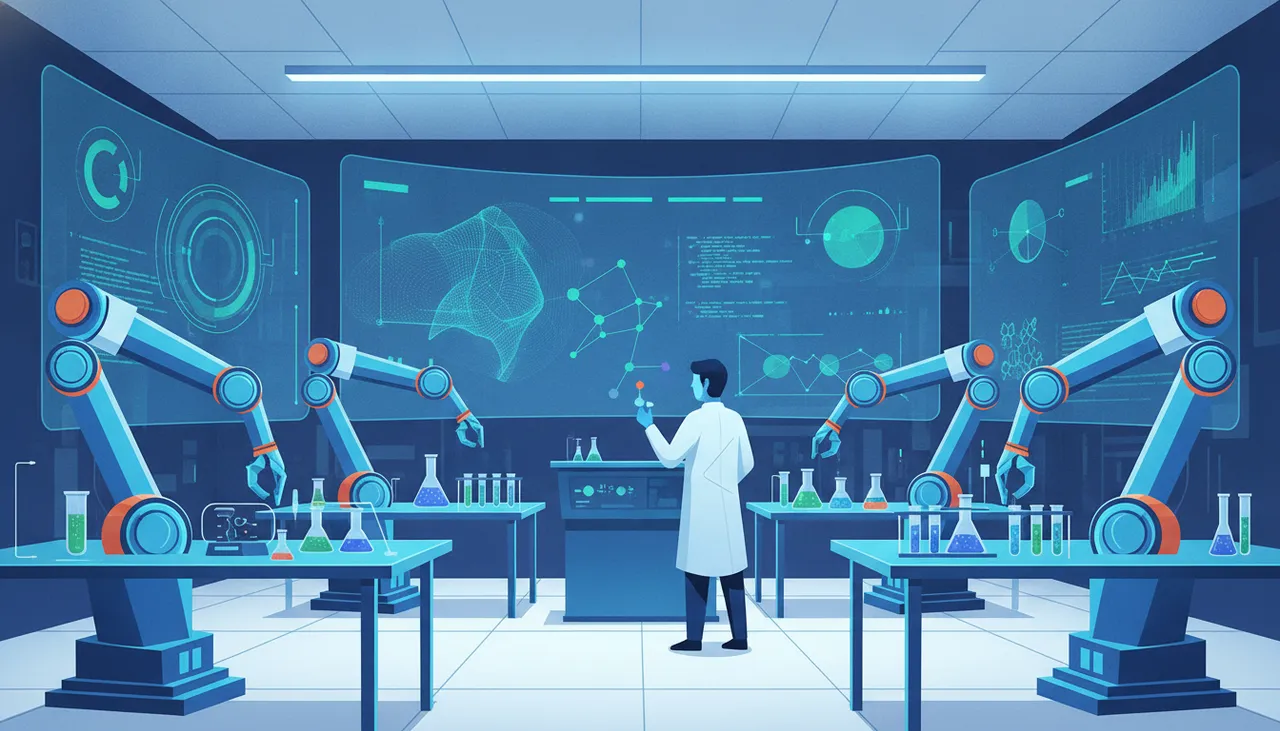
Scientific research has always been the cornerstone of human progress, yet its pace is often slow and resource-intensive. With the increasing volume of data and the complexity of challenges, scientists are seeking innovative solutions to accelerate the discovery process. This is where artificial intelligence comes in, no longer just an auxiliary technology but a fundamental engine of innovation, pushing the boundaries of human knowledge to new horizons.
What's New
In 2026, AI is undergoing a qualitative shift in its role within scientific research. It's no longer limited to analyzing large datasets or automating repetitive tasks; AI is now capable of generating hypotheses, designing experiments, analyzing results, and even proposing new research avenues almost autonomously. [3, 7]
Autonomous laboratories, combining AI and robotics, are establishing themselves as a new paradigm for scientific research. [9, 15] These labs are capable of executing full cycles of the scientific method, from hypothesis generation and experimental design to execution, data analysis, and conclusion drawing, with minimal human intervention. [25] This integration creates a closed and continuous research loop, significantly reducing the effort and time required for discovery. [9, 10]
In drug discovery, AI has become an integral part of the entire process, from identifying biological targets to analyzing clinical data and making development decisions. [1, 10] Reports anticipate that 2026 will see a shift in the adoption of digital twins from pilot experiments to practical implementation in clinical drug development. [1] AI-designed drugs, such as Insilico Medicine's drug for idiopathic pulmonary fibrosis, have led to significant breakthroughs, completing Phase IIa trials with a discovery cost of approximately $6 million and in 18 months, compared to $100-200 million and 6-8 years using traditional methods. [6]
In materials science, AI is compressing material discovery timelines from decades to months, enabling researchers to computationally screen millions of candidate structures before a single gram of material is synthesized in the lab. [4, 12] Graph neural networks are used to model material properties, Bayesian optimization to tune synthesis conditions, and generative models to design new materials with targeted properties. [4]
AI is also revolutionizing climate modeling, where hybrid models integrating AI and physics-based simulations are replacing computationally expensive numerical simulations with much faster alternatives. [3, 36] For instance, the Samudra model can predict ocean states 1,000 times faster than traditional models. [3] A recent study published in npj Climate and Atmospheric Science proposes a new approach combining AI with probabilistic modeling to improve seasonal forecasts. [40]
Why It Matters
The significance of this transformation lies in AI's ability to overcome human limitations in processing and analyzing complex and massive datasets. [5, 28] As the volume of scientific knowledge grows exponentially, it becomes challenging for individual scientists to grasp the full picture. [19] Here, AI acts as a force multiplier for intellectual power, handling complex tasks and allowing researchers to focus on formulating the most impactful questions and developing theories. [19]
Accelerating scientific discoveries has profound economic and social implications. In pharmaceuticals, it means developing new treatments for diseases faster and at lower costs, improving the quality of life for millions. [6, 17] In materials science, it opens the door to innovating new materials with enhanced properties for energy, computing, and national security applications. [11] In climate modeling, more accurate and flexible predictions can support better decision-making for climate change mitigation and adaptation. [22, 47]
Furthermore, the use of AI enhances research accuracy and reduces human error, ensuring more reliable and robust findings. [5] It also enables scientists to explore broader research spaces and test multiple hypotheses in parallel, increasing the chances of unexpected discoveries. [8] This is clearly demonstrated in AI models' unprecedented ability to accurately predict protein structures, a challenge that remained unsolved for decades. [23, 38]
Conclusion
2026 marks a crucial turning point in the relationship between artificial intelligence and scientific research. With the increasing integration of AI at the core of the discovery process, we expect to witness unprecedented leaps in our understanding of the world and our ability to solve some of humanity's greatest challenges. Leveraging this technology requires researchers and scientists to adopt new tools and develop their skills to work collaboratively with AI systems, which will undoubtedly open new horizons for a future fueled by accelerated innovation.






Comments 0
No comments yet — be the first to share your thoughts.
Share your thoughts
To comment, sign in first — we email you a one-time code (no password). This keeps the discussion clean.
Sign in to comment →