
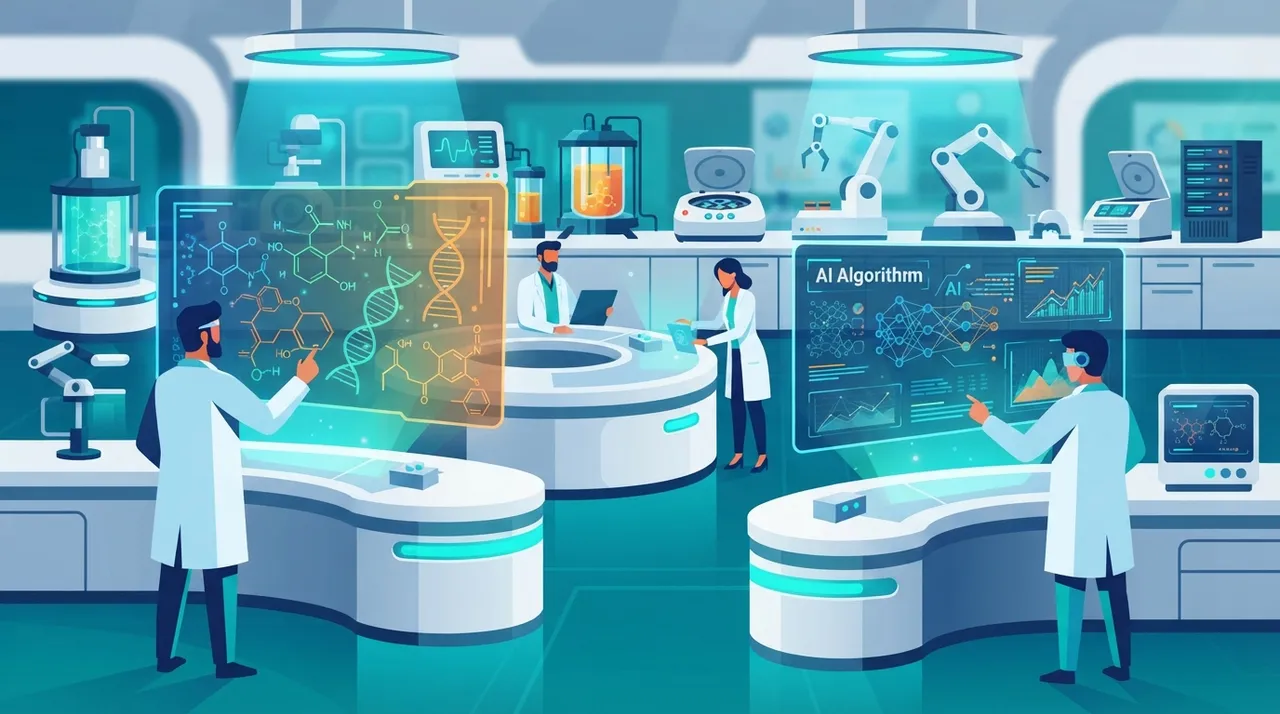
The journey of discovering a new drug has long been a complex, lengthy, and expensive process, typically taking 10 to 15 years and costing billions of dollars. However, with the significant advancements in artificial intelligence (AI), we are now witnessing a fundamental transformation that is reshaping this industry from its core, promising a faster, more accurate, and efficient path to developing life-saving treatments.
What's New
In 2026, AI is no longer merely an assistive tool in drug discovery; it has become an integral part of the entire process, from identifying therapeutic targets to molecular design and even clinical development decisions. The industry is shifting from isolated digital tools to fully integrated, AI-native discovery systems. This means that digital models and laboratory experiments now exist in a continuous, closed-loop discovery cycle.
One of the most significant advancements is the use of machine learning models to identify disease targets in weeks instead of years. Instead of reviewing published evidence and developing biological hypotheses through repeated laboratory experiments, early target selection is now expected to rely far more on computational analysis of large biological datasets, particularly in genomics. For instance, Insilico Medicine's PandaOmics platform discovered a novel target for idiopathic pulmonary fibrosis (TNIK kinase) that traditional methods had missed.
Generative AI models also play a crucial role in designing new molecules from scratch, optimizing them for the therapeutic target. For example, Insilico Medicine's Chemistry42 generated the lead compound for their IPF drug in 21 days, compared to 2-4 years with traditional methods. These models are capable of predicting protein structures and interactions, and even designing new proteins with targeted structures with unprecedented precision. DeepMind's AlphaFold achieved a breakthrough in this area, solving a problem that had resisted biology for fifty years by predicting the three-dimensional shape a protein folds into from its amino acid sequence.
Furthermore, AI is increasingly being used in later stages of drug development, particularly through digital twins, which are expected to move from pilot to practice in clinical development in 2026. AI contributes to improving diagnostic accuracy, earlier disease prediction, workflow automation, and personalized treatment planning through real-time data analysis.
Why It Matters
The core significance of this trend lies in its ability to accelerate the delivery of new drugs to patients, while simultaneously reducing the exorbitant costs associated with traditional discovery processes. While the traditional process takes 10-12 years, AI improvements in the early stages contribute to faster cycles and fewer dead ends, leading to a significant long-term return on investment. Half of those adopting AI in biotech already report faster time-to-target, and 42% see an uplift in accuracy and hit rates with scientific models.
For instance, Insilico Medicine's AI-designed drug for idiopathic pulmonary fibrosis completed Phase IIa trials in approximately 18 months at an estimated cost of $6 million, whereas the traditional path to the same milestone costs $100-200 million and takes 6-8 years. This inversion in cost and time has real implications for the entire pharmaceutical industry.
AI also enhances personalized medicine by analyzing a patient's genetic data, medical history, lifestyle factors, and continuous health metrics to generate tailored treatment plans. This reduces reliance on trial-and-error approaches and makes treatment more precise. It also lessens the administrative burden on clinicians, allowing them to focus more on patient care and empathy.
Moreover, AI tools help overcome the challenges associated with the massive scale of biological data currently being generated, particularly in genomics, where AI assists in interpreting complex data to better understand biology.
For the reader, understanding this trend means recognizing that the future of healthcare is moving towards more personalized and effective treatments, and that the drug development process will be faster and more efficient. Those interested in this field can benefit from continuously emerging tools and platforms that streamline this process.
How to Practically Benefit (Tools/Steps)
To benefit from this development, readers, whether researchers, investors, or those interested in public health, can follow these steps:
- Stay updated on specialized platforms: New companies and platforms are emerging that offer AI-based tools for protein design and drug discovery. For example, OpenProtein.AI provides a no-code platform that allows scientists to access powerful foundational models and a suite of tools for designing proteins and predicting their structure and function. Biohub has also released an open-source AI system to support protein design in drug discovery.
- Continuous learning: The field of AI in healthcare is evolving rapidly. It is advisable to follow reports and studies from research bodies and leading companies, such as the Benchling 2026 Biotech AI Report, which highlights the shift towards AI-native drug discovery systems.
- Invest in data infrastructure: For research institutions and companies, investing in robust data infrastructure is crucial. Focus on collecting high-quality, well-structured data to train AI models effectively.
- Expert collaboration: This field requires deep integration between AI experts, biologists, and medical professionals. AI does not replace human expertise; rather, it augments it.
- Monitor regulatory developments: With the increasing use of AI in drug development, regulatory bodies such as the U.S. Food and Drug Administration (FDA) and the European Medicines Agency (EMA) are focusing on establishing strict standards for transparency and trustworthiness.
The integration of AI into drug discovery is not just a technological advancement; it is a paradigm shift that redefines the boundaries of what is possible in healthcare, promising a future where intractable diseases can be treated faster and more efficiently.





Comments 0
No comments yet — be the first to share your thoughts.
Share your thoughts
To comment, sign in first — we email you a one-time code (no password). This keeps the discussion clean.
Sign in to comment →