Executive Summary
The physical therapy center project in the medical and health sector in Jordan targets a promising market opportunity. With an investment of 120,000 JOD, it achieves a Net Present Value (NPV) of -61,016 JOD, an Internal Rate of Return (IRR) of -13%, and a payback period of — years.
| Indicator | Value |
|---|---|
| Initial Investment | 120,000 JOD |
| Year 1 Revenue | 80,000 JOD |
| Annual Growth (CAGR) | 12% |
| Net Margin (Y1) | -15% |
| Return on Investment (Avg.) | -7% annually |
| Net Present Value (NPV) | -61,016 JOD |
| Internal Rate of Return (IRR) | -13% |
| Profitability Index (PI) | 0 |
| Payback Period | — |
| Breakeven Year | — |
| Expected NPV (Probability-Weighted) | -58,888 JOD |
Assumptions and Basis
The figures in this study are based on project data, the nature of the medical and health sector in Jordan, and local market indicators, according to the following assumptions:
| Assumption | Value |
|---|---|
| Initial Capital | 120,000 JOD |
| Year 1 Revenue | 80,000 JOD |
| Annual Growth | 12% |
| Cost of Goods Sold (COGS) | 25% of Revenue |
| Operating Expenses | 60% of Revenue |
| Tax/Zakat | 10% |
| Discount Rate (WACC) | 9% |
| Study Horizon | 5 years |
Basis of Assumptions: Figures are based on average operating costs and expected revenues for medium-sized physical therapy centers in Jordan, taking into account sector growth and continuous demand.
Project Description and Opportunity
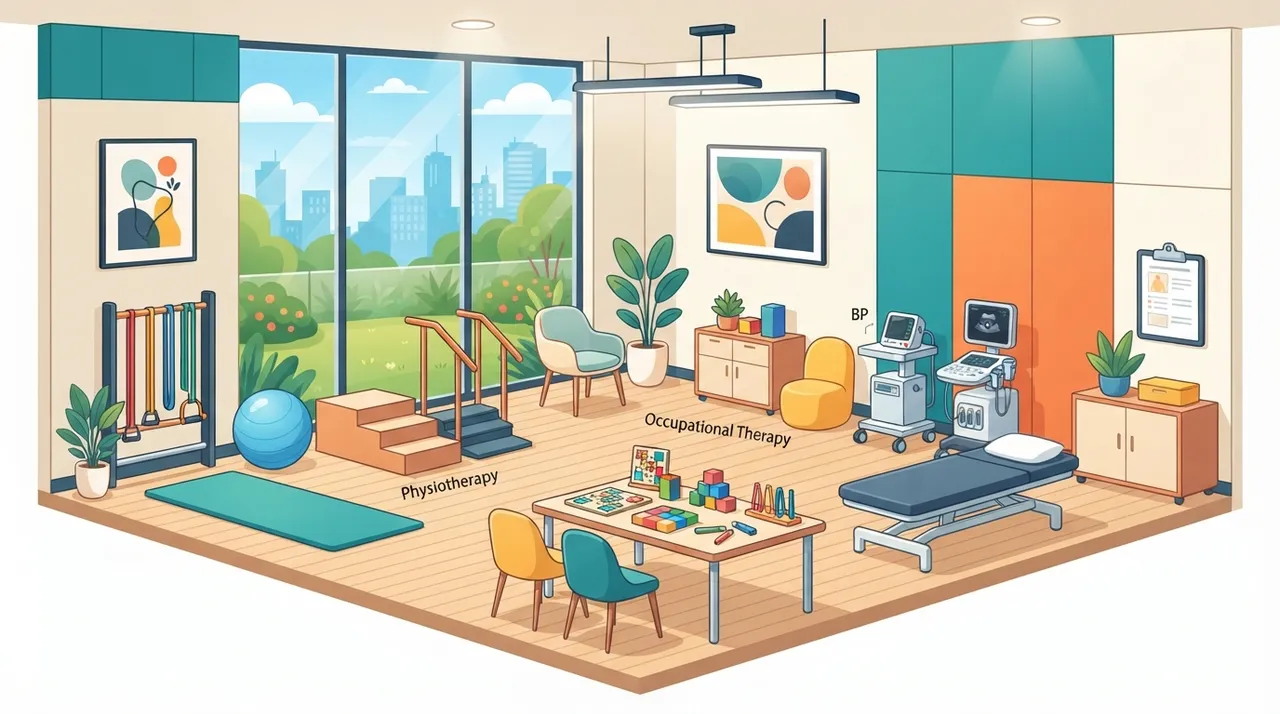
The physical therapy center project in Jordan aims to provide high-quality physical therapy and motor rehabilitation services for various age groups and health conditions. The project is based on the increasing demand for these services in the Kingdom, driven by increased health awareness, a growing elderly population, a rise in sports injuries, and the need for rehabilitation after surgeries and chronic injuries. The business model focuses on providing individualized and integrated treatment programs, utilizing the latest equipment and techniques, under the supervision of a team of qualified specialists. The center targets clients seeking effective solutions for bone and joint pain, neurological injuries, post-surgical rehabilitation, and improvement of overall motor performance.
Market and Demand Study
The physical therapy market in Jordan is experiencing continuous growth. Jordan is considered a leading center for medical tourism in the Middle East and North Africa region, which increases demand for specialized medical services, including physical therapy. Several factors contribute to this growth, including increasing awareness of the importance of health and fitness, rising rates of sports injuries and car accidents, and an increase in the life expectancy of the population, which increases the need for rehabilitation services for the elderly. The quality of medical services in Jordan and its competitive prices compared to Western countries also attract patients from the region and beyond. However, the sector faces challenges such as fierce regional competition and high operating costs, necessitating service differentiation and effective marketing.
Market Sizing (TAM / SAM / SOM)
The market was qualitatively sized through an analysis of demographic and epidemiological factors in Jordan, such as population growth rate, the proportion of the elderly, and rates of common injuries requiring physical therapy (e.g., bone, nerve, and sports injuries). Data on inbound medical tourism to Jordan, which constitutes a significant part of the demand for health services, was also considered. The number of target population who may require physical therapy services annually was estimated, followed by an estimation of the average number of sessions an individual might need and the average session price in Jordan. Cases fully covered by public sector insurance were excluded, focusing on the market segment seeking specialized services in private centers.
| Level | Annual Size | Description |
|---|---|---|
| TAM — Total Available Market | 110.0 million JOD | Total serviceable demand |
| SAM — Serviceable Available Market | 35.0 million JOD | The portion your model reaches |
| SOM — Serviceable Obtainable Market | 5.0 million JOD | Your realistic early share |
Basis of Sizing: The total market size was estimated based on the projected annual spending on physical therapy services in Jordan, considering the growth in the medical tourism sector and increasing awareness of the importance of physical therapy. The serviceable available market represents the segment of customers capable of accessing the service, and the serviceable obtainable market focuses on the center's operational capacity in its early years.
Unit Economics
Measures the profitability of each sales unit/customer — the most accurate feasibility indicator:
| Unit Indicator | Value |
|---|---|
| Sales Unit | Physical therapy session |
| Average Price/Revenue per Unit | 25 JOD |
| Customer Acquisition Cost (CAC) | 70 JOD |
| Customer Lifetime Value (LTV) | 400 JOD |
| LTV/CAC Ratio | 5.7× (healthy) |
| Contribution Margin | 75% |
Competitive Analysis
The Jordanian market is characterized by the presence of several physical therapy centers, some affiliated with major hospitals and others independent centers. The proposed center's sustainable advantage lies in focusing on precise specialization (e.g., sports rehabilitation, chronic pain management, pediatric rehabilitation) and providing a distinctive customer experience centered on quality, comfort, and effective results. This will be achieved by investing in the latest equipment and technologies, employing highly experienced and qualified specialists, providing a modern and comfortable treatment environment, and building strong relationships with doctors and hospitals for referrals. Offering diverse treatment packages and customizing rehabilitation programs for each case will also enhance competitiveness.
Market Entry and Pricing Plan
The market entry plan involves focusing on effective digital marketing through social media and search engine targeting, in addition to building strong relationships with consulting doctors, hospitals, and sports clubs for referrals. Opening offers will be provided to attract initial customers, and loyalty programs will be offered to regular clients. The pricing strategy is based on offering competitive prices ranging from 20-30 Jordanian Dinars per session, with the possibility of offering treatment packages at reduced prices. Emphasis will be placed on price transparency and clarifying the value of the services provided. Awareness campaigns will also be launched on the importance of physical therapy and its health benefits.
Capacity and Operations
The center is expected to start with a capacity of 20-30 sessions per day, with the possibility of gradual expansion to 50-60 sessions per day within 3-5 years, based on an increase in staff and equipment. The expected occupancy rate for the first year ranges between 40-50% and will gradually increase.
Daily operations include receiving patients, assessing their conditions, developing individualized treatment plans, and delivering therapy sessions using appropriate equipment and techniques. An efficient appointment management system will be implemented to ensure smooth operations and reduce waiting times. Emphasis will be placed on service quality through continuous monitoring of patient progress, gathering feedback for service improvement, and providing a clean and sterile environment. Continuous training programs will also be provided for medical staff to ensure they keep up with the latest developments in physical therapy.
The project requires a strategic location in an easily accessible area, preferably close to hospitals, residential complexes, or sports clubs, with an area of not less than 150-200 square meters to include treatment rooms, an exercise hall, reception, and separate waiting rooms for both genders. Technical equipment includes physical therapy beds, electrical stimulation devices, ultrasound devices, heat therapy devices, therapeutic bicycles, and limb exercise devices. Contracts will be made with local and international suppliers for medical devices and supplies, with a focus on quality and after-sales services. All equipment and facilities must comply with the requirements of the Jordanian Ministry of Health and safety and quality standards.
Projected Income Statement (5 Years)
| Item \ Year | Y1 | Y2 | Y3 | Y4 | Y5 |
|---|---|---|---|---|---|
| Revenues | 80,000 JOD | 89,600 JOD | 100,352 JOD | 112,394 JOD | 125,882 JOD |
| Cost of Sales | (20,000 JOD) | (22,400 JOD) | (25,088 JOD) | (28,099 JOD) | (31,470 JOD) |
| Gross Profit | 60,000 JOD | 67,200 JOD | 75,264 JOD | 84,296 JOD | 94,411 JOD |
| Operating Expenses | (48,000 JOD) | (53,760 JOD) | (60,211 JOD) | (67,437 JOD) | (75,529 JOD) |
| EBITDA | 12,000 JOD | 13,440 JOD | 15,053 JOD | 16,859 JOD | 18,882 JOD |
| Tax | (0 JOD) | (0 JOD) | (0 JOD) | (0 JOD) | (0 JOD) |
| Net Profit | -12,000 JOD | -10,560 JOD | -8,947 JOD | -7,141 JOD | -5,118 JOD |
| Net Margin | -15% | -12% | -9% | -6% | -4% |
Investment Cost Structure
| Item | Cost | Percentage |
|---|---|---|
| Center preparation and furnishing (including medical equipment) | 60,000 JOD | 50% |
| Initial staff salaries and bonuses | 24,000 JOD | 20% |
| License and registration fees | 12,000 JOD | 10% |
| Marketing and opening expenses | 12,000 JOD | 10% |
| Working capital | 12,000 JOD | 10% |
Cash Flow and Breakeven Point
| Year | Operating Cash Flow | Cumulative Cash Flow |
|---|---|---|
| Year 1 | 12,000 JOD | -108,000 JOD |
| Year 2 | 13,440 JOD | -94,560 JOD |
| Year 3 | 15,053 JOD | -79,507 JOD |
| Year 4 | 16,859 JOD | -62,648 JOD |
| Year 5 | 18,882 JOD | -43,766 JOD |
Estimated breakeven point at annual revenue ≈ 96,000 JOD (~120% of Year 1 revenue), with a contribution margin of 75%. Cumulative cash breakeven is beyond the study horizon.
Funding Structure
| Funding Source | Percentage | Amount |
|---|---|---|
| Equity | 60% | 72,000 JOD |
| Debt Financing (8% interest) | 40% | 48,000 JOD |
Sensitivity Analysis (Revenue × Operations)
Impact of simultaneous changes in revenue and costs on Net Present Value:
| Revenue \ Operations | −10% | −5% | Base | +5% | +10% |
|---|---|---|---|---|---|
| −20% | -41,433 JOD | -57,083 JOD | -72,813 JOD | -88,542 JOD | -104,271 JOD |
| −10% | -31,904 JOD | -49,219 JOD | -66,914 JOD | -84,609 JOD | -102,305 JOD |
| Base | -22,571 JOD | -41,433 JOD | -61,016 JOD | -80,677 JOD | -100,339 JOD |
| +10% | -13,403 JOD | -33,788 JOD | -55,117 JOD | -76,745 JOD | -98,372 JOD |
| +20% | -4,371 JOD | -26,260 JOD | -49,219 JOD | -72,813 JOD | -96,406 JOD |
Scenario Analysis
| Scenario | Probability | NPV | Assessment |
|---|---|---|---|
| Pessimistic | 25% | -91,688 JOD | Not viable |
| Base | 50% | -61,016 JOD | Not viable |
| Optimistic | 25% | -21,833 JOD | Not viable |
Expected Present Value (Weighted): -58,888 JOD.
Risk Analysis and Management
| Risk | Probability | Impact | Mitigation |
|---|---|---|---|
| Intense competition from other centers | Medium | High | Service differentiation, specialization, effective marketing, and building strong relationships with referring doctors. |
| Insufficient customer numbers initially | Medium | Medium | Intensive marketing campaigns, opening offers, and building partnerships with insurance companies and hospitals. |
| Unexpected rise in operating costs | Low | Medium | Precise financial management, equipment maintenance contracts, and periodic review of suppliers for best prices. |
| Difficulty attracting specialized competencies | Medium | Medium | Offering competitive salaries and benefits, providing a stimulating work environment, and investing in continuous professional development. |
| Changes in government regulations and laws | Low | Medium | Continuous monitoring of legal updates and cooperation with professional associations and legislative bodies. |
Organizational Structure and Team
The proposed organizational structure consists of a center manager (who can be one of the qualified physical therapists), several licensed physical therapists, a receptionist, and a cleaner. Physical therapists must hold a bachelor's or master's degree in physical therapy and be licensed to practice by the Jordanian Ministry of Health. Emphasis will be placed on recruiting highly experienced and competent staff, with opportunities for continuous professional development.
Legal and Regulatory Aspects
Establishing and operating a physical therapy center in Jordan requires obtaining multiple licenses from the Jordanian Ministry of Health and other relevant authorities. Legal requirements include a practice license for physical therapists, engineering approval for the site, and an operating permit from the Ministry of Health. Compliance with specified health and medical standards and provision of all necessary facilities for people with disabilities are also required. The center must be registered as an individual establishment or a company with the Ministry of Industry and Trade.
Expansion and Sustainability Plan
The project can be expanded by increasing the number of physical therapists and available equipment, allowing for increased capacity and offering additional specialized services (such as hydrotherapy or nutrition clinics). Geographic expansion is also possible by opening new branches in other densely populated areas or areas in need of physical therapy services. Partnerships can also be built with hospitals, sports clubs, or insurance companies to expand the customer base. To ensure sustainability, focus must be placed on building a strong reputation, providing high-quality services, and effective financial management.
Environmental, Social, and Governance (ESG) Impact
The environmental impact of the project is limited and focuses on proper management of medical and non-medical waste. Sustainable practices will be adopted, such as rationalizing energy and water consumption, and using environmentally friendly materials wherever possible. The social impact is highly positive, as the center contributes to improving individuals' quality of life by alleviating pain, restoring motor function, and improving overall health. It also provides employment opportunities for medical and administrative staff. Principles of good governance, transparency in dealing with patients and employees, and ensuring compliance with all regulations and laws will be adhered to.
Conclusions and Recommendations
The physical therapy center project in Jordan is a promising investment opportunity, given the increasing demand for these services and continuous growth in the health sector. With the implementation of a well-thought-out business strategy focused on quality, specialization, effective marketing, and sound financial management, significant financial returns can be achieved, contributing to improving community health. It is recommended to start by establishing a medium-sized center and focusing on building a strong reputation before expanding.
Frequently Asked Questions
How much does it cost to open a physical therapy center in Jordan?
The cost of opening a medium-sized physical therapy center in Jordan ranges around 120,000 Jordanian Dinars, including equipment, licenses, and initial working capital.
Is a physical therapy center project profitable in Jordan?
Yes, a physical therapy center project is profitable in Jordan, with an operating profit margin that can reach 20-35% with good management and diverse services.
What licenses are required to open a physical therapy center in Jordan?
Opening a physical therapy center in Jordan requires a practice license for the physical therapist, engineering approval for the location, and an operating permit from the Jordanian Ministry of Health.
What is the average price of a physical therapy session in Jordan?
The average price of a physical therapy session in Jordan ranges between 15-25 Jordanian Dinars, and can reach 35 Dinars for specialized or initial assessment sessions.
What services does a physical therapy center offer?
A physical therapy center offers various services including treatment for spinal and joint pain, post-surgical and sports injury rehabilitation, neurological therapy, and therapy for children and the elderly.
What are the qualifications for a physical therapist in Jordan?
A physical therapist must hold a bachelor's or master's degree in physical therapy, in addition to a practice license from the Jordanian Ministry of Health, and practical experience ranging from 3 to 5 years.
Sources and Disclaimer
- Jordanian Ministry of Health (session prices, licenses).
- Specialized feasibility studies for physical therapy centers in the region.
- Reports on the medical tourism market in Jordan.
- Average prices for physical therapy sessions in Jordan (forums and specialized websites).
- Central Bank of Jordan data (interest rates, discount rates).
Disclaimer: This is an indicative study that provides financial analysis according to approved sector standards; verify local figures according to your project's reality before any investment decision.