
What it is
When we try to swat a fly, we often find ourselves in a losing battle. This challenge is not a coincidence; it’s the result of highly complex defense mechanisms that flies have evolved, enabling them to respond to threats at a speed far exceeding human capabilities. Understanding these mechanisms requires delving into the neurobiology and optics of insects, which reveal highly sophisticated sensory and motor systems.
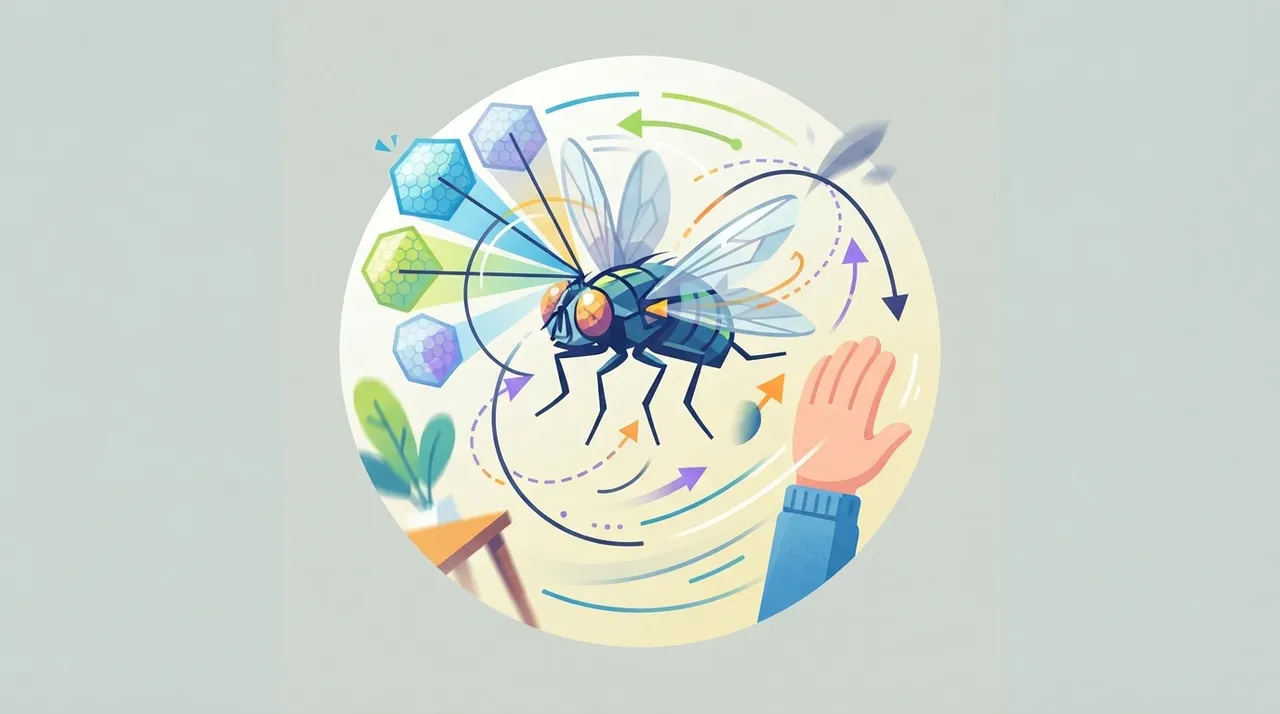
The primary reason why a fly is so hard to swat lies in its superior ability to process visual information. Flies possess compound eyes made up of thousands of individual lenses, called ommatidia, which provide them with a nearly spherical, 360-degree field of vision. This structure gives them a crucial advantage: the ability to detect movement from almost all directions without needing to move their head. Furthermore, a fly can process up to 250 frames per second, compared to humans' 60 frames per second. This means they perceive the world as if it's moving in very slow motion, while we see their movement as a rapid blur. This speed in visual processing gives them ample time to decide to flee and plan an escape route.
In addition to their visual speed, flies have an exceptional ability to preemptively sense threats. Flies possess aerial sensors, known as 'halteres,' which are small, club-shaped organs that vibrate at high speeds and act as natural gyroscopes. These halteres enable the fly to sense any slight changes in the airflow around it, such as the air current generated by your hand approaching. These sensory signals are immediately sent to the fly's brain, which responds instantaneously before your hand makes contact. This allows them to anticipate the trajectory of the attack and determine the optimal direction for escape.
Finally, the physiological agility of flies contributes to the difficulty in swatting them. Flies have powerful and highly developed flight muscles that allow them to change direction and speed abruptly in a fraction of a second. They can take off vertically, change direction at a 90-degree angle, or even fly backward if necessary, all with astonishing efficiency. This maneuverability makes it extremely difficult to track them and predict their next move.
Key benefits
- Deeper Understanding of Complex Biological Systems: Studying the fly's escape mechanisms reveals the complexity of nervous and sensory systems in living organisms, enriching biological knowledge.
- Inspiration for Advanced Technology: Small flying robots (drones) and the development of vision and control systems can draw inspiration from the fly's flight and evasion mechanisms.
- Improved Pest Control Methods: Understanding fly behavior can aid in developing more effective ways to control these insects, whether through traps or repellents.
- Development of AI Algorithms: Models of visual data processing and rapid response in flies can be used to develop faster and more efficient machine learning algorithms for visual data processing.
How to use it
As a freelancer or entrepreneur, you might wonder how a concept like "why a fly is hard to swat" can practically benefit you. The benefit here lies in extracting lessons from the fly's efficiency in adaptation and rapid response to risks, and applying these principles to your productivity and work. Here’s how you can do it:
- Develop a “360-degree vision” for your project: Just like a fly's compound eyes, you should strive to have a comprehensive view of your project. Don't just focus on immediate aspects; look at potential market changes, competitors, technological trends, and future customer needs. Regularly use data analytics tools and customer reviews to gain this holistic view. This helps you anticipate challenges and opportunities before they become fully apparent, giving you a competitive edge.
- Speed of Processing and Decision-Making: The fly processes information at lightning speed to avoid danger. In your work, this means developing your ability to analyze information quickly and make decisive choices without excessive hesitation. Instead of procrastinating, establish mechanisms for making data-driven decisions, even if they are not perfect. The faster you adapt to market changes or customer requirements, the greater your chances of success.
- Preemptive Sensing of Risks and Opportunities: The halteres in a fly allow it to sense threats before they arrive. In business, this means developing your business acumen and your ability to read early indicators. Is there talk of a new technology that might impact your field? Have customer behaviors subtly changed? Stay constantly aware of your surroundings and market interactions, and use these initial signals to redirect your strategy or discover new opportunities before others see them.
- Flexibility and Rapid Maneuvering: A fly's ability to change its course quickly is key to its survival. As a freelancer or entrepreneur, you must be flexible and able to adjust your plans and strategies quickly when necessary. Do not rigidly stick to one plan if data shows it to be ineffective. Be prepared to change your business model, offer new services, or even pivot entirely if circumstances demand it. This flexibility increases your chances of survival and growth in a rapidly changing business environment.
Smart Use Tip:
To enhance your flexibility and responsiveness, apply the principle of "Minimum Viable Change" (MVC) to your projects. Instead of trying to launch massive, perfect projects, release small, viable changes and test them quickly. If they succeed, scale them up. If they fail, learn from them, adjust, or discard them quickly. This reduces risk and increases your ability to maneuver and adapt, just like a fly rapidly responding to changing threats.








Comments 0
No comments yet — be the first to share your thoughts.
Share your thoughts
To comment, sign in first — we email you a one-time code (no password). This keeps the discussion clean.
Sign in to comment →