
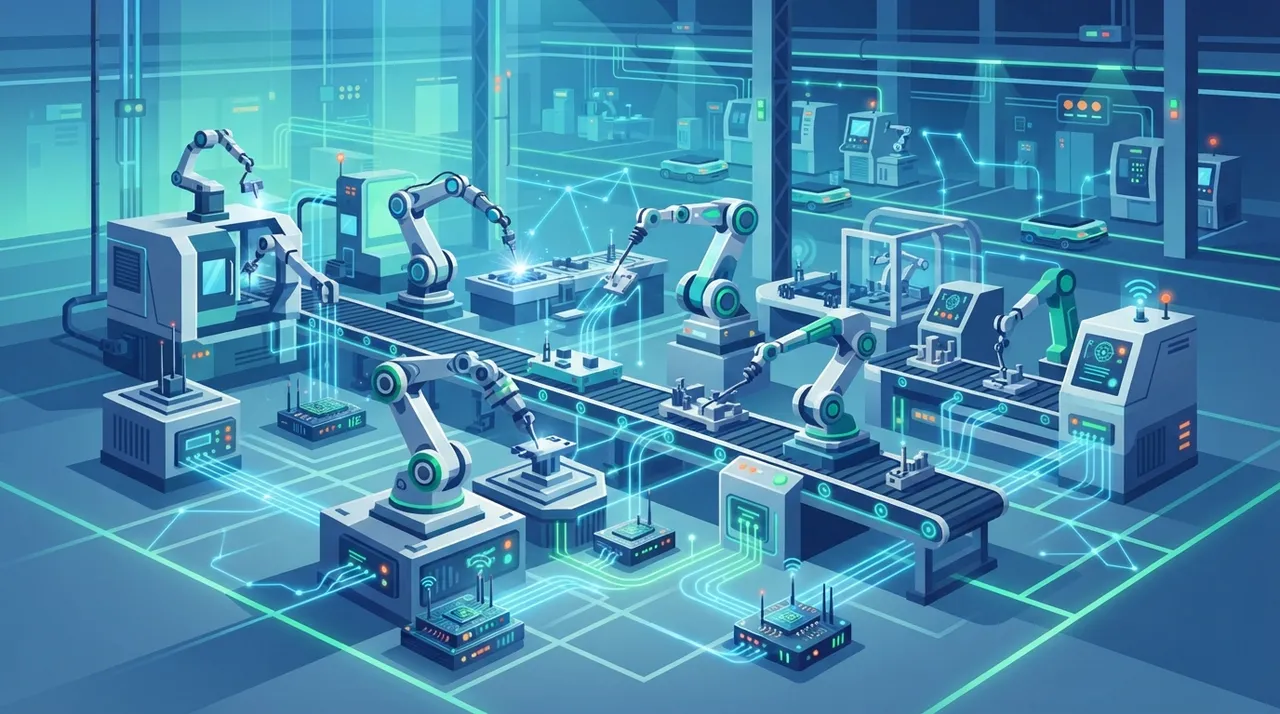
The technology sector is undergoing a profound transformation with the rising prominence of Edge AI, a new trend redefining how companies interact with their data and operations. Instead of sending vast amounts of data to centralized cloud data centers for processing, AI tasks are executed directly on devices near the data source, such as sensors and cameras on the factory floor. This structural shift not only addresses latency challenges but also enhances data security and operational resilience, making it a cornerstone for smart factories and the next generation of industrial automation in 2026.
What's New
The novelty of Edge AI lies in its increasing adoption and establishment as a core operational infrastructure, especially within the manufacturing sector. By 2026, it has transitioned from an experimental concept to a production-ready foundation for smart factory operations. This advancement enables real-time data processing and decision-making directly on devices located near the data source, such as sensors and machinery, minimizing reliance on centralized cloud systems. This technology leverages energy-efficient, high-performance processors, like those based on the Arm architecture, capable of handling complex AI workloads on-device.
Furthermore, 2026 witnesses a shift towards smaller, more efficient AI models, such as Small Language Models (SLMs) and Vision Language Models (VLMs), specifically optimized for edge environments, thereby reducing power and computational requirements. These new models possess a deeper contextual understanding, making them more resilient to real-world condition changes, which is crucial for applications like worker safety and defect detection. Additionally, integration with 5G networks and technologies like Digital Twins further enhances Edge AI capabilities, enabling ultra-low latency communications and precise simulation analytics.
Why It Matters
Edge AI is critically important for several reasons, primarily its ultra-low latency processing, which is vital for industrial applications demanding instantaneous responses. Instead of waiting for data to be transmitted to the cloud, processed, and results returned, decisions are made in milliseconds directly on the factory floor, preventing costly failures and improving production efficiency. For instance, in manufacturing lines, Edge AI can analyze video feeds from cameras to detect product defects instantly, without waiting for data to travel to a remote server. Large-scale deployments of AI-driven quality control have reduced defect rates by as much as 90%, saving millions and boosting customer satisfaction.
Moreover, Edge AI enhances data privacy and security by processing sensitive information locally within the facility, mitigating the risks of breaches or data violations when transmitted to the cloud. It also reduces network bandwidth costs by filtering and processing data at the source and forwarding only actionable insights to centralized systems, thereby alleviating network congestion. In operational environments with limited or unreliable internet connectivity, such as remote oil rigs, Edge AI devices can autonomously monitor equipment health, ensuring operational continuity.
Practically, readers can benefit from Edge AI by focusing on several key tools and steps. First, identify operational pain points that stand to gain significantly from real-time processing, such as quality control, predictive maintenance, or worker safety. Second, explore edge computing platforms that support AI models, like NVIDIA's industrial edge computing solutions or Arm-based systems. Third, collaborate with specialized Edge AI solution providers to assess needs and design a tailored infrastructure. Fourth, invest in training employees to understand and manage Edge AI systems, bridging the technical skills gap. Finally, adopt a hybrid approach combining cloud-based model training with edge execution for maximum efficiency and flexibility.





Comments 0
No comments yet — be the first to share your thoughts.
Share your thoughts
To comment, sign in first — we email you a one-time code (no password). This keeps the discussion clean.
Sign in to comment →