
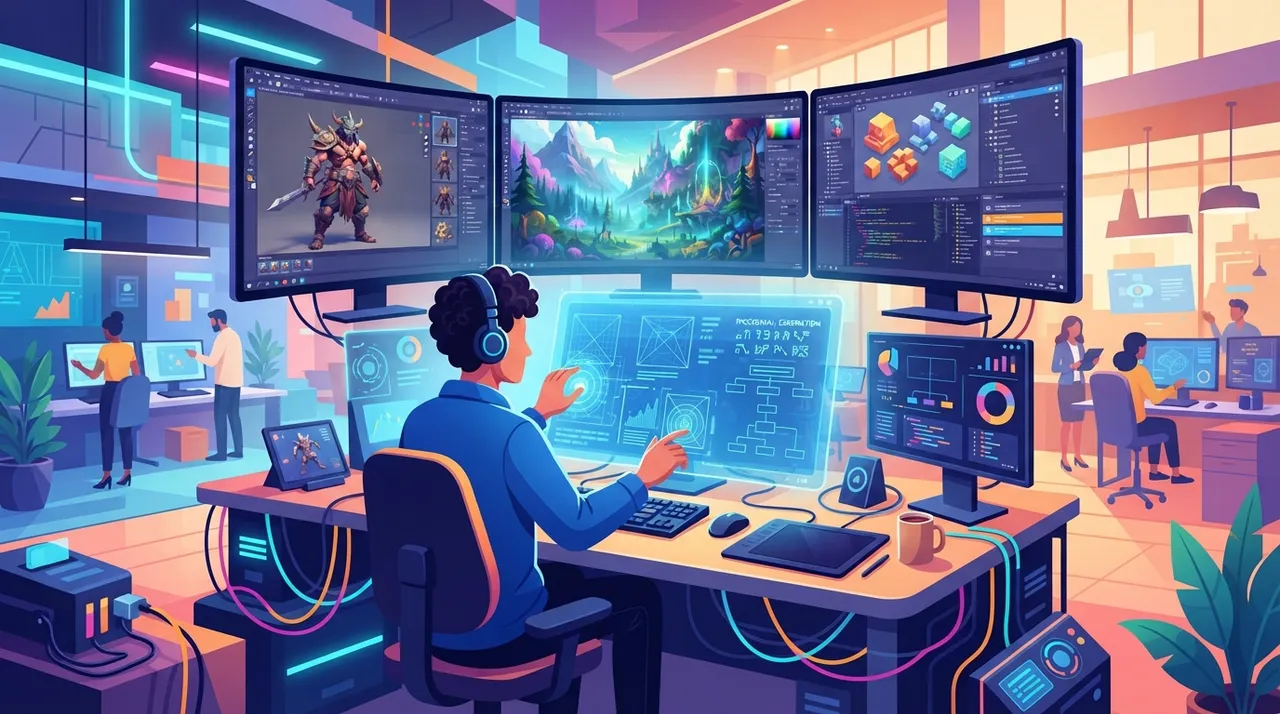
Game development has always been a blend of art and engineering, with developers constantly striving to deliver immersive worlds and unforgettable experiences. As games grow in complexity and player expectations rise, traditional content creation methods have become increasingly time-consuming and costly. This is where AI steps in, fundamentally transforming how games are built and designed.
What's New: AI-Powered Procedural Content Generation (PCG)
Procedural Content Generation (PCG) refers to the automatic creation of game content using algorithms, rather than manual creation [3, 5, 7, 23]. This technique has existed for some time, but its integration with generative AI has elevated it to an entirely new level of sophistication [5, 22]. In 2026, 40% of game developers are using generative AI tools in their daily workflow, a 4-percentage-point increase from 2025 [1]. A recent Japanese industry survey found that 85.8% of Japanese game developers now use generative AI, with 63% using it daily [16].
AI is now capable of generating a wide range of game assets, including:
- Environments and Levels: AI can create terrains, landscapes, complex level designs, and even entire cities, ensuring that each playthrough is unique [3, 5, 7, 14, 17, 18].
- Characters and 3D Assets: Creating detailed character models or 3D objects no longer requires hours of manual labor, as AI tools can generate them rapidly with customization options [2, 5, 6, 10, 11, 12].
- Stories and Dialogue: AI can assist in drafting dialogues, generating side quests, and developing branching narratives that adapt to player choices, enhancing immersion and replayability [3, 5, 14, 17, 18].
- Diverse Artistic Assets: This includes textures, animations, icons, and user interface (UI) elements [2, 6, 12].
Tools like Ludo, Meshy, PixelLab, and Scenario are prominent all-in-one and specialized solutions in this field, offering capabilities ranging from 2D animation generation to complex 3D model design [2, 10, 11, 12].
Why It Matters: Streamlining and Enhancing Creativity
AI-powered PCG makes a significant difference for developers, especially small and indie teams facing budget and resource constraints [8, 14, 20]. Instead of spending days or weeks creating assets manually, developers can now achieve this in minutes [25]. Estimates suggest these tools can cut art production time by up to 50% [14].
Key benefits include:
- Increased Efficiency and Accelerated Development: AI reduces human workload on repetitive tasks, such as texture creation or level layout, allowing developers to focus on creative aspects and core game design [1, 3, 4, 13, 14, 21].
- Replayability and Personalization: AI can generate dynamic content that adapts to player actions and preferences, ensuring a unique experience every time [3, 5, 17, 18, 24]. This enhances game value and keeps players engaged longer [20, 24].
- Cost Reduction: By automating content creation, small teams can compete with larger studios without needing massive workforces, significantly lowering production costs [8, 14, 20, 22].
- Improved Quality and Testing: AI can also assist in game testing, bug identification, and difficulty balancing more efficiently, leading to a more polished final product [3, 14, 18, 24, 25].
While some developers view AI as potentially harmful to the industry, the majority of companies continue to adopt it due to its practical benefits [1, 9, 16, 19]. AI is seen as a powerful assistive tool that augments human creativity rather than replacing it [13, 21, 22].
How to Practically Benefit
To leverage AI-powered PCG in game development projects, readers can follow these steps:
- Identify Required Content Type: Do you need 2D assets (e.g., icons, characters) or 3D assets (e.g., models, environments)? Are you looking for assistance with dialogue writing or level design? Pinpointing your needs will help select the right tool.
- Choose the Right Tool:
- For All-in-One Assets (2D, 3D, Audio, Video): Ludo is an excellent option, offering a wide range of animatable assets [2].
- For Pixel Art: PixelLab specializes in this area with in-depth tools [2, 12].
- For 3D Models: Meshy and Tripo.ai are strong choices for generating, texturing, and rigging 3D models for engine use [2, 6, 10, 11, 12].
- For Concept Art and Textures: Midjourney, Adobe Firefly, and Stable Diffusion can be used for initial ideation and texture generation [6].
- For Audio and Music: ElevenLabs provides tools for creating sound effects, voices, and music [2].
- Practice Effective Prompting: The quality of outputs depends on precise and clear prompts. Experiment with different phrasings and be as specific as possible in describing your desired outcome.
- Integrate AI into Your Workflow: Start by integrating AI tools into repetitive tasks or prototyping phases. Use them to generate initial drafts or placeholder assets, then manually refine and customize them to maintain your project's unique creative touch [4, 13].
- Continuous Evaluation and Review: Do not rely solely on initial AI outputs. Carefully review AI-generated assets and code to ensure their quality, originality, and alignment with your artistic vision [4].
Integrating AI-powered PCG is an investment in game development efficiency and innovation. By intelligently embracing these tools, developers can accelerate creation, reduce costs, and deliver richer, more personalized gaming experiences to players.




Comments 0
No comments yet — be the first to share your thoughts.
Share your thoughts
To comment, sign in first — we email you a one-time code (no password). This keeps the discussion clean.
Sign in to comment →