
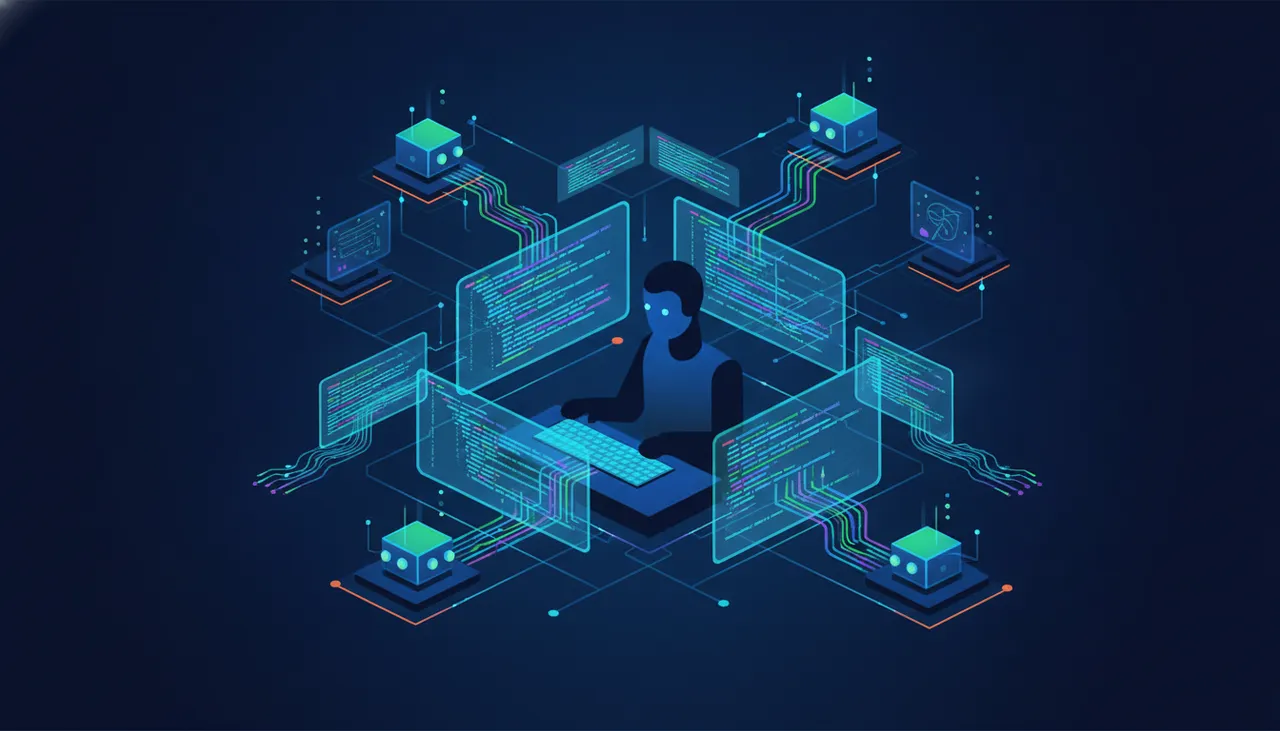
2026 has witnessed a fundamental shift in the world of software development, as generative AI has transitioned from a promising technology to a core driver of innovation and efficiency. The question is no longer "should we adopt AI?" but rather "how quickly can we effectively integrate it?" This revolution is changing how applications are built, tested, and deployed, offering immense potential for organizations seeking to excel in the rapidly accelerating digital landscape.
What's New
The new reality is that generative AI has become an integral part of the entire Software Development Life Cycle (SDLC), not just an auxiliary tool. In 2025, AI generated 41% of all written code, and this figure is expected to exceed 50% by late 2026 in companies with high AI adoption. This transformation is powered by robust tools such as Large Language Models (LLMs) like GPT-4, Gemini, and Claude, as well as code generation tools like GitHub Copilot and Amazon CodeWhisperer. AI-powered Integrated Development Environments (IDEs) such as Cursor and Replit Ghostwriter have also emerged, alongside no-code/low-code platforms that integrate AI capabilities like Builder.ai and Microsoft Power Platform. These tools don't just suggest lines of code; they can now create entire functions, design user interfaces, write test cases, and even deploy complete applications based on simple natural language descriptions.
Developers are now regularly relying on multiple AI tools, with most using between 2.4 and 3.1 tools. These tools don't operate in isolation; they integrate to create multi-agent systems where one agent generates code, another performs tests, and a third manages deployment processes. Statistics show that 84% of developers use or plan to use AI tools in their development processes, and 51% of professional developers use AI tools daily.
Why it Matters
Generative AI is revolutionizing custom software development for several core reasons:
- Dramatically Reduced Development Time: AI-powered code generation can cut the time needed to write code from 8 hours to 30 minutes, significantly accelerating prototyping and transforming ideas into ready products in days instead of months. This means faster product and feature release cycles, and better alignment with customer and market demands.
- Improved Productivity and Efficiency: Developers using AI coding assistants can ship 26-55% more code per sprint, with the largest gains seen in less experienced developers. This allows teams to focus on high-value tasks such as architectural design and security logic, rather than repetitive tasks. Estimates suggest that generative AI could add between $2.6 and $4.4 trillion annually to the global economy.
- Enhanced Software Quality and Reduced Technical Debt: AI tools help identify potential bugs earlier in the development cycle, suggest architectural improvements, and automate regression testing. However, it's important to note that AI-authored pull requests contain 1.7 times more issues than human-only pull requests, necessitating careful monitoring and continuous review.
- Greater Adaptability to Business Needs: Custom software development in 2026 is inherently more adaptive. Systems are now built to learn from user behavior and operational data, providing continuous improvements automatically.
- Evolving Developer Roles: The role of developers is shifting from merely writing code to directing AI agents, validating results, and making strategic decisions. The World Economic Forum estimates that 65% of developers expect their roles to be redefined in 2026.
To practically benefit from this trend, readers can follow these steps and tools:
Actionable Steps for Readers
- Embrace Code Assistants: Start using tools like GitHub Copilot or Amazon CodeWhisperer. These tools offer real-time code suggestions and help complete programming tasks faster.
- Explore AI-Powered IDEs: Try environments like Cursor or Replit Ghostwriter, which integrate AI directly into the editing environment, providing advanced assistance in writing and debugging code.
- Leverage AI Design Platforms: Utilize tools like Figma AI or Galileo AI to transform text descriptions into professional user interface designs, accelerating the design and iteration process.
- Apply AI in Testing and Quality Assurance: Look for AI tools that automatically generate test cases and help detect bugs and security vulnerabilities early on.
- Learn Prompt Engineering: As AI generates a significant portion of code, the ability to formulate effective and precise prompts for AI tools has become a crucial skill.
- Focus on Review and Auditing: Despite AI's efficiency, reviewing and auditing AI-generated code is paramount to ensure quality, security, and to mitigate technical debt.
- Consider Multi-Agent Systems: For more complex projects, explore platforms like Atoms that combine multiple AI agents to handle different aspects of development, from research to deployment.
Integrating generative AI into software development processes is not an option, but a strategic imperative. Companies that adopt these technologies now are the ones that will endure and thrive in the competitive landscape of 2026 and beyond.





Comments 0
No comments yet — be the first to share your thoughts.
Share your thoughts
To comment, sign in first — we email you a one-time code (no password). This keeps the discussion clean.
Sign in to comment →