
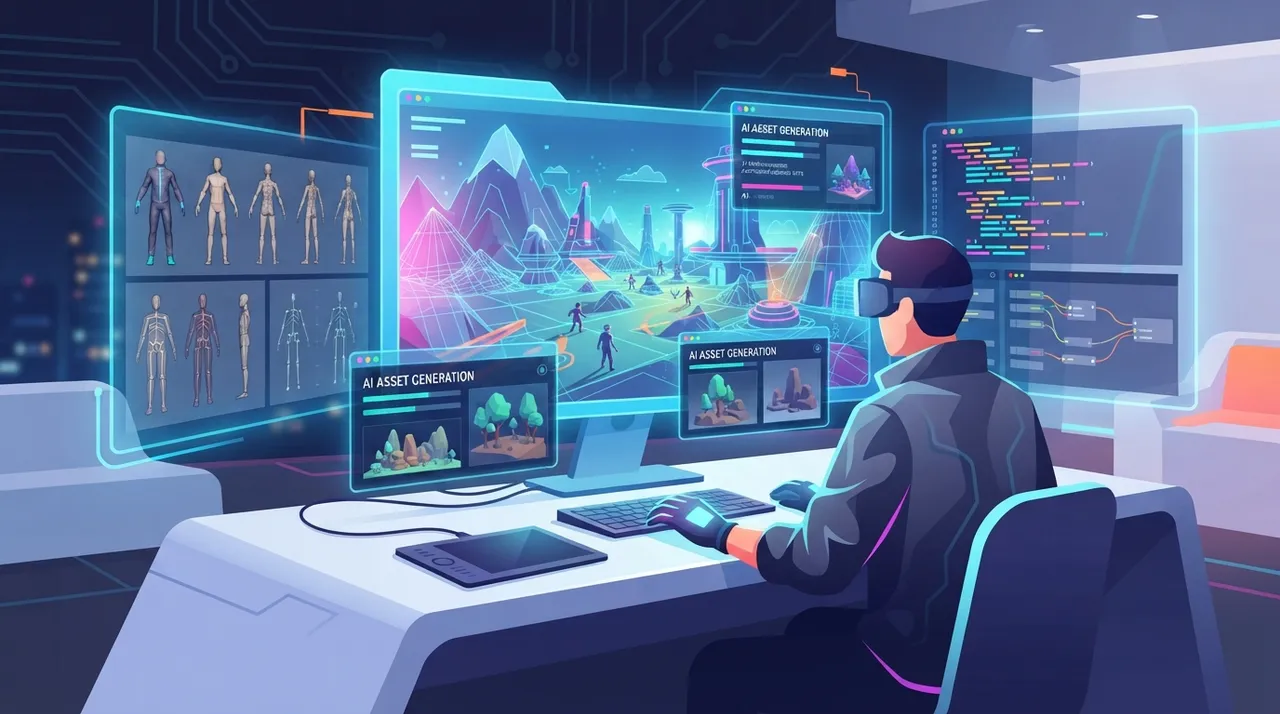
Game development has always been a complex and time-consuming process, requiring large teams to manually design every aspect, from characters and environments to intricate gameplay systems. But in 2026, this dynamic is fundamentally shifting with the rapid rise of generative AI, which not only accelerates the process but also unlocks previously unimaginable creative possibilities.
What's New
The game development sector is experiencing a significant transformation due to the integration of AI tools into daily workflows. Instead of replacing developers, these tools empower them to work smarter and faster, focusing on creative and design aspects. In 2026, 36% of developers are using generative AI tools, and 83% expect AI to affect team structure or productivity in some way over the next three years.
- Faster Asset Creation: Game development requires thousands of assets including textures, animations, sound effects, and environments. AI tools now help developers generate these assets much faster, including high-quality textures, character animations, dialogue scripts, environmental designs, and concept art. For example, tools like Meshy can help transition from a 2D idea to a workable 3D starting point.
- Procedural Game Worlds: While procedural generation has existed in games for years, AI has taken it to a completely new level. Developers can now use AI algorithms to automatically generate infinite maps and terrains, dynamic quests and missions, randomized environments, and unique gameplay experiences. This means small teams can build worlds that traditionally required large art departments.
- Smarter NPC Behavior: In older games, Non-Player Characters (NPCs) followed scripted instructions and predictable patterns. However, modern AI-driven NPC systems allow characters to dynamically respond to player actions, adapt to their strategies, and learn from interactions, creating more realistic encounters.
- Personalized Player Experiences: AI is also helping developers create personalized gaming experiences. By analyzing player behavior, AI systems can adapt gameplay elements based on how someone plays the game, such as automatically adjusting difficulty levels or recommending missions based on progress.
- Narrative Generation: AI story generators are revolutionizing narrative design, enabling developers to create dynamic branching storylines in real-time based on player choices, emotions, and achievements. Tools like ChatGPT and Gemini can be powerful co-pilots for narrative design, generating detailed descriptions for complex settings and crafting believable character dialogues.
Why It Matters
AI significantly reduces the time and resources needed for game development, enabling smaller development teams and indie studios to compete with larger corporations. Projections indicate that AI can reduce UE5 and C++ work by roughly 30% to 50% for routine tasks, and collapse pre-production timelines for concept art, voice-over, and music generation from weeks to days. These tools also enhance creativity by automating repetitive and time-consuming tasks, freeing developers to focus on design and innovating new gameplay.
Furthermore, AI tools contribute to improving game quality by assisting in bug detection and code optimization; what used to take weeks can now be completed in hours. A 2025 survey of 615 game development professionals found that 1 in 3 game developers are now using generative AI to streamline game development, with 95% stating it reduces repetitive tasks and frees them to focus on more creative work.
A patent filed by Microsoft in June 2026 outlines a system that would allow generative AI to intelligently change the game based on what players do. This means games could adapt to players' interests, create new quests, or remove unengaging content, offering a wholly unique experience for each player.
How Readers Can Practically Benefit (Tools/Steps)
To leverage AI in game development, readers, whether indie developers or part of larger teams, can follow these steps and utilize available tools:
- For Visual Asset Creation: Use tools like Midjourney, Leonardo AI, Scenario, or SDXL to generate concept art, textures, and environment designs. Meshy can assist in turning 2D ideas into initial 3D models.
- For Code Enhancement and Programming: Take advantage of AI-powered code assistants like Cursor, GitHub Copilot, or chat interfaces such as Claude or ChatGPT for managing architectural questions and translating Blueprints to C++. These tools reduce time spent on routine tasks and writing tests.
- For Narrative and Dialogue Design: Utilize ChatGPT or Gemini to generate story ideas, develop dialogues, and outline branching narrative paths. Tools like ElevenLabs offer game voice engines for real-time dialogue creation.
- For Game World Generation: Explore engines that incorporate AI-enhanced procedural generation, such as Summer Engine or Godot Engine. You can describe the world you want in plain language, and the AI will create a custom generator.
- For Rapid Prototyping: Use tools like Rosebud AI or SoonLab AI to quickly create playable browser prototypes. Tools like Makko AI and Ludo.ai can help generate art and game designs without requiring artistic or coding skills.
- For Enhanced Player Experience: Consider integrating AI systems that analyze player behavior to adapt game difficulty and personalize missions, making the experience more engaging.
In summary, AI is a driving force in game development in 2026. It doesn't replace human creativity but augments it, enabling developers to build more complex, engaging, and personalized worlds for players. The key is to use AI as a tool to enhance efficiency, not as a substitute for human design and artistic flair.




Comments 0
No comments yet — be the first to share your thoughts.
Share your thoughts
To comment, sign in first — we email you a one-time code (no password). This keeps the discussion clean.
Sign in to comment →