
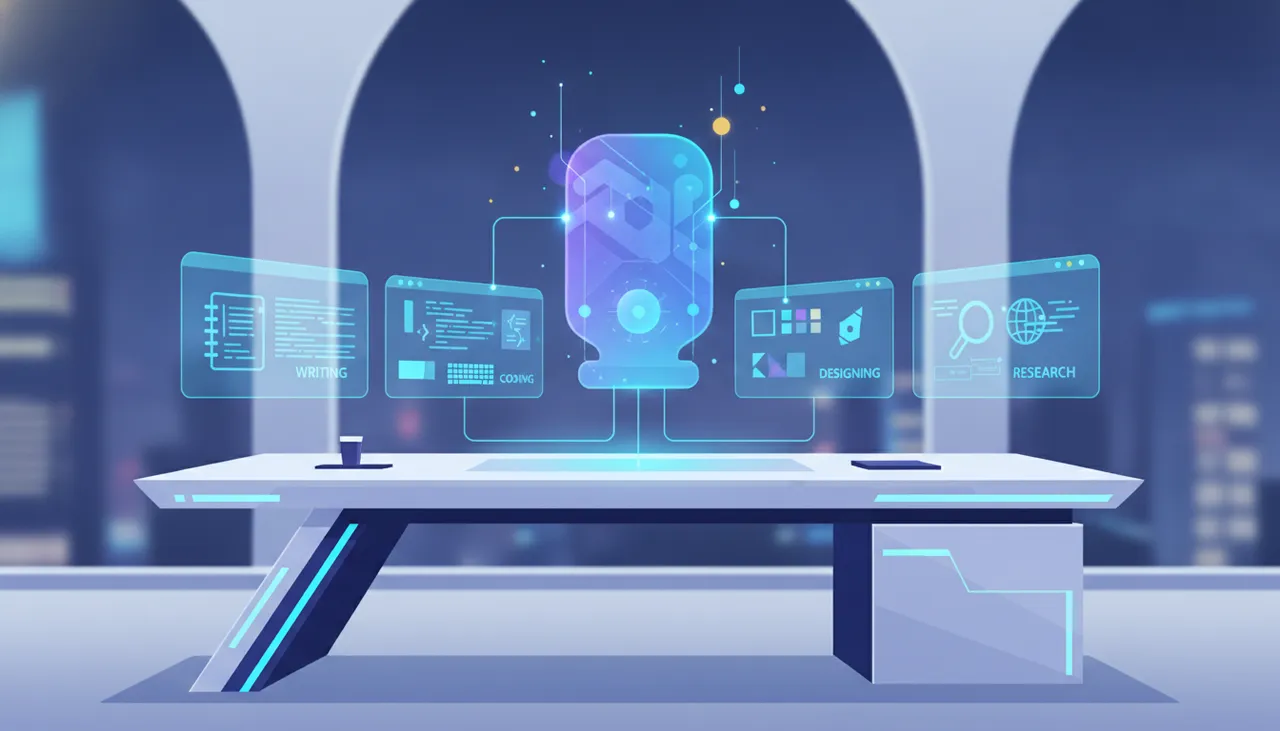
Artificial intelligence is no longer a futuristic promise but an integral part of our daily and professional lives in 2026. The most significant transformation we are witnessing now is the emergence and expansion of 'Agentic AI,' a qualitative leap beyond merely answering questions or executing simple commands.
What's New
At its core, Agentic AI is an AI system that doesn't just respond to prompts but possesses the ability to think, plan, and take multiple steps autonomously to accomplish a complex task. Imagine a virtual assistant that not only writes text for you but can also research information, summarize it, draft a complete report, and even review sources and refine content independently.
This new generation of AI tools is characterized by a deeper understanding of context, the ability to integrate with existing workflows, and the generation of high-quality outputs in various fields such as writing, design, programming, and even app development.
Why It Matters
Agentic AI is spreading rapidly for several reasons: First, it addresses a key problem faced by individuals and businesses: wasted time on repetitive and routine tasks. According to McKinsey, the average knowledge worker spends nearly 2.5 hours daily reading and responding to emails, not to mention preparing for meetings and tracking tasks. Agentic AI automates these tasks, freeing humans to focus on creative and strategic work.
Second, the focus has shifted from 'which AI model is best?' to 'how can the best integrated workflow be built?' AI is no longer an isolated technology but has become a fundamental part of businesses' operational infrastructure. This shift is leading to the emergence of a 'Shadow AI Economy,' where employees use personal AI tools for daily tasks, highlighting the urgent need for companies to strategically integrate these tools.
Real-world Examples:
- **Enhanced Customer Service:** Companies like Sephora use AI in tools like 'Virtual Artist,' allowing customers to try makeup virtually and receive personalized beauty advice, increasing engagement and sales.
- **Office Automation:** AI integrated into work environments like Google Workspace can assist in drafting emails, summarizing meetings, and providing smart suggestions.
- **Software Development:** AI programming tools have become indispensable for developers, helping generate clean code, debug, and improve productivity. Tools like Cursor 2.0 and NxCode enable even non-developers to launch full-stack applications in hours.
- **Research and Analysis:** Tools like Perplexity AI and Gemini 3.1 Pro provide comprehensive answers with reliable sources, significantly reducing research time.
- **Visual Content Creation:** Tools like Midjourney V8 and Runway ML enable the creation of professional advertising images and videos from simple text prompts, drastically cutting costs and time.
To practically benefit from this development, individuals and businesses must adopt a clear strategy: start by identifying routine tasks that consume time and effort. Look for Agentic AI tools that integrate with your current workflow. For example, if you are in writing, you might prefer Claude Opus 4.7 for its accuracy and deep contextual understanding, or ArWriter for Arabic content. For comprehensive research, Gemini 3.1 Pro is an excellent choice for its integration with Google products. For complex automation tasks, Manus can perform multi-step work autonomously.
Do not hesitate to try free tools or those with trial plans before committing. Remember that the goal is not to use every tool, but to choose the right tool for your objective to increase efficiency and productivity. As Agentic AI continues to evolve, the ability to adopt and integrate these technologies into our daily tasks will be a crucial factor for success.





Comments 0
No comments yet — be the first to share your thoughts.
Share your thoughts
To comment, sign in first — we email you a one-time code (no password). This keeps the discussion clean.
Sign in to comment →