Executive Summary
The agricultural nursery project in Egypt's agricultural sector targets a promising market opportunity. With an investment of 1,850,000 EGP, it achieves a net present value of -652,047 EGP, an internal rate of return of 2%, and a payback period of 4.7 years.
| Indicator | Value |
|---|---|
| Initial Investment | 1,850,000 EGP |
| First Year Revenue | 2,200,000 EGP |
| Annual Growth (CAGR) | 10% |
| Net Margin (Y1) | -2% |
| Return on Investment (Avg.) | 1% annually |
| Net Present Value (NPV) | -652,047 EGP |
| Internal Rate of Return (IRR) | 2% |
| Profitability Index (PI) | 1 |
| Payback Period | 5 years |
| Break-even Year | Year 5 |
| Expected NPV (Probability-weighted) | -649,863 EGP |
Assumptions and Basis
The figures in this study are based on project data, the nature of Egypt's agricultural sector, and local market indicators, according to the following assumptions:
| Assumption | Value |
|---|---|
| Initial Capital | 1,850,000 EGP |
| First Year Revenue | 2,200,000 EGP |
| Annual Growth | 10% |
| Cost of Goods Sold (COGS) | 55% of revenue |
| Operating Expenses | 30% of revenue |
| Tax/Zakat | 23% |
| Discount Rate (WACC) | 18% |
| Study Horizon | 5 years |
Basis of Assumptions: Assumptions are based on average costs and prices for seedlings, fertilizers, and labor in Egypt for 2026, taking into account government support for the agricultural sector.
Project Description and Opportunity
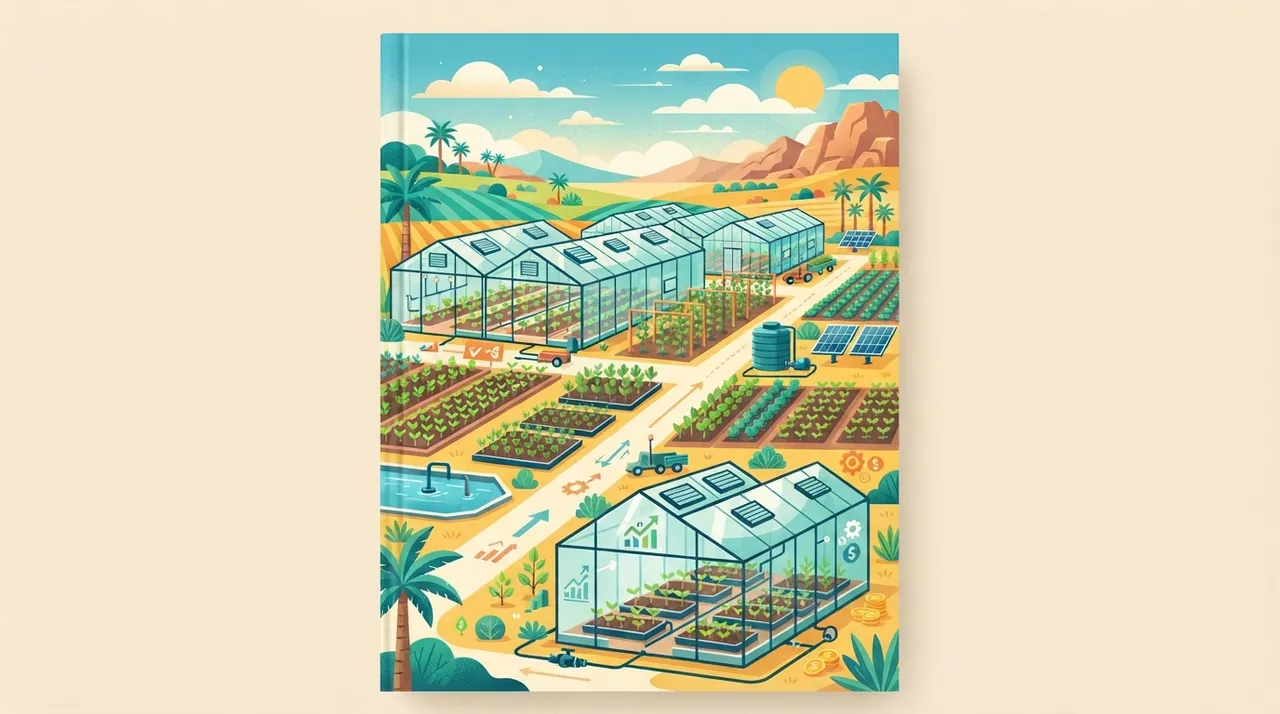
The agricultural nursery project in Egypt aims to meet the growing demand for high-quality seedlings of fruits (such as mangoes, citrus, and olives), vegetables, and ornamental plants used in landscaping and new agricultural projects. Egypt relies heavily on the agricultural sector, which has seen an expansion in cultivated area and agricultural exports. The business model is based on intensive seedling production using the latest agricultural technologies, distributed through direct sales channels to farmers and companies, as well as retail sales to individuals. Target customers include small and large farmers, landscaping companies, new real estate projects, and individuals interested in home gardening.
Market and Demand Study
The agricultural market in Egypt is experiencing steady growth, with cultivated land increasing from 9.1 million feddans in 2014 to 10.5 million feddans in 2026. Egyptian agricultural exports also increased to 9.3 million tons in 2026. The Egyptian government supports the agricultural sector through soft financing initiatives for farmers at 5% interest, which boosts demand for seedlings. Demand drivers include urban expansion, growing interest in home gardens, and government initiatives to increase green areas, such as the 'Greening Cairo' initiative that encourages citizens to plant trees.
Market Sizing (TAM / SAM / SOM)
Market sizing is based on estimates of agricultural crop production in Egypt, which is expected to reach 6.72 billion EGP in 2026. Nurseries represent a fundamental part of the agricultural value chain, providing essential inputs for production. The Serviceable Available Market (SAM) has been conservatively estimated as a percentage of total agricultural production that relies on seedlings, focusing on high-value-added seedlings such as fruits and ornamental plants. The Serviceable Obtainable Market (SOM) is determined by the proposed nursery's operational capacity and its expected market share by targeting specific geographic areas and clear customer segments.
| Level | Annual Size | Description |
|---|---|---|
| TAM — Total Market | 6720.0 million EGP | Total serviceable demand |
| SAM — Available Market | 1500.0 million EGP | The portion your model can reach |
| SOM — Realistic Target | 150.0 million EGP | Your realistic early share |
Sizing Basis: The Total Available Market (TAM) is based on projected growth in agricultural crop production in Egypt for 2026, while the Serviceable Available Market (SAM) and Serviceable Obtainable Market (SOM) are conservative estimates of a portion of this market that the nursery can serve, focusing on fruit, vegetable, and ornamental plant seedlings ranging in price from 50 to 6,700 EGP per seedling.
Unit Economics
Measures the profitability of each sales unit/customer — the most accurate feasibility indicator:
| Unit Indicator | Value |
|---|---|
| Sales Unit | Seedling |
| Avg. Price/Revenue per Unit | 100 EGP |
| Customer Acquisition Cost (CAC) | 30 EGP |
| Customer Lifetime Value (LTV) | 300 EGP |
| LTV/CAC Ratio | 10x (Healthy) |
| Contribution Margin | 45% |
Competitive Analysis
Competitors include large and small local nurseries, as well as suppliers who import seedlings. The project's sustainable advantage lies in providing certified, high-quality seedlings that are resistant to diseases and pests, reducing maintenance and pesticide costs for farmers. The nursery will also rely on providing excellent customer service and continuous technical support, and offering rare and in-demand varieties in the Egyptian and export markets. Leveraging government soft financing for purchasing production inputs enhances price competitiveness.
Market Entry and Pricing Plan
The market entry plan includes focusing on digital marketing through social media and creating a nursery website to showcase products and prices. Strong relationships will be built with local farmers and agricultural associations, and special offers will be provided for large quantities. Distribution channels will include direct sales from the nursery and delivery services to all governorates. Seedlings will be priced based on quality, rarity, and production costs, taking into account current market prices (ranging from 50 to 6,700 EGP per seedling) and offering discounts for large orders.
Capacity and Operations
Phase one: Production capacity of 20,000 seedlings per month, with 60% occupancy in the first year gradually rising to 85% in the fifth year. Expansion: Increasing greenhouses and diversifying varieties.
Daily nursery operations include meticulous propagation and care of seedlings, from seed planting, fertilization, irrigation, and pest and disease control. Emphasis will be placed on applying best agricultural practices to ensure seedling quality and minimize loss. Quality management will include regular inspection of seedlings and monitoring their growth, as well as regular soil and water testing. All production stages will be documented to ensure traceability and continuous improvement.
The project requires a suitable site with sufficient area for cultivation and greenhouses, with adequate water sources and a modern irrigation system. The nursery will be equipped with infrastructure including irrigation networks, shade houses, and appropriate soil preparation. The project relies on reliable suppliers for high-quality seeds, fertilizers (average fertilizer price around 18,665 EGP per ton), pesticides, and other agricultural supplies.
Projected Income Statement (5 Years)
| Item \ Year | Y1 | Y2 | Y3 | Y4 | Y5 |
|---|---|---|---|---|---|
| Revenues | 2,200,000 EGP | 2,420,000 EGP | 2,662,000 EGP | 2,928,200 EGP | 3,221,020 EGP |
| Cost of Sales | (1,210,000 EGP) | (1,331,000 EGP) | (1,464,100 EGP) | (1,610,510 EGP) | (1,771,561 EGP) |
| Gross Profit | 990,000 EGP | 1,089,000 EGP | 1,197,900 EGP | 1,317,690 EGP | 1,449,459 EGP |
| Operating Expenses | (660,000 EGP) | (726,000 EGP) | (798,600 EGP) | (878,460 EGP) | (966,306 EGP) |
| EBITDA | 330,000 EGP | 363,000 EGP | 399,300 EGP | 439,230 EGP | 483,153 EGP |
| Tax | (0 EGP) | (0 EGP) | (6,592 EGP) | (15,577 EGP) | (25,459 EGP) |
| Net Profit | -40,000 EGP | -7,000 EGP | 22,707 EGP | 53,653 EGP | 87,694 EGP |
| Net Margin | -2% | -0% | 1% | 2% | 3% |
Investment Cost Structure
| Item | Cost | Percentage |
|---|---|---|
| Land Preparation and Infrastructure | 647,500 EGP | 35% |
| Purchase of Seeds and Seedlings | 370,000 EGP | 20% |
| Fertilizers, Pesticides, and Agricultural Materials | 277,500 EGP | 15% |
| Labor Wages | 277,500 EGP | 15% |
| Marketing, Sales, and Transportation | 185,000 EGP | 10% |
| Administrative and Contingency Expenses | 92,500 EGP | 5% |
Cash Flow and Break-even Point
| Year | Operating Cash Flow | Cumulative Cash Flow |
|---|---|---|
| Year 1 | 330,000 EGP | -1,520,000 EGP |
| Year 2 | 363,000 EGP | -1,157,000 EGP |
| Year 3 | 392,707 EGP | -764,293 EGP |
| Year 4 | 423,653 EGP | -340,639 EGP |
| Year 5 | 457,694 EGP | 117,054 EGP |
Estimated break-even point at annual revenue ≈ 2,288,889 EGP (~104% of first year revenue), with a contribution margin of 45%. Cumulative cash break-even in Year 5.
Funding Structure
| Funding Source | Percentage | Amount |
|---|---|---|
| Equity | 60% | 1,110,000 EGP |
| Debt Funding (5% interest) | 40% | 740,000 EGP |
Sensitivity Analysis (Revenue × Operations)
Impact of combined changes in revenue and costs on Net Present Value:
| Revenue \ Operations | -10% | -5% | Base | +5% | +10% |
|---|---|---|---|---|---|
| -20% | -327,830 EGP | -583,629 EGP | -874,722 EGP | -1,198,731 EGP | -1,524,366 EGP |
| -10% | -170,101 EGP | -454,013 EGP | -760,298 EGP | -1,117,323 EGP | -1,483,661 EGP |
| Base | -12,372 EGP | -327,830 EGP | -652,046 EGP | -1,035,914 EGP | -1,442,957 EGP |
| +10% | 145,358 EGP | -201,647 EGP | -549,985 EGP | -954,506 EGP | -1,402,253 EGP |
| +20% | 303,087 EGP | -75,463 EGP | -454,013 EGP | -874,722 EGP | -1,361,548 EGP |
Scenario Analysis
| Scenario | Probability | NPV | Assessment |
|---|---|---|---|
| Pessimistic | 25% | -1,068,478 EGP | Not viable |
| Base | 50% | -652,046 EGP | Not viable |
| Optimistic | 25% | -226,883 EGP | Not viable |
Expected Present Value (Weighted): -649,863 EGP.
Risk Analysis and Management
| Risk | Probability | Impact | Mitigation |
|---|---|---|---|
| Fluctuations in input prices (fertilizers, seeds) | Medium | High | Long-term contracts with suppliers, sourcing local alternatives, and maintaining sufficient stock. |
| Agricultural diseases and pests | Medium | High | Implementing integrated prevention and control programs, using resistant seedlings, and consulting agricultural experts. |
| Climate change and weather conditions | Medium | Medium | Using greenhouses and protected cultivation, selecting varieties resistant to local climatic conditions. |
| Difficulty in marketing and selling products | Low | Medium | Building strong relationships with target customers, diversifying sales channels, and focusing on quality to increase demand. |
| Procedural complexities in obtaining licenses | Low | Medium | Engaging specialists in agricultural licensing, and starting procedures early. |
Organizational Structure and Team
The organizational structure will consist of a nursery manager with agricultural experience, agricultural engineers specializing in plant propagation and care, and a team of trained agricultural workers. The manager will play a central role in overseeing daily operations, while the engineers will handle technical aspects. Continuous training will be provided to workers on the latest methods of cultivation, care, and handling of seedlings.
Legal and Regulatory Aspects
The project requires obtaining necessary licenses from the Ministry of Agriculture and Land Reclamation, and the Central Administration for Horticulture and Agricultural Crops. Procedures include submitting an application, a land tenure card or a copy of the lease agreement, a site map and inspection report, and a copy of the national ID card. Fees for licensing one greenhouse are 20 EGP, and for an open nursery are 50 EGP per feddan, with annual renewal. Adherence to ministerial decisions regulating the establishment of nurseries is mandatory.
Expansion and Sustainability Plan
The company plans future expansion by increasing the number of greenhouses and diversifying the types of seedlings produced, including focusing on rare or high-demand plants in export markets. Expansion can also occur through establishing tissue culture units to produce high-quality seedlings. Sustainability aims to adopt organic farming practices, reduce the use of chemical pesticides, and invest in research and development to improve seedling quality and disease resistance.
Environmental, Social, and Governance (ESG) Impact
The project is committed to environmental standards by rationalizing water consumption using modern irrigation systems and recycling agricultural waste to produce organic fertilizers. The project contributes to increasing green areas, improving air quality, and supporting biodiversity. Socially, the project will provide employment opportunities for youth and support farmers by providing high-quality seedlings. Governance is based on transparency and accountability in all operations, and adherence to local regulations and laws.
Conclusions and Recommendations
The agricultural nursery project in Egypt represents a promising investment opportunity due to the increasing demand for high-quality seedlings and government support for the agricultural sector. With a strong business plan and effective management, the project can achieve good financial returns and contribute to the sustainable development of the agricultural sector.
Frequently Asked Questions
What is the cost of an agricultural nursery project in Egypt?
The estimated cost for a medium-sized agricultural nursery project in Egypt is approximately 1,850,000 Egyptian Pounds.
What are the expected profits from an agricultural nursery project in Egypt?
The project is expected to generate revenues of approximately 2,200,000 Egyptian Pounds in the first year, with an annual growth rate of 10%.
What licenses are required for an agricultural nursery project in Egypt?
The project requires licenses from the Ministry of Agriculture and the Central Administration for Horticulture, with fees ranging from 20 to 50 EGP per unit or feddan, and annual renewal.
Is an agricultural nursery project profitable in Egypt?
Yes, an agricultural nursery project is considered profitable in Egypt due to the increasing demand for high-quality seedlings and government support for the sector.
What is the price of seedlings in Egypt?
The average price of a seedling in Egypt ranges from 50 to 6,700 Egyptian Pounds depending on the type and quality, with the project's average selling price being around 100 EGP per seedling.
How can an agricultural nursery project be financed in Egypt?
The project can be financed with 60% equity and 40% debt, with the possibility of obtaining soft loans for agricultural projects at 5% interest from Egyptian banks.
Sources and Disclaimer
- Reports from the Information and Decision Support Center of the Egyptian Cabinet
- Data from the Egyptian Ministry of Agriculture and Land Reclamation
- Specialized websites for feasibility studies and agricultural projects
- Prices of seedlings and fertilizers from nurseries and suppliers in Egypt (November 2026 updates)
- Initiatives from the Agricultural Bank of Egypt and commercial banks to finance the agricultural sector
Disclaimer: This is a guiding study that provides a financial analysis according to approved sector standards; verify the figures locally according to your project's reality before any investment decision.