Executive Summary
The car maintenance workshop project in the service sector in the Sultanate of Oman targets a promising market opportunity. With an investment of 85,000 OMR, it achieves a Net Present Value (NPV) of -35,689 OMR, an Internal Rate of Return (IRR) of -7%, and a payback period of — years.
| Indicator | Value |
|---|---|
| Initial Investment | 85,000 OMR |
| Year 1 Revenue | 75,000 OMR |
| Annual Growth (CAGR) | 8% |
| Net Margin (Y1) | -8% |
| Return on Investment (Avg) | -4% annually |
| Net Present Value (NPV) | -35,689 OMR |
| Internal Rate of Return (IRR) | -7% |
| Profitability Index (PI) | 1 |
| Payback Period | — |
| Break-even Year | — |
| Expected NPV (Probability-Weighted) | -34,678 OMR |
Assumptions and Basis
The figures in this study are based on project data, the nature of the service sector in the Sultanate of Oman, and local market indicators, according to the following assumptions:
| Assumption | Value |
|---|---|
| Initial Capital | 85,000 OMR |
| Year 1 Revenue | 75,000 OMR |
| Annual Growth | 8% |
| Cost of Goods Sold (COGS) | 40% of Revenue |
| Operating Expenses | 45% of Revenue |
| Tax/Zakat | 15% |
| Discount Rate (WACC) | 10% |
| Study Horizon | 5 years |
Basis of Assumptions: Average establishment and operating costs for maintenance workshops in the Sultanate of Oman, considering the proposed project size.
Project Description and Opportunity
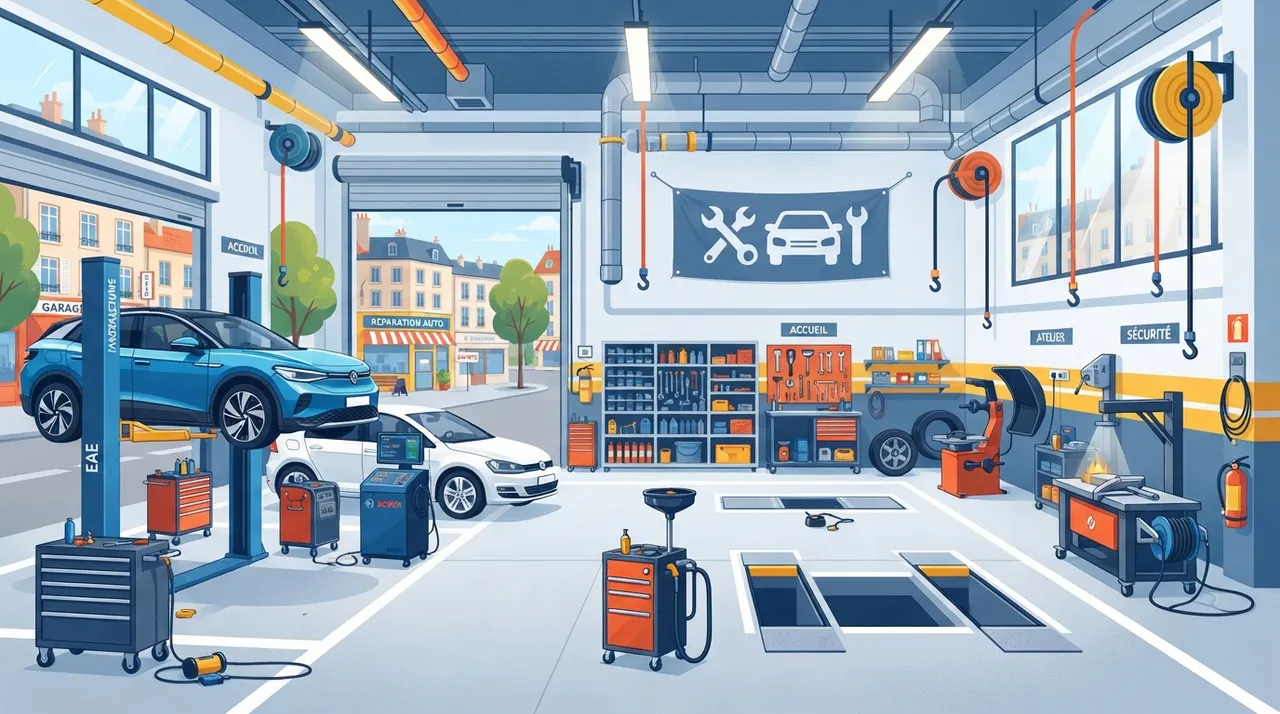
The car maintenance workshop project in the Sultanate of Oman aims to provide comprehensive maintenance and repair services for light and medium vehicles. This investment opportunity is driven by the continuous growth in the number of vehicles in the Sultanate and the increasing need for reliable and high-quality maintenance services. The business model relies on offering a variety of services such as mechanical maintenance, oil and filter changes, electronic fault diagnosis and inspection, car electrical services, and air conditioning and cooling system maintenance. The workshop targets individual car owners, in addition to the possibility of contracting with companies and fleet operators to provide periodic maintenance services. The workshop distinguishes itself by focusing on using original spare parts, employing skilled and trained technicians, and providing excellent customer service to build customer loyalty in a competitive market.
Market and Demand Study
The car maintenance market in the Sultanate of Oman is experiencing increasing and continuous demand, driven by the steady rise in vehicle numbers and increased awareness of the importance of periodic maintenance to preserve car performance and lifespan. Many individuals rely on their cars as a primary mode of transportation, creating a constant demand for repair and maintenance services regardless of economic fluctuations. Private workshops compete with authorized car dealerships, as many customers prefer private workshops due to lower costs and personalized service. Additionally, climatic conditions in Oman require specific periodic maintenance, especially for regular oil and air filter changes due to high dust levels. This creates an opportunity for workshops that offer fast and efficient services at competitive prices.
Market Sizing (TAM / SAM / SOM)
Market sizing was conducted based on an estimate of registered vehicles in the Sultanate of Oman and the expected average annual spending on maintenance and repair services per vehicle. The market was divided into Total Available Market (TAM), which includes all possible car maintenance services; Serviceable Available Market (SAM), which focuses on maintenance and repair services that an independent maintenance workshop project can provide; and finally, Serviceable Obtainable Market (SOM), which represents the market share the workshop can achieve in a competitive environment with a focus on quality and customer service. These estimates are based on automotive industry data and reports from feasibility study consultants in the region.
| Level | Annual Size | Description |
|---|---|---|
| TAM — Total Market | 250.0 million OMR | Total serviceable demand |
| SAM — Available Market | 75.0 million OMR | The segment your model can reach |
| SOM — Realistic Target | 7.5 million OMR | Your realistic early share |
Sizing Basis: Estimating the size of the car maintenance market in Oman based on the number of registered vehicles and average annual spending on maintenance.
Unit Economics
Measures the profitability of each sales unit/customer — the most accurate feasibility indicator:
| Unit Indicator | Value |
|---|---|
| Sales Unit | Customer |
| Avg. Price/Revenue per Unit | 35 OMR |
| Customer Acquisition Cost (CAC) | 20 OMR |
| Customer Lifetime Value (LTV) | 210 OMR |
| LTV/CAC Ratio | 10.5× (Healthy) |
| Contribution Margin | 60% |
Competitive Analysis
The Omani market for car maintenance services is characterized by intense competition, with many independent workshops in addition to dealership service centers. Our sustainable competitive advantage lies in: Superior Quality: Using original or equivalent quality spare parts, and adhering to the highest service standards. Skilled Technicians: Employing and training highly experienced and competent technicians, with a focus on accurate diagnosis and effective fault repair. Modern Technologies: Investing in computerized diagnostic equipment and modern maintenance tools to ensure service accuracy and speed. Transparent Pricing: Providing clear and fair pricing for services and spare parts, which builds trust with customers. Excellent Customer Service: Focusing on effective communication with customers, clearly explaining faults and solutions, and adhering to appointments.
Market Entry and Pricing Plan
The market entry and marketing plan relies on a mix of traditional and digital channels. A strategic location will be chosen for the workshop near main roads or busy residential areas to ensure easy access and visibility. Marketing channels include: Local Marketing: Signage, billboards, and flyers distributed in surrounding areas. Digital Marketing: Establishing a strong presence on social media, targeted online advertising campaigns, and local search engine optimization (SEO) to ensure the workshop appears in search results. Public Relations: Building partnerships with insurance companies, car rental companies, or companies with car fleets. Offers and Discounts: Providing opening offers, periodic maintenance packages, and discounts for regular customers or referrals. Pricing: A competitive pricing strategy will be adopted that reflects the quality of services provided and is attractive to customers compared to dealership and other workshop prices.
Capacity and Operations
In the first phase, the workshop aims to service 5-7 cars daily, with the potential to expand to service 10-12 cars daily within 3 years, by increasing the number of technicians and upgrading equipment.
The daily operation of the workshop relies on an effective management system that ensures smooth and efficient workflow. The process begins with welcoming the customer, registering vehicle data, and identifying the problem. Specialized technicians then inspect the vehicle and diagnose faults using the latest equipment. A price quote is provided to the customer, including the cost of spare parts and labor. After customer approval, maintenance and repair work is performed accurately and professionally. The quality of the completed work is checked before handing over the vehicle to the customer, with adherence to specified deadlines. An inventory management system will be implemented to ensure the availability of essential spare parts and reduce waiting times. Emphasis will also be placed on cleanliness and order within the workshop to provide a professional and attractive working environment for customers.
The technical aspects of the project require selecting a site with sufficient space (not less than 150-200 square meters) to accommodate different work areas, parking, reception, and spare parts storage. The site must be equipped with good ventilation, adequate lighting, and safety and security systems compliant with civil defense standards. Essential equipment includes: hydraulic car lifts, computerized diagnostic equipment, air compressor, integrated mechanical and electrical tools, tire balancing and alignment machines, and oil and filter change equipment. Suppliers for spare parts and oils will be selected based on quality, reliability, and cost, with a focus on providing original or high-quality spare parts.
Projected Income Statement (5 Years)
| Item \ Year | Y1 | Y2 | Y3 | Y4 | Y5 |
|---|---|---|---|---|---|
| Revenues | 75,000 OMR | 81,000 OMR | 87,480 OMR | 94,478 OMR | 102,037 OMR |
| Cost of Sales | (30,000 OMR) | (32,400 OMR) | (34,992 OMR) | (37,791 OMR) | (40,815 OMR) |
| Gross Profit | 45,000 OMR | 48,600 OMR | 52,488 OMR | 56,687 OMR | 61,222 OMR |
| Operating Expenses | (33,750 OMR) | (36,450 OMR) | (39,366 OMR) | (42,515 OMR) | (45,917 OMR) |
| EBITDA | 11,250 OMR | 12,150 OMR | 13,122 OMR | 14,172 OMR | 15,306 OMR |
| Tax | (0 OMR) | (0 OMR) | (0 OMR) | (0 OMR) | (0 OMR) |
| Net Profit | -5,750 OMR | -4,850 OMR | -3,878 OMR | -2,828 OMR | -1,694 OMR |
| Net Margin | -8% | -6% | -4% | -3% | -2% |
Investment Cost Structure
| Item | Cost | Percentage |
|---|---|---|
| Site Lease and Preparation | 25,500 OMR | 30% |
| Equipment and Tools | 34,000 OMR | 40% |
| Initial Salaries and Labor Expenses | 12,750 OMR | 15% |
| Licenses and Initial Marketing | 8,500 OMR | 10% |
| Working Capital and Initial Inventory | 4,250 OMR | 5% |
Cash Flow and Break-even Point
| Year | Operating Cash Flow | Cumulative Cash Flow |
|---|---|---|
| Year 1 | 11,250 OMR | -73,750 OMR |
| Year 2 | 12,150 OMR | -61,600 OMR |
| Year 3 | 13,122 OMR | -48,478 OMR |
| Year 4 | 14,172 OMR | -34,306 OMR |
| Year 5 | 15,306 OMR | -19,001 OMR |
Estimated break-even point at an annual revenue of ≈ 84,583 OMR (~113% of Year 1 revenue), with a contribution margin of 60%. Cumulative cash break-even is beyond the study horizon.
Funding Structure
| Funding Source | Percentage | Amount |
|---|---|---|
| Equity | 70% | 59,500 OMR |
| Debt Financing (5% interest) | 30% | 25,500 OMR |
Sensitivity Analysis (Revenue × Operations)
Impact of simultaneous changes in revenue and costs on Net Present Value:
| Revenue \ Operations | −10% | −5% | Base | +5% | +10% |
|---|---|---|---|---|---|
| −20% | -19,820 OMR | -32,402 OMR | -45,552 OMR | -58,701 OMR | -71,851 OMR |
| −10% | -12,480 OMR | -25,955 OMR | -40,621 OMR | -55,414 OMR | -70,207 OMR |
| Base | -5,477 OMR | -19,820 OMR | -35,690 OMR | -52,126 OMR | -68,563 OMR |
| +10% | 1,508 OMR | -13,928 OMR | -30,759 OMR | -48,839 OMR | -66,920 OMR |
| +20% | 8,494 OMR | -8,271 OMR | -25,955 OMR | -45,552 OMR | -65,276 OMR |
Scenario Analysis
| Scenario | Probability | NPV | Assessment |
|---|---|---|---|
| Pessimistic | 25% | -57,386 OMR | Not Feasible |
| Base | 50% | -35,690 OMR | Not Feasible |
| Optimistic | 25% | -9,948 OMR | Not Feasible |
Expected Present Value (Weighted): -34,678 OMR.
Risk Analysis and Management
| Risk | Probability | Impact | Mitigation |
|---|---|---|---|
| Intense competition from existing workshops and car dealerships. | Medium | High | Differentiate with quality, speed, competitive pricing, and excellent customer service. |
| Rising costs of spare parts and skilled labor. | Medium | Medium | Build strong relationships with suppliers to get good prices, and continuous training for technicians to maintain efficiency and reduce errors. |
| Insufficient customer base at the start of operations. | Medium | High | Strong marketing plan, attractive opening offers, and building a good reputation through word-of-mouth. |
| Sudden equipment malfunctions or shortage of spare parts. | Low | Medium | Regular equipment maintenance, maintaining sufficient stock of most requested spare parts, and contracting with reliable suppliers. |
Organizational Structure and Team
The proposed organizational structure consists of the project owner/general manager, who oversees all aspects of the business. The operational team includes: a workshop manager responsible for daily supervision of technicians and job scheduling, specialized mechanical technicians, a car electrician, and assistant workers. Emphasis will be placed on recruiting experienced and competent staff in car maintenance, with continuous training programs to keep up with the latest technologies and developments in the automotive industry. A qualified team contributes to building a good reputation for the workshop and increasing customer satisfaction.
Legal and Regulatory Aspects
Establishing a car maintenance workshop in the Sultanate of Oman requires obtaining several licenses and approvals from relevant government authorities. These licenses include: commercial registration from the Ministry of Commerce, Industry and Investment Promotion, municipal approval for the location and design, civil defense license to ensure the application of safety and security standards, and registration with the Public Authority for Social Insurance for employees. Environmental regulations related to the disposal of hazardous waste such as used oils and tires must be adhered to. Compliance with these legal requirements ensures smooth operation and protects the project from any violations or fines.
Expansion and Sustainability Plan
The future expansion plan consists of several pathways. In the medium term, the workshop's capacity can be increased by adding more technicians and equipment, and expanding the range of services offered to include more specialized services such as car body repair and painting. In the long term, consideration can be given to opening additional branches of the workshop in different areas of the Sultanate, or developing strategic partnerships with car dealerships or car rental companies. Opportunities to provide mobile maintenance services to meet customer needs at their locations can also be explored. Focusing on quality and customer service ensures building a strong customer base that supports the sustainable growth of the project.
Environmental, Social, and Governance (ESG) Impact
The environmental impact of the project is represented by the management of waste generated from maintenance operations, such as used oils, tires, batteries, and chemical materials. The best environmental practices for safe disposal of these wastes will be adhered to by contracting with specialized and certified companies. As for the social impact, it is represented by providing job opportunities for technicians and workers in the local community, and contributing to the development of their technical skills through continuous training. From a governance perspective, the project will rely on principles of transparency and integrity in dealing with customers and suppliers, and adherence to all applicable laws and regulations in the Sultanate of Oman.
Conclusions and Recommendations
Based on a comprehensive market analysis and realistic assumptions, the car maintenance workshop project in the Sultanate of Oman is a promising and profitable investment opportunity. Continuous demand for maintenance services, population growth and increasing vehicle numbers, in addition to the potential for differentiation through quality and excellent service, all contribute to the project's success. With a proposed initial capital of 85,000 OMR, viable returns can be achieved. The recommendation is to proceed with this project, focusing on implementing a strong business plan, investing in human resources and modern equipment, and building strong relationships with customers and suppliers to ensure long-term sustainability and growth.
Frequently Asked Questions
How much does it cost to establish a car maintenance workshop in the Sultanate of Oman?
The cost of establishing a medium-sized car maintenance workshop in the Sultanate of Oman ranges around 85,000 OMR, including rent, equipment, licenses, and initial salaries.
Is a car maintenance workshop project profitable in the Sultanate of Oman?
Yes, a car maintenance workshop project is profitable in the Sultanate of Oman due to the continuous demand for maintenance and repair services and the increasing number of vehicles.
What licenses are required to open a car maintenance workshop in Oman?
Required licenses include commercial registration, municipal approval, civil defense license, and registration with the Public Authority for Social Insurance.
What are the basic services provided by a car maintenance workshop?
Basic services include mechanical maintenance, oil and filter changes, electronic fault diagnosis and inspection, car electrical services, and air conditioning system maintenance.
What is the average expected annual revenue for a car maintenance workshop in Oman?
The average annual revenue for a car maintenance workshop in Oman can be around 75,000 OMR in the first year, with potential for annual growth.
Sources and Disclaimer
- Specialized feasibility study reports in the car maintenance sector in Gulf countries.
- Omani news and economic websites specialized in the automotive and transport sector.
- Articles and analyses on the costs and profits of car maintenance workshops in the region.
- Data on average prices of car maintenance services in the Sultanate of Oman.
Disclaimer: This is a guiding study that provides financial analysis according to approved industry standards; verify the figures locally according to your project's reality before any investment decision.