
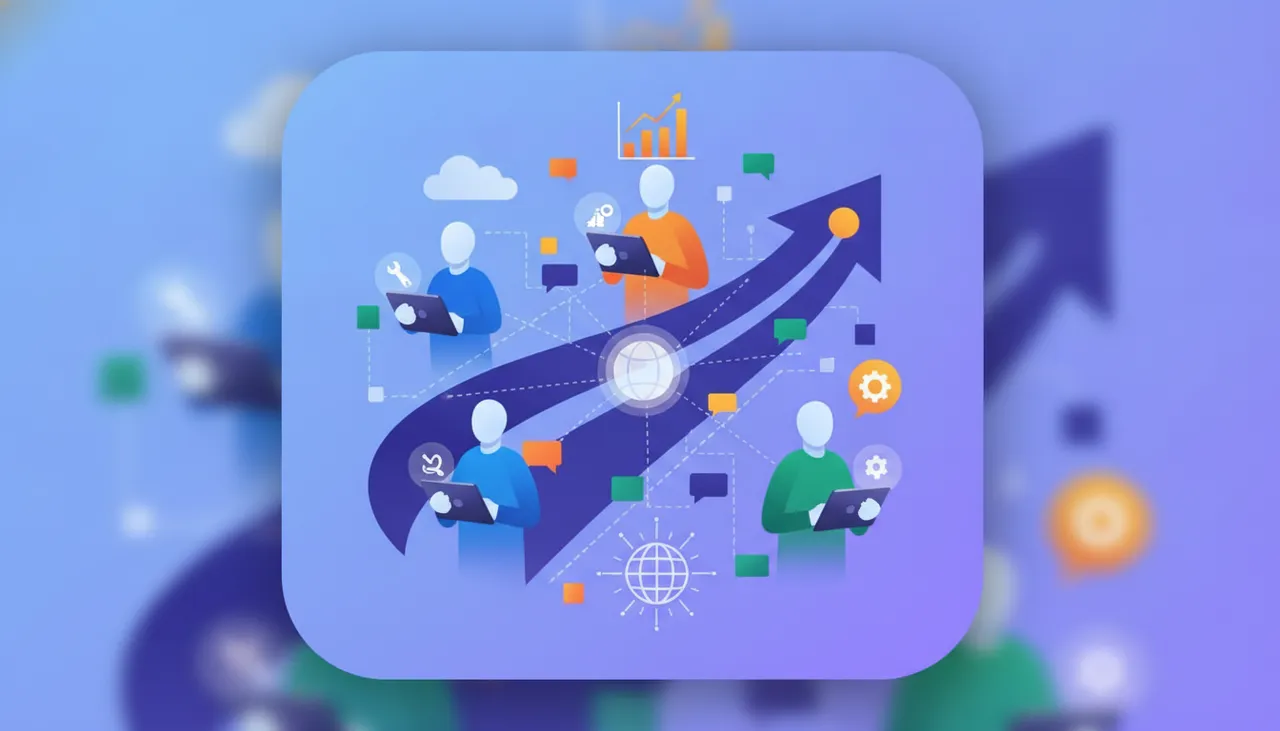
What is Quick and Dirty Inter-Agent Collaboration?
“Quick and Dirty Inter-Agent Collaboration” is a practical approach that focuses on enabling AI agents to work together quickly and flexibly to achieve common goals or accomplish complex tasks. Instead of designing elaborate and rigid collaboration systems that require meticulous planning and strict protocols, this concept aims to create simple, direct mechanisms that allow agents to exchange information, delegate tasks, and coordinate with each other, even if all possibilities and variables are not known beforehand. The core idea is to prioritize speed and adaptability over initial perfection, allowing agents to find practical solutions in dynamic contexts.
This type of collaboration relies on principles such as simple communication, flexible role definition, and the ability to instantly adjust course based on feedback. It can involve agents specialized in specific tasks (e.g., information retrieval, data analysis, text generation, or user interaction), where they pass their outputs as inputs to other agents, or request assistance from other agents when facing challenges beyond their individual capabilities. The goal is to reduce friction in collaboration processes and accelerate the completion cycle.
Key benefits
- Increased Efficiency and Faster Completion: Quick and dirty collaboration reduces the time required for complex planning and coordination, allowing agents to start working immediately and complete tasks faster. This is particularly beneficial in environments requiring rapid response or where deadlines are tight.
- High Flexibility in Handling Changing Tasks: This approach allows agents to adapt to unexpected changes in requirements or conditions. They can reallocate tasks, change priorities, or even swap roles quickly without needing a comprehensive redesign of the collaboration system.
- Improved Ability to Solve Complex Problems: By breaking down large problems into smaller parts and assigning different agents to tackle each part, the system as a whole can handle more complex challenges that exceed the capabilities of any single agent. Partial solutions are then aggregated to reach a comprehensive solution.
- Reduced Operational and Development Costs: Since this approach avoids the need for complex and expensive collaboration systems to design and maintain, it can significantly reduce initial development and ongoing operational costs. It focuses on practical, simple solutions that achieve desired results.
- Enhanced System Learning and Evolution: With each collaboration cycle, agents can gather data on the effectiveness of their strategies. This data can be used to improve individual agent behavior or the collaboration mechanisms themselves, leading to a smarter, more efficient system over time.
How can a freelancer/entrepreneur practically use it to increase productivity or income?
For a freelancer or entrepreneur, adopting the principles of “Quick and Dirty Inter-Agent Collaboration” can be a cornerstone in building a highly effective automated workflow. Imagine you are running a project that requires content generation, market data analysis, and customer interaction. Instead of doing all these tasks yourself or hiring a large team, you can utilize specialized digital agents. For example, you could have:
- A Content Generation Agent: This agent receives specific topics (e.g., “Top 5 Tips for Entrepreneurs in 2026”) and produces initial drafts for articles, social media posts, or video scripts.
- A Market Analysis and Keyword Agent: This agent receives outputs from the content agent or your queries, analyzes trending keywords, market trends, and provides recommendations to optimize content and attract an audience.
- A Marketing and Publishing Agent: This agent schedules and publishes the optimized content across various platforms (blog, LinkedIn, Twitter, etc.) based on optimal times to reach the audience.
- A Basic Customer Service Agent: Handles frequently asked customer inquiries, provides immediate answers, and escalates complex queries directly to you.
The essence lies in the absence of a rigid, complex central system that strictly orchestrates everything. Instead, they interact organically: the content agent finishes a draft and sends it to the analysis agent, who reviews it and sends recommendations, which in turn modify the draft, then it's passed to the publishing agent. This rapid and flexible interaction reduces your time as a project manager, allowing you to focus on strategic or creative aspects that require human intervention. The result is a massive increase in completed work volume, better output quality, and ultimately, an increase in income through scaling operations and reaching a wider audience efficiently.
Smart usage tip
To maximize the benefits of quick and dirty inter-agent collaboration, focus on defining the core roles and clear boundaries for each agent initially, but allow significant flexibility in how information and deliverables are exchanged between them. Do not try to design every possible collaboration path beforehand. Instead, define simple “communication protocols” (e.g., “each agent that completes a task passes its result as a JSON file to this path, and monitors the other path for new inputs”). Then, as the system evolves, refine these protocols based on actual performance, always prioritizing reduced complexity and increased responsiveness. Use feedback from collaboration failures to improve agent rules or interaction methods, rather than rebuilding the entire system.



Comments 0
No comments yet — be the first to share your thoughts.
Share your thoughts
To comment, sign in first — we email you a one-time code (no password). This keeps the discussion clean.
Sign in to comment →