
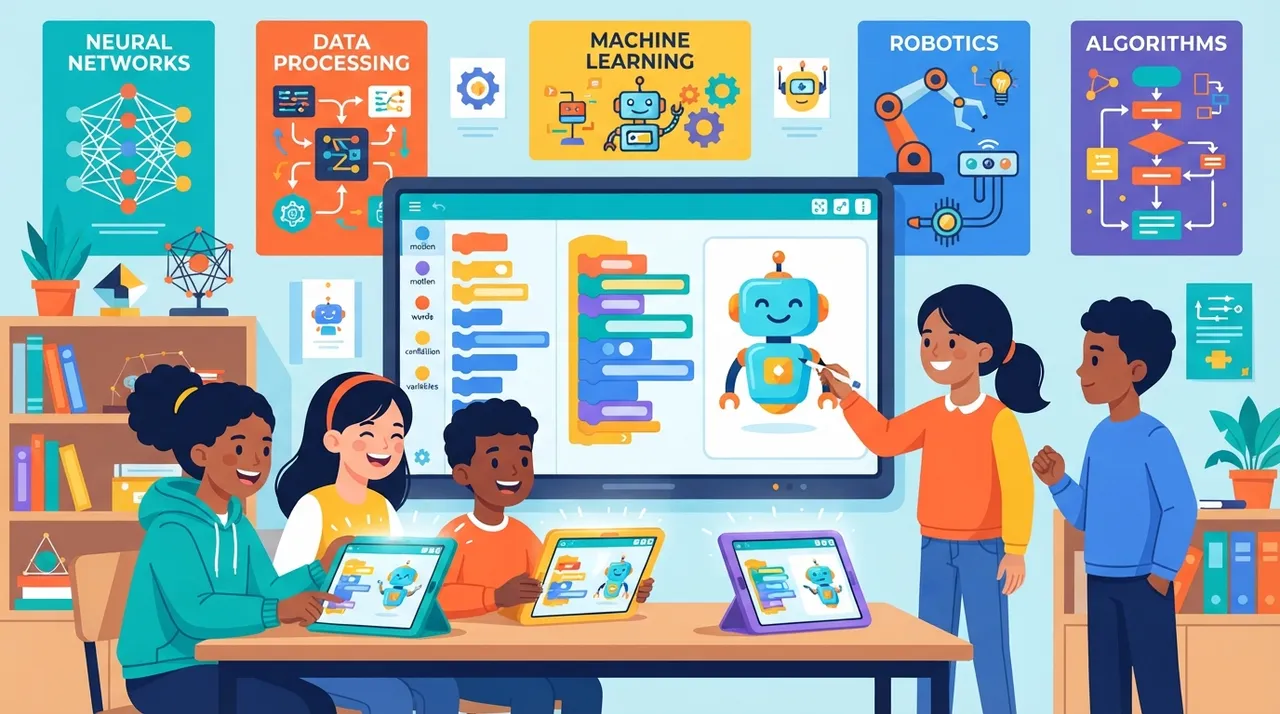
Introducing artificial intelligence (AI) to young learners, especially at the 5th-grade level, isn't about complex algorithms; it's about fostering curiosity and computational thinking through engaging, hands-on experiences. By simplifying core AI concepts, we can empower students to understand and even create with this transformative technology. This article outlines practical projects designed to make AI accessible and exciting for elementary school students.
Why Teach AI to 5th Graders?
The world is increasingly shaped by AI. Equipping 5th graders with foundational AI knowledge prepares them for a future where understanding and interacting with intelligent systems will be commonplace. Early exposure helps demystify AI, encourages critical thinking about its applications, and nurtures problem-solving skills. It also lays the groundwork for more advanced studies in STEM fields.
Core AI Concepts for Young Learners
Before diving into projects, it's helpful to simplify key AI ideas:
- Pattern Recognition: How computers find similarities in data.
- Machine Learning Basics: Teaching computers to learn from examples without explicit programming.
- Decision Making: How AI makes choices based on rules or learned patterns.
- Ethics and Bias: Discussing fairness and potential pitfalls when AI is trained on biased data.
These concepts can be introduced through relatable examples, like how a streaming service recommends movies or how a smart assistant understands commands.
Interactive Projects for the Classroom
1. "Smart Sorter" Project: Teaching Classification
This project introduces the concept of classification. Students can train a simple AI (or simulate one) to sort objects based on visual characteristics.
Steps:
- Define Categories: Ask students to choose two categories of items (e.g., fruits vs. vegetables, living vs. non-living).
- Gather Data: Have them collect images or physical objects for each category.
- "Train" the AI: Using a tool like Google Teachable Machine, students upload images and label them. This visual training helps them understand how an AI learns from examples.
- Test and Refine: Students then present new, unlabeled items, and the AI (or their simulated AI) attempts to classify them. Discuss why certain items were classified correctly or incorrectly, leading to discussions about improving the "training data."
2. "AI Storyteller" Challenge: Generative AI Introduction
Introduce the idea of AI generating creative content. This project can use simple text-generating tools or even manual simulation.
Steps:
- Choose a Theme: Students select a theme for a short story (e.g., adventure in space, a day with a talking animal).
- Provide Prompts: Using a safe, child-friendly AI text generator (like a heavily restricted ChatGPT or a specialized educational tool), students input simple prompts (e.g., "Write a story about a brave knight and a dragon").
- Review and Edit: Discuss the AI's output. What did it do well? What was unexpected? How can they edit and improve the story? This highlights that AI is a tool, and human creativity remains essential.
- Ethical Discussion: Talk about giving credit to AI when used and the importance of original thought.
3. "Robot Friend" Design: AI Decision-Making
This project focuses on how AI makes decisions based on rules and input, without needing actual robots.
Steps:
- Define a "Robot Friend": Students imagine a robot designed for a specific task (e.g., a robot to help with homework, a robot that cleans their room).
- Identify Decisions: What decisions would this robot need to make? (e.g., If homework is done, then play. If room is messy, then clean.)
- Create "If-Then" Rules: Students draw flowcharts or write simple "if-then" statements describing their robot's logic. This teaches basic algorithmic thinking.
- Simulate Scenarios: Present different scenarios and have students "act out" how their robot would respond based on its rules. This reinforces the concept of AI following programmed instructions.
Fostering Ethical AI Awareness
Beyond the technical aspects, it's crucial to integrate discussions about the ethical implications of AI:
- Bias: Explain that if an AI learns from biased examples (e.g., only images of certain people doing certain jobs), it might develop biases.
- Privacy: Discuss how AI uses data and why protecting personal information is important.
- Responsibility: Emphasize that humans are responsible for how AI is designed and used.
By engaging 5th graders in these discussions, we empower them to become thoughtful and responsible digital citizens in an AI-driven world. These projects are stepping stones to understanding a technology that will define their future, making learning both relevant and exciting.








Comments 0
No comments yet — be the first to share your thoughts.
Share your thoughts
To comment, sign in first — we email you a one-time code (no password). This keeps the discussion clean.
Sign in to comment →